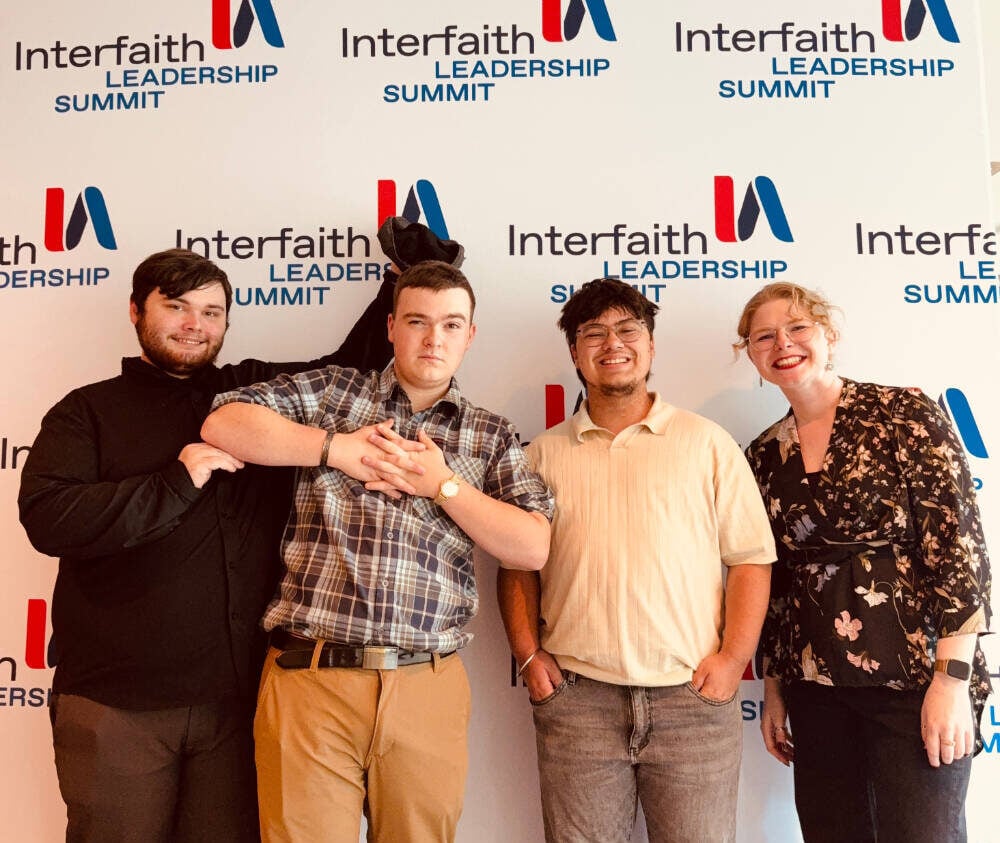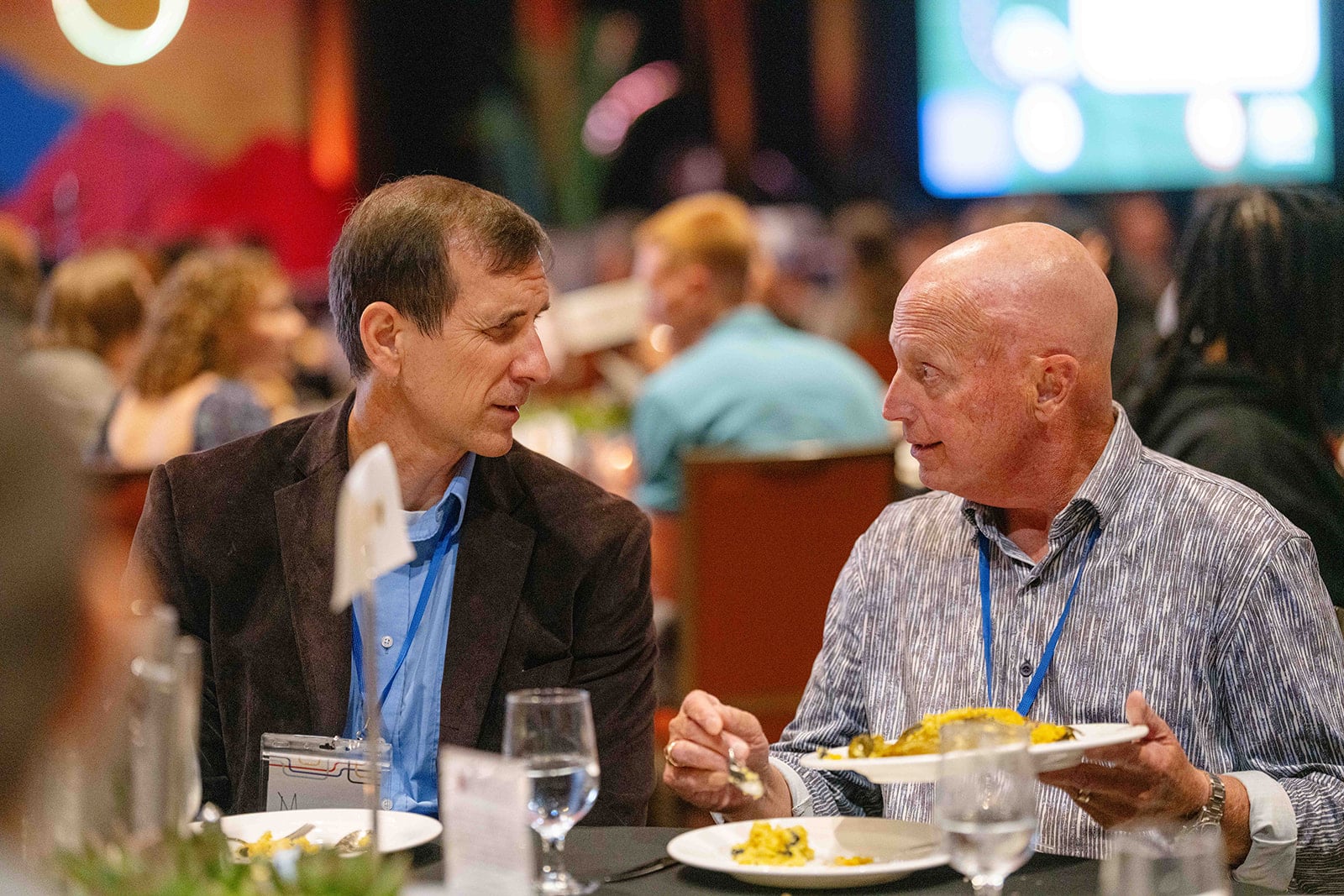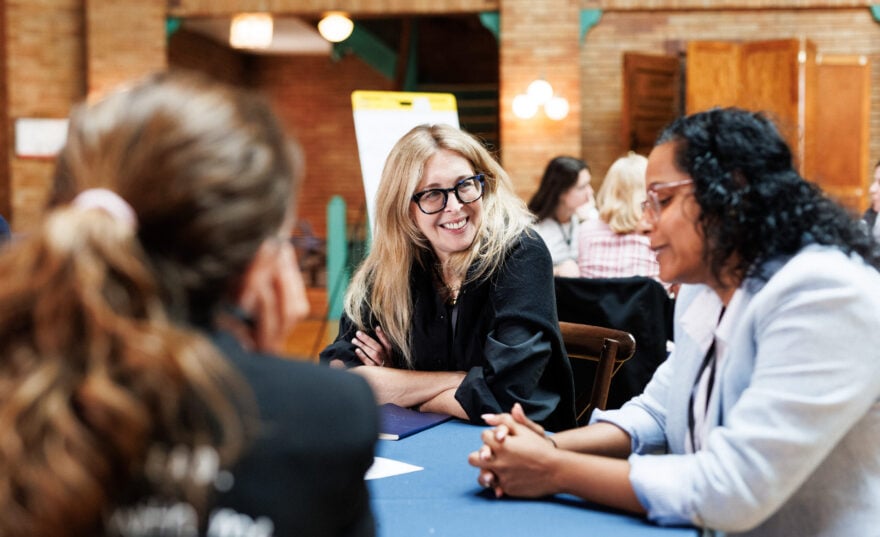
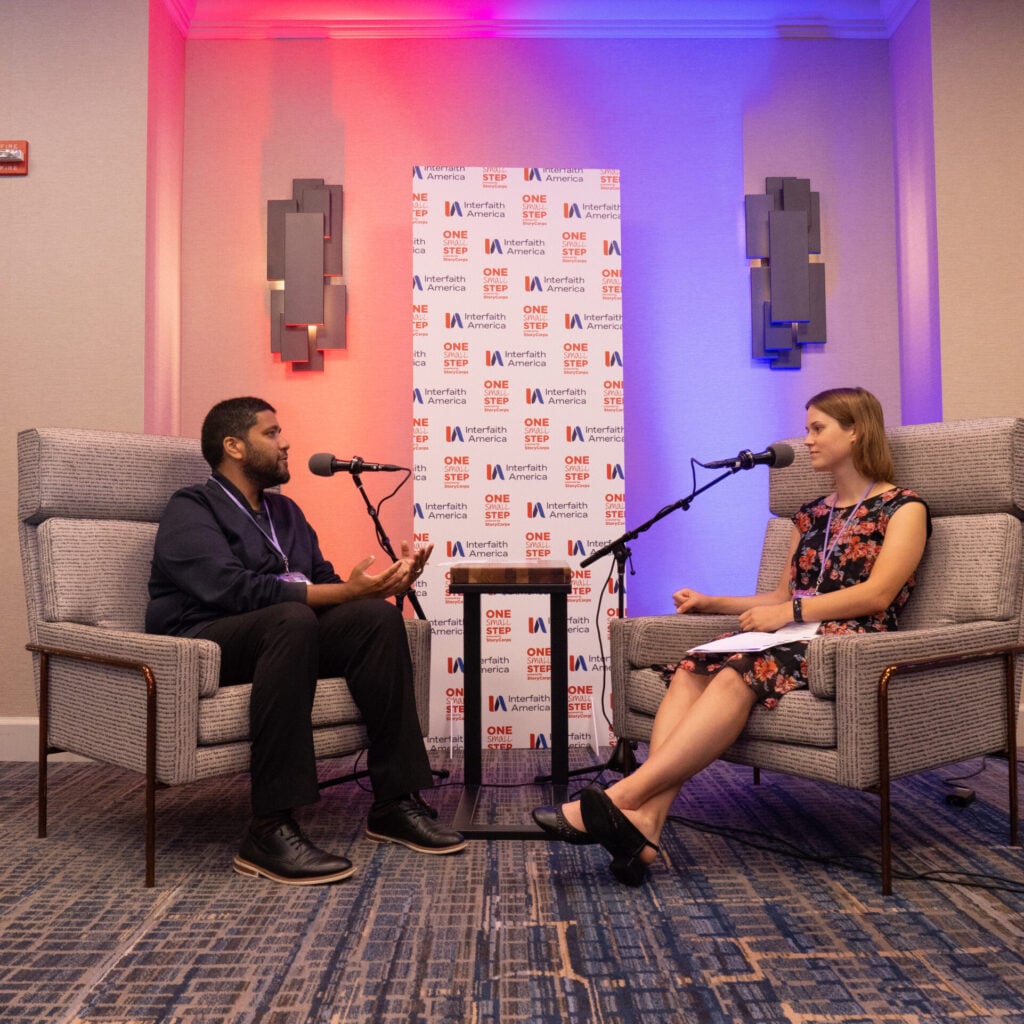
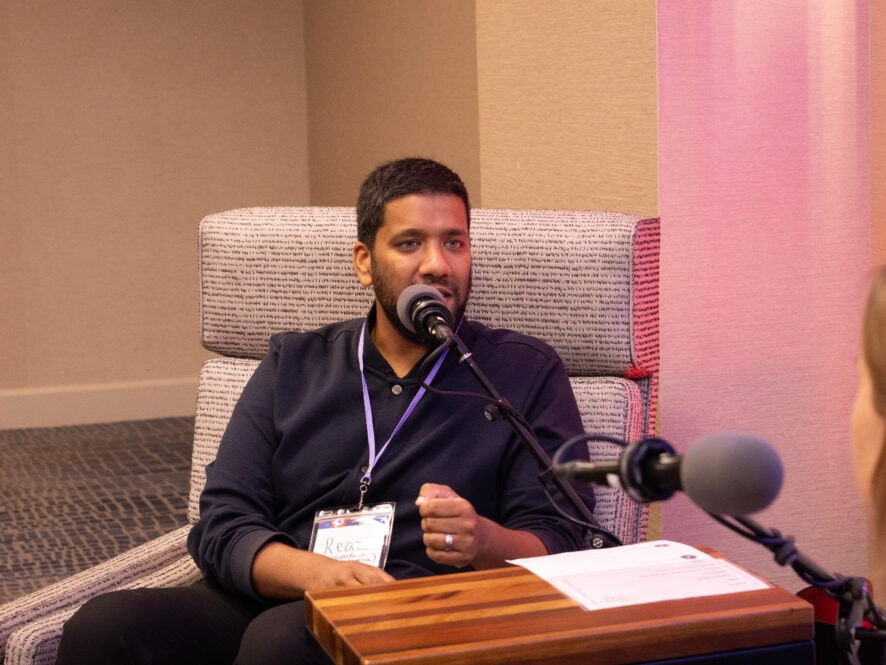
IA network members joined StoryCorps One Small Step for 30-minute, one-on-one conversations across lines of difference. These kinds of conversations happen every day among students, co-workers, and family members in America, and the Interfaith Leadership Summit is a space where participants can learn to seek them out with the purpose of respecting diverse identities, fostering meaningful relationships, and cooperating for the common good.
Listen to Reaz Khan and Meg Huber’s full conversation for more of their discussion on the values of bridgebuilding, the tensions that can arise within faith communities, and how practicing pluralism leads to personal growth.
Developing a commitment to building connections across lines of difference often begins with one’s personal experiences. For colleagues Reaz Khan and Meg Huber, the path to bridgebuilding has included many defining moments that led to their roles at Interfaith America, where they help others see the value of pluralism.
“Bridgebuilding is a reflection of personal identity, and that’s what I really enjoy about this work. It’s like an instant connection,” said Khan, who serves as a program manager on IA’s campus partnerships team.
Growing up in New York City, he was surrounded by a diversity of cultures and faiths. In Khan’s elementary school, people were open about their traditions — from Hanukkah to Chinese New Year. Learning about these different customs often prompted him to reflect on how his own Muslim traditions related.
For Huber, who grew up in a less urban area and as a member of the Church of Jesus Christ of Latter-day Saints, a passion for bridgebuilding was shaped by her family’s encouragement to seek out the diversity in her community.
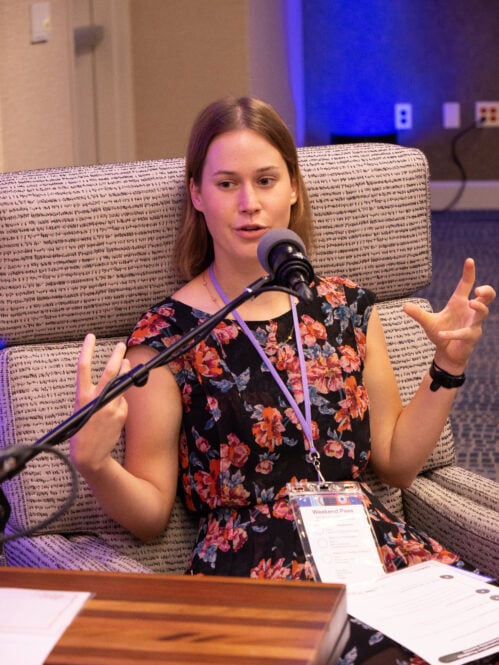
From service projects with Jewish neighbors to attending a weekly Catholic girls’ group with her close friends, interfaith cooperation has been a part of her life since childhood.
“I understood that there were communities that believed differently, but then I also had the chance to see people that were politically different,” said Huber, who now serves as a program coordinator on IA’s Democracy Initiatives team.
Her investment in pluralism has grown in recent years, especially as she’s forged friendships with people who have served presidential administrations on both sides of the political aisle.
“I live in this middle space of friends that deeply disagree, and I love that. I think it makes me a better person,” she reflected.
I live in this middle space of friends that deeply disagree, and I love that. I think it makes me a better person.
The two discussed how bridgebuilding doesn’t always take place across lines of religious difference; sometimes it means navigating intra-faith diversity and challenges that arise within faith communities.
Huber described an experience when she was misunderstood by her faith community, but “was able to reckon with [her] own faith and build a different framework that feels very true and true to [her] community.”
They also addressed how different stereotypes and frameworks are attached to certain labels — like “orthodox,” “liberal,” or even “believer.”
“Our faith communities are such vast traditions,” Khan said. “There’s misunderstanding within interfaith issues, and then we’re expected to speak on behalf of our religion on interfaith issues. So, a lot of that happens internally, and it’s important to be exposed to people who practice differently [within faith communities].”
The leaders reflected on interfaith experiences that have shaped them, with Khan recounting his month-long stay in the Golden Temple, the spiritual home of Sikhism in India, and Huber describing an interfaith peace walk with stops in different houses of worship that she helped to plan while living in Edinburgh.
“Going to religious sites, even if it’s not [your] own religion, is really helpful because it grounds you and the impact you want to have in the world,” Khan said.
These opportunities, he notes, and the chance to learn about and work alongside people of differing religions and cultures, are not only key to building pluralism, but also an avenue for personal growth.
Huber agrees. “I love doing that work,” she said. “It’s helped me better understand my personal identities and better articulate my faith, or things that drive me.”
Rachel Crowe
Rachel Crowe, Staff Writer for IA Today, tells compelling stories about interfaith cooperation across diverse communities and supports our narrative programming. She is a graduate of Gettysburg College where she earned a BA in English with a Writing Concentration and a German Studies minor.