
IA network members joined StoryCorps One Small Step for 30-minute, one-on-one conversations across lines of difference. These kinds of conversations happen every day among students, co-workers, and family members in America.
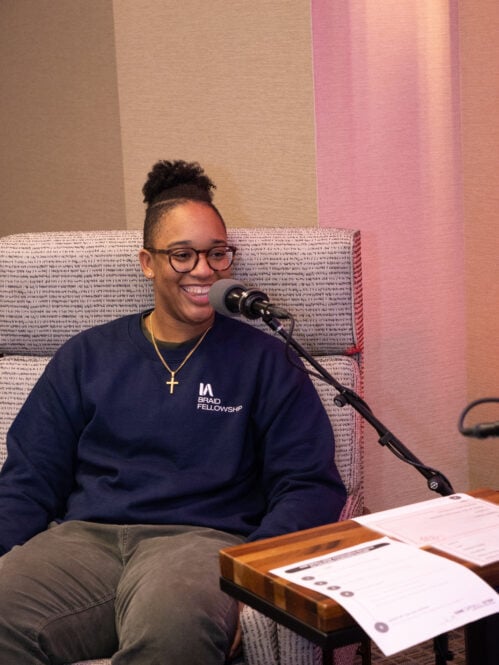
Listen to partners Desirae Taylor and Tina Grace’s conversation to hear them discuss the story of how they met and how they navigate their individual approaches to building and maintaining relationships with those they disagree with.
Partners since 2018, Desirae Taylor, a content creator, and Tina Grace, an Interfaith America program manager and inaugural Bridging the Gap cohort member, have different conflict management styles.
Now engaged, the two discussed how they met in at a Christian college in a small town and their different approaches to relationships, the challenges of navigating a partnership with a professional bridgebuilder, and their respect and gratitude for one another’s worldviews.
They both reflected on how Taylor’s approach to relationships is rooted in her desire to protect herself and those she cares about, influenced by her experience growing up in the foster care system and with socioeconomic hardship.
Grace, on the other hand, is quick to give adversaries the benefit of the doubt, leading first with curiosity — even in situations of deep disagreement — and adopting what they describe as a “kill ’em with kindness” mindset.
“People don’t know what to do with that,” Grace said of this style of conflict resolution, but they’re also understanding of their fiancé’s approach, who described herself as more apt to burn bridges than build them.
“I don’t think you’re confrontational,” Grace said in response to Taylor’s self-characterization. “You’re very strong in your beliefs.”
The couple discussed how their deep differences in managing relationships unfolded at different points of their life, starting when they met and continuing as they faced conflict with the mutual friend who introduced them, including Taylor’s reasoning for burning that bridge.
“She [the mutual friend] exemplified every stereotype of how the Christian world attacks the gay community,” Taylor said.

Grace maintained that for them, the bridge with this individual was not burned, but cracked. “I saw a wounded person who just wanted to be loved,” they said.
Grace and Taylor illustrate that deep differences exist within and across friendship, partnership, and love — and that pluralism is a shared endeavor.
When cooperating across a difference crosses someone’s line or boundary for engaging, their friend, colleague, or partner might be able to build that bridge.
For Taylor and Grace, their own differences encourage them to learn and grow from one another.

“I learn from you every day of the importance of standing up for yourself and standing up for others, first … let[ting] them know what they’re doing is not okay, and then … car[ing] for the person if you want to,” said Grace.
“Part of why I’m so in love with you is because I really admire you, and I strive to be more like you,” said Taylor. “I do think it’s crazy how often or how much we said bridge in this conversation, and I wonder if other couples who are in this realm of work do the same thing. I would be so curious of how other couples talk in their homes about this.”
Rachel Crowe
Rachel Crowe, Staff Writer for IA Today, tells compelling stories about interfaith cooperation across diverse communities and supports our narrative programming. She is a graduate of Gettysburg College where she earned a BA in English with a Writing Concentration and a German Studies minor.