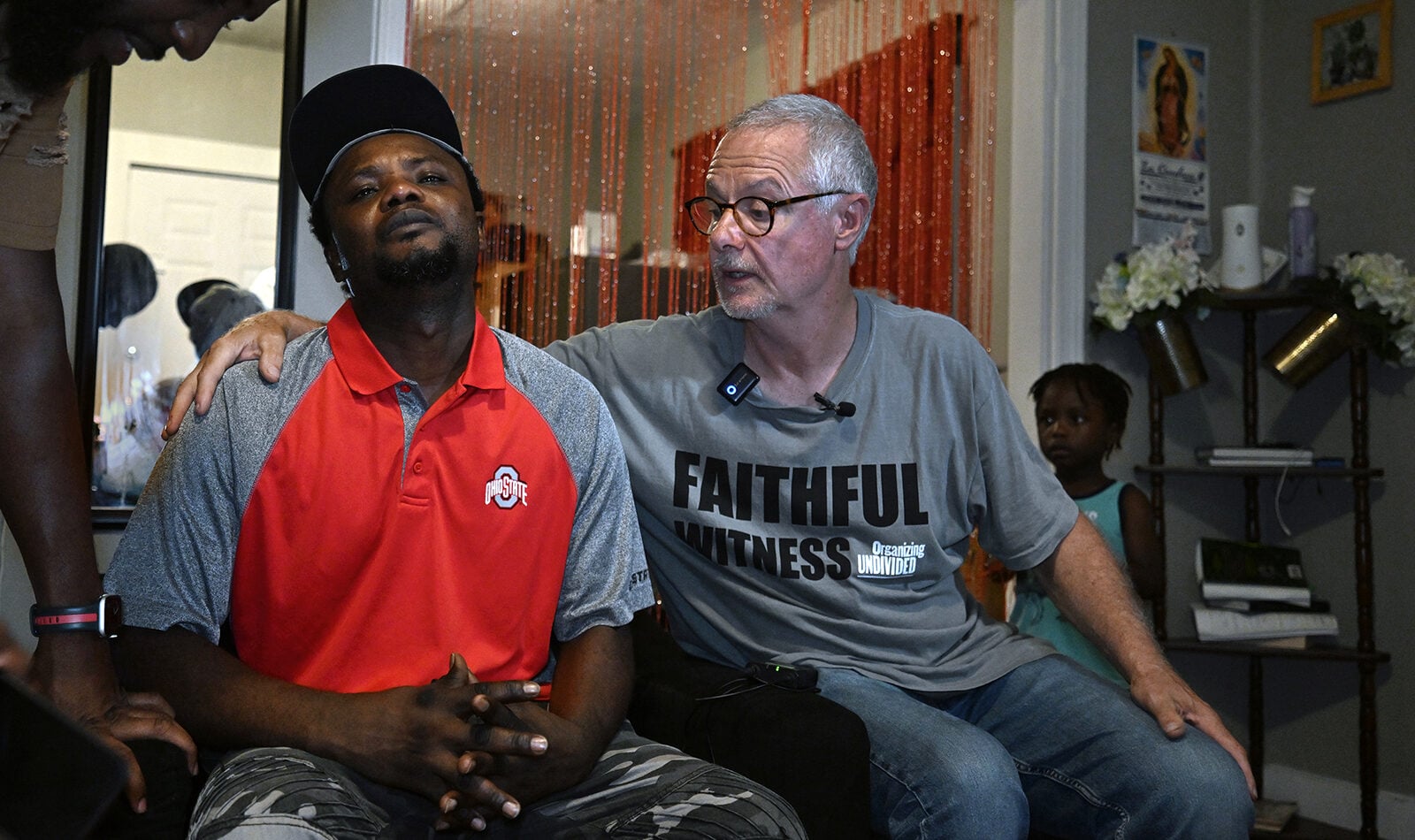

Simon Greer and Saad Soliman should, by some accounts, be fierce ideological opponents.
Greer is a Jewish social entrepreneur whose uncles fought for Israel in 1967; Soliman is a Muslim justice reform leader whose uncles died fighting for Egypt in that same war.
“We could have been enemies,” Soliman has said of their shared history, “but we chose something else.”
That “something else” has become an intensive teaching partnership on Israel and Palestine, and an effort to use what they have learned from overcoming divisions to teach a new generation of leaders. Continuing this work in the wake of the vicious Oct. 7 Hamas attacks and the brutal war that followed has added immeasurably to this challenge.

Greer and Soliman first met several years ago at a retreat for criminal justice leaders. “We were at this retreat, talking about punishment, justice, and dignity, and then I find out that our uncles fought against each other in a war,” Soliman reflects. The realization made their meeting feel like a fork in the road.
“We both could have retreated into the safety of our existing narratives,” he recalls, “but that would have been a betrayal of everything we say we believe in.” Instead, they chose to pursue a friendship, convinced that “transformation happens not when we simply defend ourselves, but when we also honor each other’s humanity.”
Greer had already spent years developing a bridgebuilding methodology he calls “Bridging the Gap,” designed to train people to engage those with whom they strongly disagree through structured, face-to-face encounters, rather than continuing to quarrel or avoid one another. He brought this model into settings as varied as labor disputes, campus controversies, and political dialogues, testing whether carefully designed encounters could dislodge people from the impulse to caricature or dismiss their interlocutors.
He also piloted Israel-Palestine conversations before Oct. 7 — some in collaboration with The Nantucket Project (TNP), an organization that promotes pluralism through film and in-person dialogue.
Greer recognized that partnering with Soliman could help take bridgebuilding work into new and challenging terrain, through their shared appreciation for vulnerability and honesty, distinct sets of life experiences, and diverging views on the Israeli-Palestinian conflict.
What began as a friendship grounded in shared questions about the struggle for dignity and justice in the United States turned toward a conflict in the Middle East that shaped both their family stories, and toward American students inheriting that conflict in real time.
“It’s university, of all places, where we must cultivate a culture that affirms our common humanity.”
– Asher Wexler, Courageous Conversations Student

After the Hamas attacks, the war, and the spillover onto college and university campuses across the U.S., the University of North Carolina’s new School of Civic Life and Leadership invited Greer and Soliman, together with TNP cofounder Tom Scott, to translate their bridgebuilding work on Israel-Palestine into a sustained, credit bearing class.
The result was a pilot course at UNC in spring 2025 — “Courageous Conversations: Israel and Palestine on Campus”— with Duke University developing a similar model some months later.
The course invites small cohorts of students into a semester-long process: studying multiple historical narratives, practicing structured dialogue, and then traveling together to Israel and the West Bank.
The syllabus pairs core historical texts with memoir, journalism, and first-person testimony; students engage the conflict not only as an abstract policy question but as lived, often contested, truths. Class sessions before and after the trip are vital, giving students time to identify their starting points and then to make sense of what they have seen and heard.
The trips are not study-abroad tourism but living laboratories to cultivate habits of heart and mind. Students meet activists and settlers, security officials and bereaved parents, religious leaders and ordinary people, whose lives often do not fit neatly into familiar scripts. The students are asked to journal daily, to name when a conversation has unsettled them, and to process those experiences with the group rather than retreat into private certainty and/or despair.
The point is not to produce a single congruent narrative but to train students to hold more than one morally serious perspective in view at the same time.
“In those five months of holding space for conflicting narratives, I experienced more growth than I had in any other academic setting.”
– Riley White, Courageous Conversations Student
In the classroom, Greer and Soliman seek to model what they ask of their students. They do not pretend to hold identical views, nor do they sand down the parts of their stories that might be challenging for the other to hear. Instead, they lean into what Soliman calls the sharing of “different truths”: the insistence that more than one narrative can be existentially compelling, even when those narratives make competing claims on land, memory, and justice.
“If you tell students there is only one legitimate story, you are not preparing them for democracy,” Greer says, “You’re preparing them for sectarianism.”
The ground rules the teaching duo set reflect that conviction. Students practice what Greer calls “agreed upon bravery,” signaling that courage is not an individual performance but a shared norm the group labors to cultivate and sustain. Participants are asked to speak from their own experience rather than rely on slogans, to listen especially for what is hardest to hear, and to resist the urge to collapse every disagreement into a referendum on their own goodness, or the goodness of others. Silence is treated not as failure but as a sign that something has landed with weight and might need time before the group can process it aloud.
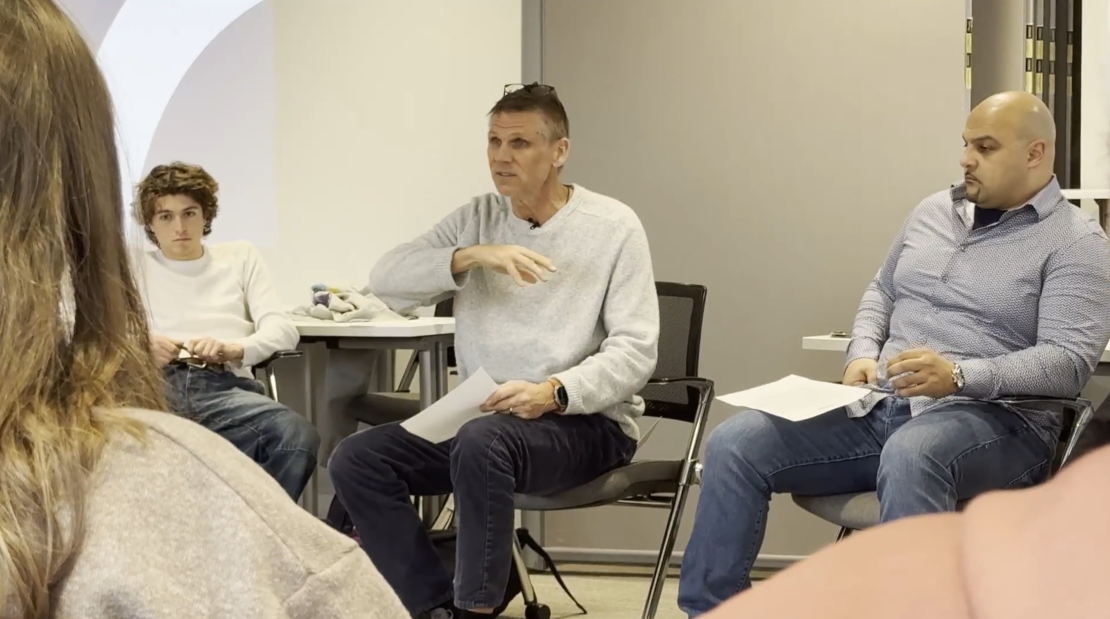
Soliman brings a complementary critique from his years in criminal justice reform and movement work where he has seen organizations fracture over purity tests and institutions retreat from hard conversations for fear of backlash. What excites him about this teaching is not that it produces consensus — “it doesn’t,” he is quick to note — but that it offers students “a different script” for what to do with serious conflict.
“You can’t build a just world if the only tools you have are shame and cancelation,” he says. “You have to learn to stand in your story and still make space for the stories of others.”
Greer and Soliman have walked into rooms thickened by an air of grief, anger, and fear — where students and faculty arrive already exasperated by social media feeds and institutional statements. In those rooms, they return to the practices that first bound them together: telling the truth about their own stories, refusing to weaponize those stories against each other, and asking participants to risk a similar kind of shared courage. “We’re not asking anyone to give up their story,” Greer says. “In fact, we want them to bring their experiences and perspectives into the classroom and explore them together.”
“I am not weakened by seeing the humanity in someone who fails to see it in me.”
– Anonymous Courageous Conversations Student
Soliman, reflecting on their unlikely friendship and the family histories that could so easily have pitted them against each other, offers a corresponding challenge:
“If Simon and I can look at our families’ histories and still choose to build a bridge, why can’t others do the same?”
Rabbi Or N. Rose is the founding Director of the Miller Center for Interreligious Learning & Leadership of Hebrew College and a Senior Consultant to Interfaith America.