Father Greg Boyle is driven by two foundational convictions: everyone is unshakably good, and everyone belongs.
For Father Boyle, we are all on the same plane. Think back to the last time you were on a plane: maybe there was a baby who wouldn’t stop crying; a man fuming on a work call; someone wearing a religious T-shirt you didn’t like; a woman watching that news channel, and on and on. There’s no point in debating whether these people belong on the plane. They are already on the plane. The question is whether you will engage them as though they belong.
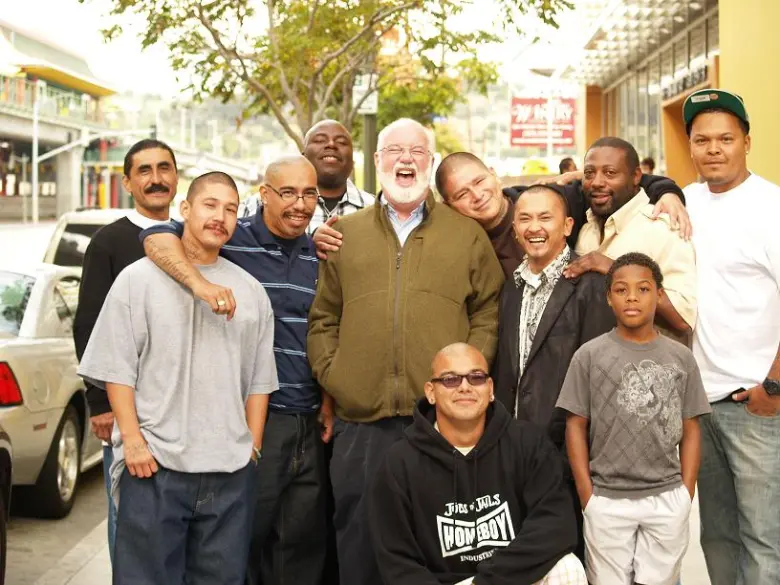
Father Boyle, a Jesuit priest who often draws from both Catholic and Buddhist traditions, runs Homeboy Industries, a nonprofit that helps formerly gang-involved and incarcerated individuals rebuild their lives through job training and support. He is a pluralism hero not just because of what he believes, but because of what he builds — spaces where people who once saw each other as enemies learn, slowly and concretely, how to belong to one another. Folks with diverse backgrounds and divergent values work together on shared projects that benefit everyone. At Interfaith America, we call this pluralism: connecting and cooperating across difference to make the world a better place.
I’m reminded of two guys who worked in a Homeboy-run bakery together, making croissants. From rival gangs, they never spoke. One of them even had a “diss tattoo” on his face, disrespecting the other guy’s gang. Eventually, he decided to remove it. He showed up one morning with the tattoo puffy and blistered from the first treatment. The first real words he uttered to his co-worker? “I’m getting this removed because of you. You’re good people.”
Boyle reminds us that Homeboy Bakery is a microcosm of our broader world. Eventually, those two guys will need to talk about the time that they shot or even killed each other’s homies. But for now? For now, they are making croissants together.
If they can do it, so can we.
Mike Whitenton
As Director of Academic Initiatives, Mike Whitenton empowers faculty nationwide to cultivate pluralism in their classrooms and on their campuses. Before joining the team at Interfaith America, he spent ten years at Baylor University as a faculty member, designing and teaching courses on interfaith cooperation, bridgebuilding, civic engagement, and religion.