Higher Education

Senior Leaders

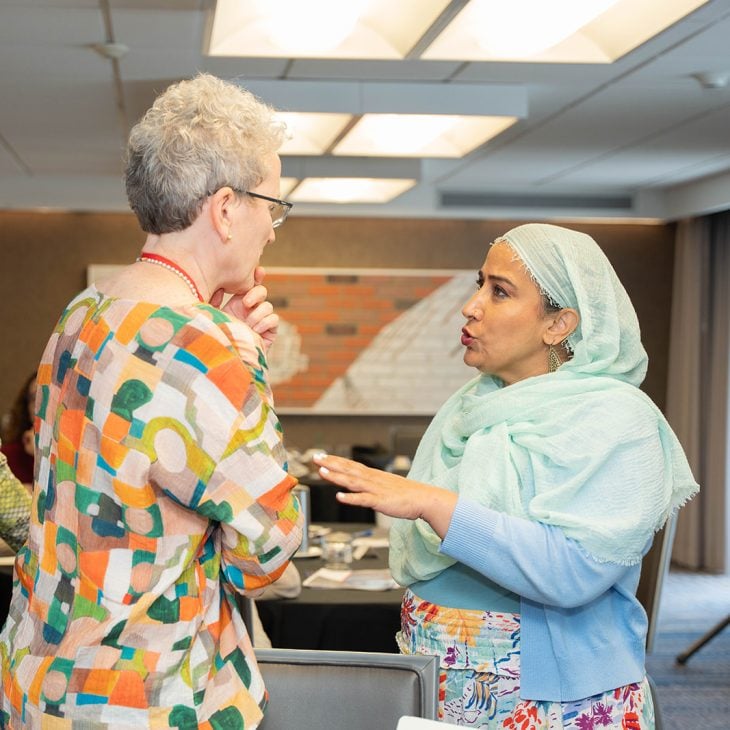
Interfaith America works with senior leaders on campuses across the country to implement the best practices in fostering pluralism.

Interfaith Leadership Summit 2026

Join us August 7-9, 2026 for the nation’s largest gathering of college students and educators committed to American civic pluralism—where you’ll gain skills, inspiration, and lasting connections to bridge divides and build a more united society.

Partners for Pluralism

Interfaith America works with senior leaders on campuses across the country to implement the best practices in fostering pluralism. We have two decades of experience as trusted partners to senior leaders at a wide range of colleges and universities, from small private to large public institutions. Our programs build sustained pluralism initiatives resulting in stronger campus climates, reduced polarization, and greater student engagement. We offer consulting, training, and learning tools, while also organizing spaces for relationship building, strategic planning, and leadership development. Through the generous support of philanthropic organizations and donors, we periodically provide funding to institutions to further pluralism on their campus. 

Work With Us

Resources for Senior Leaders

An actionable resource designed to equip senior leaders to champion cooperative campus cultures.
Campus climate assessment is an important step in determining how to support religious diversity and foster interfaith cooperation on campus.
A curriculum for educators and facilitators focused on the bridgebuilding practices and skills that help people engage across deep divides.
Join people who care about the future of our religiously diverse society as we learn about interfaith cooperation and bridgebuilding.
Use Interfaith America's Learning & Action Bridge to discover your next steps. Find interfaith opportunities based on your role and goals.

Working with Interfaith America

The offerings below will be of particular interest to senior administrators seeking to advance a culture of civic pluralism or interfaith cooperation at their institutions. These live (in-person or virtual) sessions are customized to suit unique campus needs and designed for an audience that includes senior leaders, and the additional faculty and staff charged with leading pluralism on campus. We provide consultations, workshops, strategy sessions, and high-level thought leadership to lead to a vision for campuswide change. 

Strategic Planning Consultation on Pluralism

Interfaith America leads a working group of campus stakeholders in extended strategic planning workshops on civic or religious pluralism, with the goal of developing a more extensive cross-campus strategy to transition an institution into becoming a model for pluralism. This can include a campus visit; a retreat in Chicago for senior administrators; use; use of the INSPIRES Index for consultations focuses on religious pluralism; virtual consultations before and after an on-campus visit; a comprehensive report with recommendations; and the option of a campus visit by Eboo Patel to help the university frame its vision for pluralism. This can also include capacity-building sessions and focused follow-up workshops. 

Introductory Session, 1-1.5 hours

Building a Culture of Pluralism on Campus

In this introductory session, attendees explore what it takes to foster a campus culture grounded in pluralism – where diverse identities are respected, community members are inspired by what others hold dear, and people regularly activate shared values to work together for the common good. Participants consider contemporary external forces that call for pluralistic approaches and explore practical examples of what works. This session will either foreground religious pluralism or civic pluralism more broadly, depending on campus context and need.  

Suggested audience: faculty, staff, and administrators

Special Topics, 1.5 hours

Promising Practices: Key Levers for Building a Culture of Pluralism

Designed for campus stakeholders already inspired to build pluralism or interfaith cooperation and looking for practical next steps, this session provides attendees with the opportunity to examine promising practices, explore examples of the practices in action, and consider which practices to prioritize. 

Suggested audience: faculty, staff, and administrators who will help lead pluralism efforts on campus

Special Topics, 3.5 hourS

The Promise of Pluralism in an Age of Prejudice: Addressing Antisemitism and Islamophobia on Campus

How do college and university professionals attend responsibly to harmful prejudicial behaviors while promoting dialogue, learning, and healing? This 2-part workshop (3.5 hours total) helps senior administrators think through the complex realities of antisemitism and Islamophobia in their campus communities and beyond. The first workshop offers foundational knowledge of antisemitism and Islamophobia, including definitions, histories, and interconnections. The second workshop offers a case study on religious prejudice (and other related biases) in a campus context that helps participants consider what a holistic response might look like in their own institutional context. While this training focuses specifically on countering antisemitism and Islamophobia, there will also be robust discussion of how to envision such interventions as part of a larger vision of civic pluralism.

Suggested audience: senior administrators

Special Topics, 1.5 hours

Using a Pluralism Approach to Build on Existing Campus Initiatives

Effective initiatives to build a culture of pluralism leverage the strength of existing campus work. In this session, attendees consider how pluralism approaches (including the engagement of religious difference) complement other models and explore strategies for cultivating pluralism in partnership with other diversity-focused campus stakeholders.

Suggested audience: senior administrators and campus leaders

time varies

Bridging the Gap

Bridging the Gap teaches students and campus professionals how to truly listen, understand, be heard, and seek common ground to positively impact their communities without compromising deeply held values. Participants learn why bridgebuilding is important and core bridgebuilding skills including connecting this work to their religious or secular worldviews; deep listening; navigating tension constructively; and finding ways to cooperate despite deeply held differences. Participants leave the training equipped to be bridgebuilders in their community and beyond.

Suggested audience: students, faculty, and staff

time varies

Bridging the Gap

Bridging the Gap’s Train-the-Trainer workshop equips campus leaders as trainers of the Bridging the Gap curriculum, allowing them to sustainably train others on their campus with core bridgebuilding skills.

Suggested audience: student leaders, faculty, and staff

Testimonials

Working with Interfaith America has expanded my circle of trusted colleagues for advice and resources in my work at Gonzaga. I know I will always find a listening ear and good ideas to enhance what we do. The support is so valuable as higher ed confronts so many difficulties at this time.

– Ellen Maccarone Ph.D.

Acting Vice President for Mission Integration and Associate Professor of Philosophy at Gonzaga University

Receiving Interfaith America’s support was a wonderful vote of confidence for a school focused on doing its very best for students and faith community.

– Dr. Gerry Turcotte

President and Vice-Chancellor, Corpus Christi College and St. Mark's College

interfaith America

Stay in Touch

Subscribe to get the latest funding opportunities, events, and resources from Interfaith America.

Contact Us

Please contact us to discuss working together.

Todd Green

Senior Director of Campus Partnerships

Interfaith America

Related Pages

Interfaith Leadership Summit

Gain skills, inspiration, and connections to bridge divides and build a more united society. Join us August 7-9 in Chicago, IL!