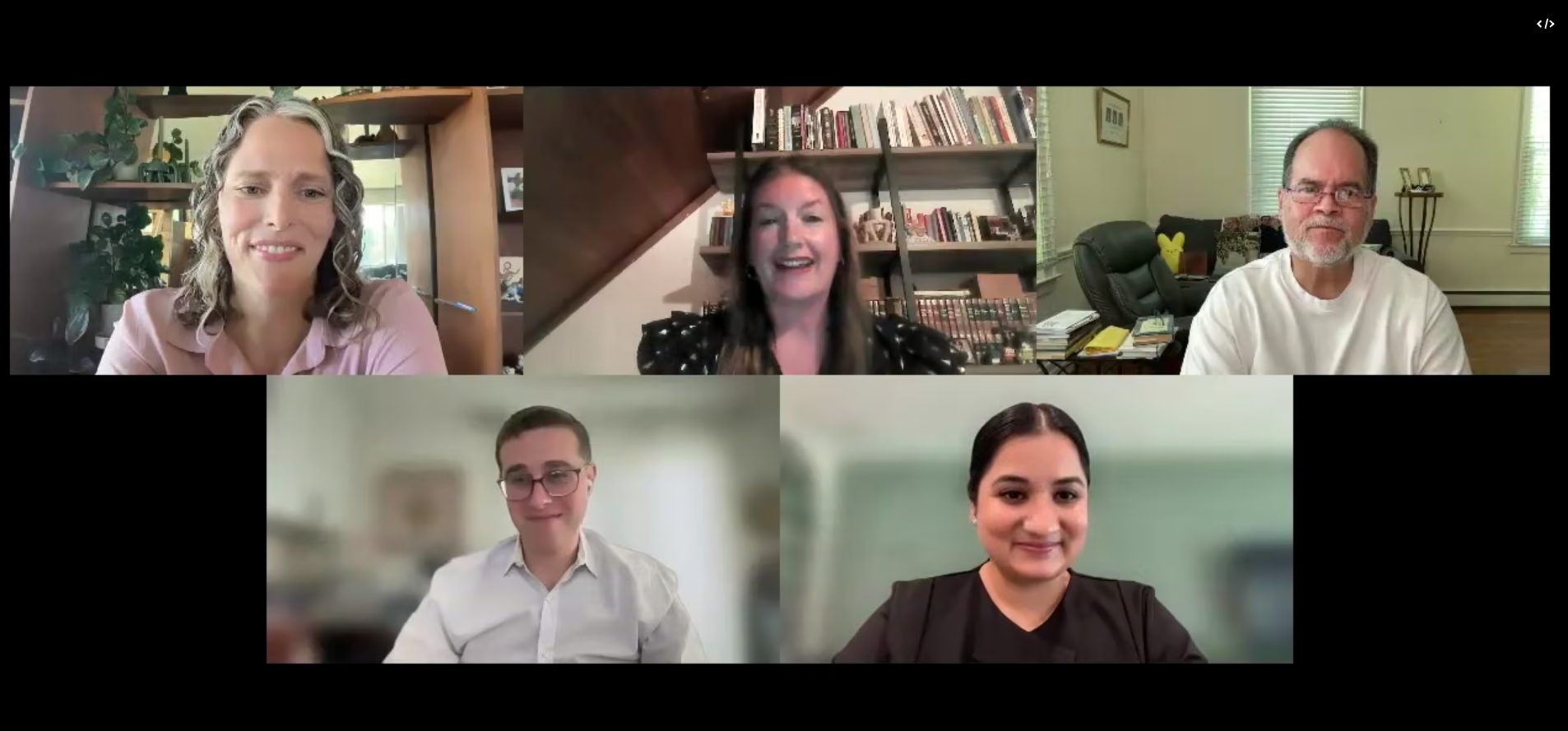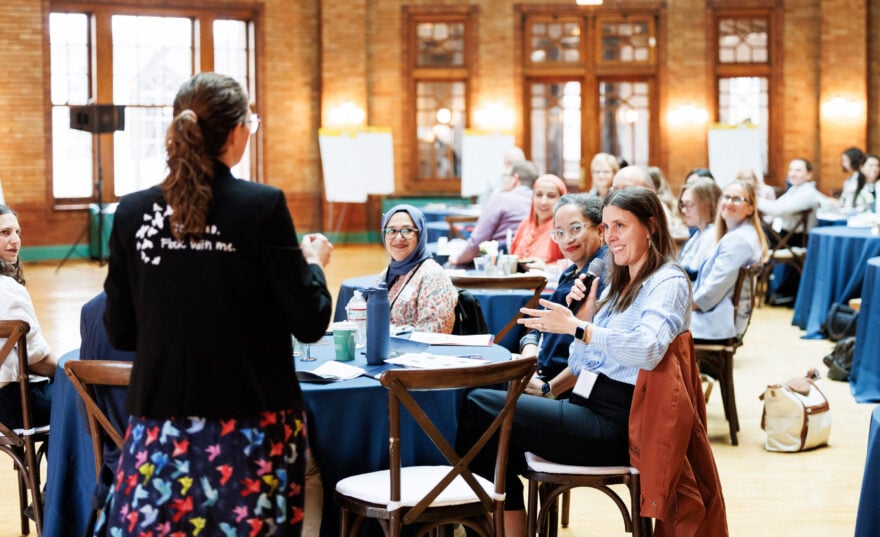

IA network members joined StoryCorps One Small Step for 30-minute, one-on-one conversations across lines of difference. These kinds of conversations happen every day among students, co-workers, and family members in America, and the Interfaith Leadership Summit is a space where participants can learn to seek them out with the purpose of respecting diverse identities, fostering meaningful relationships, and cooperating for the common good.
Listen to the full conversation to hear campus administrators Dr. Fernie Rodriguez and Matt Hoffman discuss the role of bridgebuilding in their personal and professional lives, how their religious backgrounds inform their work, and how they support others cooperating across difference.
As campus administrators, Dr. Fernie Rodriguez and Matt Hoffman both aim to model the kind of resilience and respect for diversity that they teach on campus.
“You are going to experience perspectives and worldviews that just are going to fundamentally contradict what you have come to believe to be true. Expect that that is part of why you come to a place like UW-Madison.”
“You are going to experience perspectives and worldviews that just are going to fundamentally contradict what you have come to believe to be true. Expect that that is part of why you come to a place like UW-Madison,” Dr. Rodriguez tells students at summer orientation sessions.
For both campus leaders — Dr. Rodriguez as Vice Chancellor of Student Affairs at the University of Wisconsin, Madison and Hoffman as director of religion, spirituality, and pluralism at the University of Maryland, Baltimore County (UMBC) — faith informs their work.
Dr. Rodriguez spoke about her experience growing up queer in an “incredibly homophobic environment,” navigating college as a first-generation student, and “holding big questions” about belief while reconciling what she’d been taught from a young age about religion.
“I have tremendous faith,” she said, reflecting on how her spirituality has evolved. “The fact that I’m here in this role, doing this job in this moment as an emerging trans fem — it’s remarkable.”

Hoffman, who grew up in a Lutheran household, described feeling “pretty lost” as a recent college graduate participating in Teach for America. Returning to his faith amid this struggle led him to get involved in interfaith organizing, attending seminary, and marrying his wife, who is Jewish.
“I’ve been surrounded by the richness of religious diversity and complexity, which really shaped my own personal faith,” he said. “I’m an ordained Lutheran pastor, and the reason that I do this work is because of those interfaith experiences.”
The two discussed how they’ve felt misunderstood, with Dr. Rodriguez citing the ways that “people wouldn’t necessarily assume [she] comes from such a religious background,” and Hoffman describing the frustration of sharing a faith tradition with those who see things differently:
“I am so angry right now about how I think parts of my tradition lead our national political conversation in ways that just are not what I was taught, or not what I studied … I’m trying to lean into claiming more of a Christian voice when I don’t always love the other Christian voices in the room,” he said.
In the face of challenges, both agree that vulnerability and storytelling are means of acknowledging shared humanity and can offer a redemptive path forward.
“I have needed to be vulnerable and allow myself to be taken care of by the so-called ‘other,’ right? That gave me so many lessons,” Dr. Rodriguez said, emphasizing how being received by others with differing worldviews at the most challenging times in her life is what shaped her, and what she hopes will shape her students.
“We teach resiliency by modeling it”
Hoffman hopes he can encourage others by sharing his own journey. “We teach resiliency by modeling it,” he said, “and I want to move forward reminding myself that my story matters.”
Rachel Crowe
Rachel Crowe, Staff Writer for IA Today, tells compelling stories about interfaith cooperation across diverse communities and supports our narrative programming. She is a graduate of Gettysburg College where she earned a BA in English with a Writing Concentration and a German Studies minor.