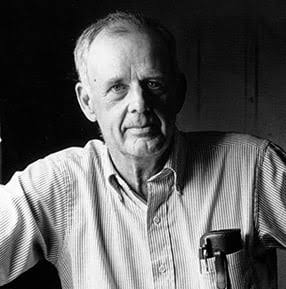
Growing up in Kentucky, I never experienced Wendell Berry as simply an author. Like the state’s other literary claims to fame, Barbara Kingsolver and bell hooks, his poetry and essays were woven through my K-12 education with notes of reverence and pride. My father shared quotes from his essays and was always sure to add, “You know he was born near Louisville.”
I have never cried as hard at the end of a book as I did at the last pages of “Jayber Crow,” Berry’s magnum opus on the power of love and what it means to care about someone, and some place, for the long haul. In my eyes, Berry was less a political thinker than someone who wrote about the particular complications of belonging. His Kentucky is not an abstract place. It is a place of families and farms, histories and grudges, beauty and violence, and he loved it enough to refuse to simplify it.
Berry resisted easy political labels throughout his life. He spoke against the Vietnam War and published “The Unsettling of America,” still one of the most sustained arguments anyone has made against industrial agriculture and the corporate consolidation of farming. His objections were never only literary. He was arrested protesting the Marble Hill nuclear plant, and he spent several days in 2011 sleeping on the floor of the Kentucky governor’s office with a group protesting mountaintop removal. He was also a hard man for either party to claim, defending the federal tobacco program long after that had become an awkward position on the grounds that it protected the small farmer, and rejecting the religious case against same sex marriage in terms that made some of his fellow Christian admirers uncomfortable. His loyalties simply ran to particular land and particular people rather than to positions. Labels usually slide right off someone whose commitments are that concrete.
Berry has written about pluralism directly, and it is uncomfortable to read what he actually says when you do the work I do and are a Kentuckian who grew up in a city and still lives in one. He is not gentle with his critique and a diverse city, in his account, is not the achievement we want it to be. He said such places look pluralistic “because they are full of refugees from destroyed communities, destroyed community economies, disintegrated local cultures, and ruined local ecosystems.”
What we call diversity, he suspects, is often the downstream visible evidence of dispossession somewhere upstream. To celebrate the variety of a city without asking what emptied the places those people came from was, for Berry, a way of admiring wreckage and calling it a garden. A pluralism that requires nothing of anyone is exactly the civic arrangement a displacing economy would want, since people who owe each other nothing are not likely to care much about each other or about a place, which makes them easy to push aside when it becomes profitable.
What strikes me about the objection is that it is not ultimately an objection to difference. His quarrel is with a coexistence where people can share a zip code for thirty years without ever once having to work anything out together, and where tolerance gets extended “always to the uprooted and passive, never to the rooted and active.” The alternative he gestures toward, people who are rooted and active and who have to live with the consequences of their choices, is not a retreat from difference but a description of what difference costs once it is real. It’s Berry’s character Jayber Crow still cutting the hair year in and year out of the man who is married to the woman he loves and whose actions are destroying the land he loves.
It reminds me why I love the action bias in how we describe this work at Interfaith America, in respect, relate, cooperate. Relationships can stall at the level of good feeling, but cooperation means holding a common project with people whose deepest commitments differ from yours and staying with it when the disagreement turns out to be rooted in something deeper than a disagreement.
The word people use to describe Berry’s writing is reverence, and its usually attached to the natural world and the seasons. What his work actually reveres is attention, the practice of looking long enough at something ordinary until it stops being just ordinary. In “Wild Geese” he said, “And we pray, not / for new earth or heaven, but to be / quiet in heart, and in eye / clear. What we need is here.” Reverence in Berry is not an emotion you bring to a thing. It is what happens when you stay somewhere long enough to be implicated in it. I wonder if the reason he distrusted what he calls pluralism was that he suspects it lets us skip the staying and attending to things.
That pause and critique is a gift to our work rather than an objection we have to answer. It demands care for the vividly particular that is so essential to pluralism. What we need is here, he wrote, and he meant a particular ridge in Henry County, Kentucky. For me, it holds the blocks in Chicago I love, where neighbors live wildly different lives, but are joined by a deep love of Rogers Park and a willingness to stay and make it better.
As Berry writes: “There are moments when the heart is generous, and then it knows that for better or worse our lives are woven together here, one with one another and with the place and all the living things.”
Wendell Berry passed away August 31, 2026 at the age of 92.
Susan Haarman
Susan Haarman is Director of Campus Partnerships at Interfaith America.