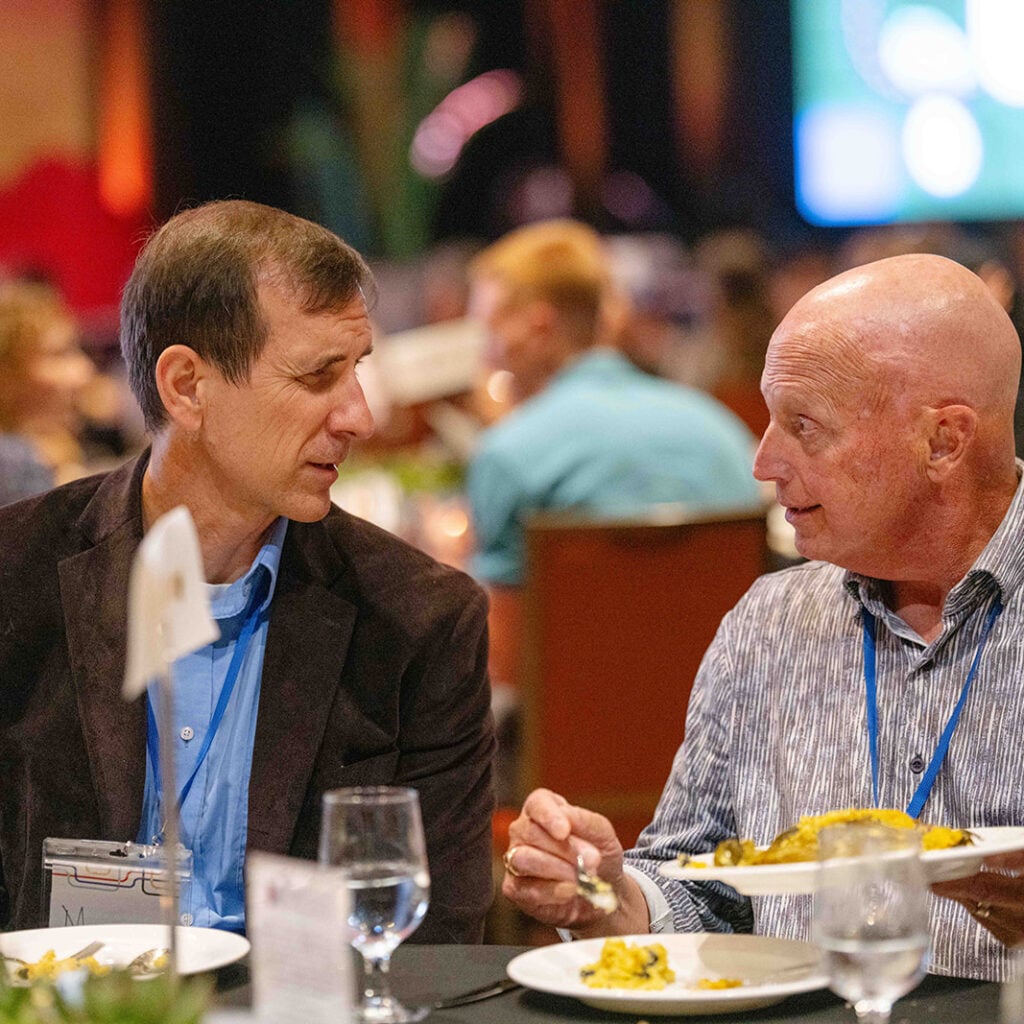
At the campus dialogues I help organize, the official program often ends before the conversation does. Participants linger, perhaps to finish a thought or just to spend another moment in the company of others. The event has given them something many adults struggle to find in the course of a normal week: a reason to spend time with people outside their usual circles.
That lingering has changed how I think about pluralism and bridgebuilding. We devote considerable attention to the moment when disagreement begins. Facilitators teach people to listen carefully and approach unfamiliar views with curiosity. Those practices are important, but the reality is that community is difficult to build, much less sustain, when everyone at the table is always a stranger. Even modest familiarity can help when participants recognize the person across the table and know there will be another meeting.
Familiarity often begins with details that have little to do with politics. You learn that another person has a child who plays the same sport as yours or cheers for the same team as you do, maybe is obsessed with the same dog breed as you. Those details complicate the shorthand we use for people we barely know. They place disagreement within a larger relationship.
The places and organizations that allow familiarity to develop are part of our social infrastructure. They give daily life a pattern in which people encounter one another repeatedly, often around an activity they already enjoy. As essential as they are, they are also disappearing. Political scientist Robert Putnam drew attention to their decline in his 1995 essay “Bowling Alone.” His example of bowling leagues showed how recreation becomes a civic habit when people return to the same lanes and recognize the same faces week after week. As fewer Americans joined such groups, they lost ordinary settings in which acquaintances could become part of a wider community.
Concerns about this decline now extend into public health. The U.S. surgeon general’s 2023 advisory on social connection urged communities to invest in local institutions and physical environments that bring people together. The 2025 American Civic Friendship Survey, which I directed, found that more than one-third of Americans say it is difficult to make friends where they live. Nearly one in five had not made a new friend within the previous three years. These findings point to a shortage of settings in which new relationships can take root.
Programs that meet regularly give participants time to revisit first impressions and discover what matters to someone they might otherwise know only by reputation or stereotype.
Programs that meet regularly give participants time to revisit first impressions and discover what matters to someone they might otherwise know only by reputation or stereotype. By the time a difficult subject arises, they have some shared history and a reason to remain engaged in the conversation. This fall, my colleagues and I at Coastal Carolina University are starting a faculty and staff bowling league (gratuitous nod to Putnam intended). The invitation will reach across offices and academic departments that rarely have a reason to share an evening. Bowling gives people something to do when conversation slows, and the league schedule supplies the next meeting. Participants can decide gradually how much to share while keeping the activity low stakes. An awkward first encounter can be followed by a better second one. They can talk about work on one night and family on another. Relationships will be allowed to develop at a pace that a single event rarely permits. Our hope is that connections form across campus divisions, that we’ll bowl ludicrously low scores and be all the better for it.
The activity itself doesn’t really matter; it just provides the excuse to engage. What matters is the space, its accessibility, and the chance to develop a recurring practice and give relationships somewhere to go.
Faculty-staff bowling leagues are just one, particularly on-the-nose way this can happen. Public libraries, bookstores, and community centers can all create the same rhythm. A book club that meets throughout the year gives readers time to move from discussing the assigned pages to understanding one another. A neighborhood organization can convene a monthly meal around a local project, allowing residents to work together before discussing whatever divisive matter the HOA has uncovered. Pubs and wine bars can host conversation nights. The activity itself doesn’t really matter; it just provides the excuse to engage. What matters is the space, its accessibility, and the chance to develop a recurring practice and give relationships somewhere to go.
As Interfaith America looks toward the nation’s next 250 years, universities and community institutions alike can contribute by giving people more reasons to meet again. By the time a difficult subject arises, the person across the table may be someone who recommended a book last month or helped keep score last week. Familiarity may help both people stay at the table even when the disagreement remains.
Justin Vaughn, Ph.D.
Justin Vaughn is a professor of political science and director of the Center for Applied Civic Leadership at Coastal Carolina University, where he leads the Coastal Civic Initiative, which creates opportunities for people from the campus and surrounding community to engage across difference. His scholarly work currently focuses on civic friendship, pluralism, democratic leadership and the public role of colleges and universities. Vaughn is a member of Interfaith America’s 2026-27 Teaching & Learning Pluralism cohort and was previously a member of the AASCU Advancing Campus Pluralism cohort and a Pluralism Fellow at the 2026 Interfaith America Summit.