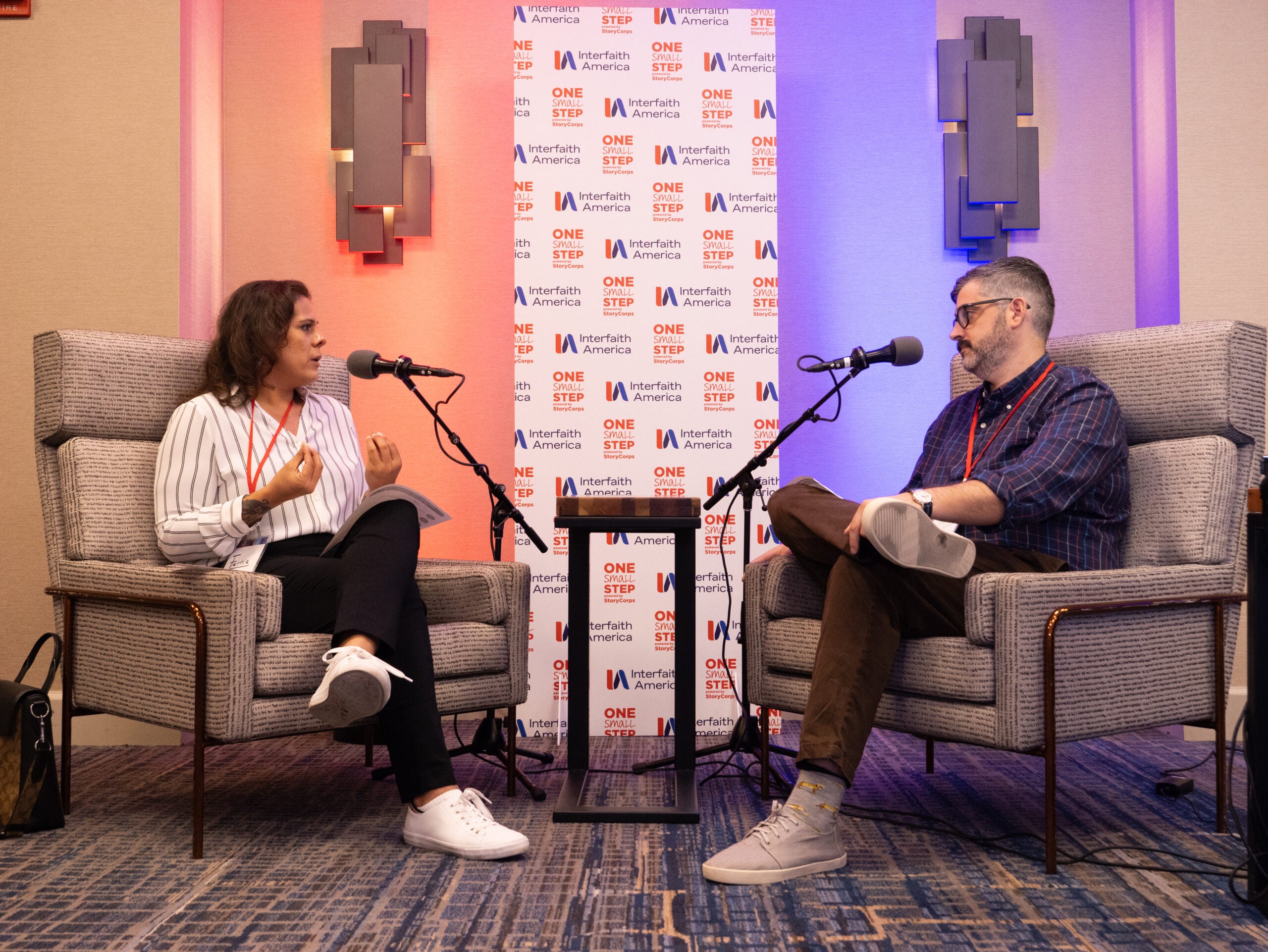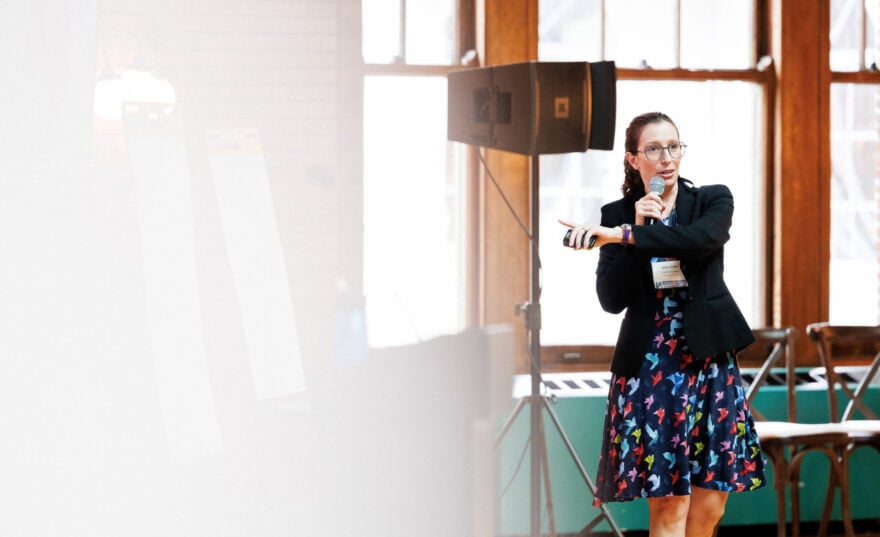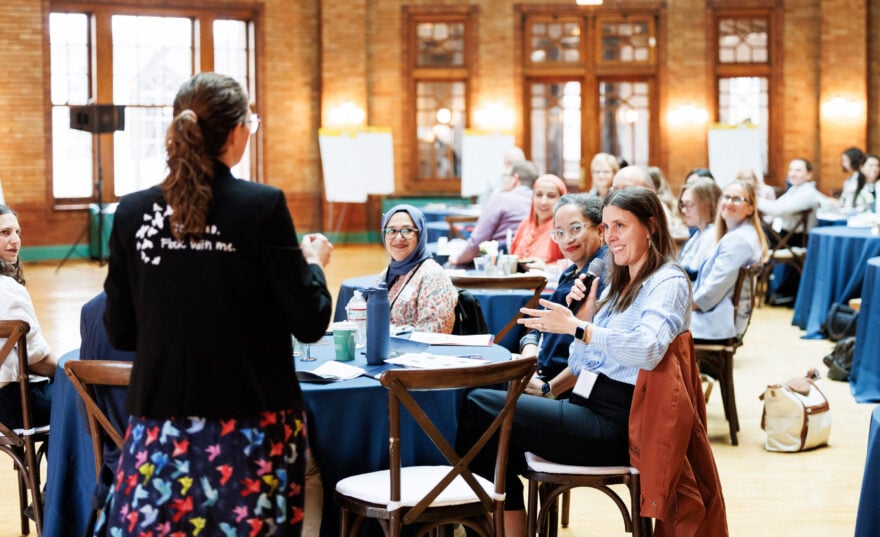
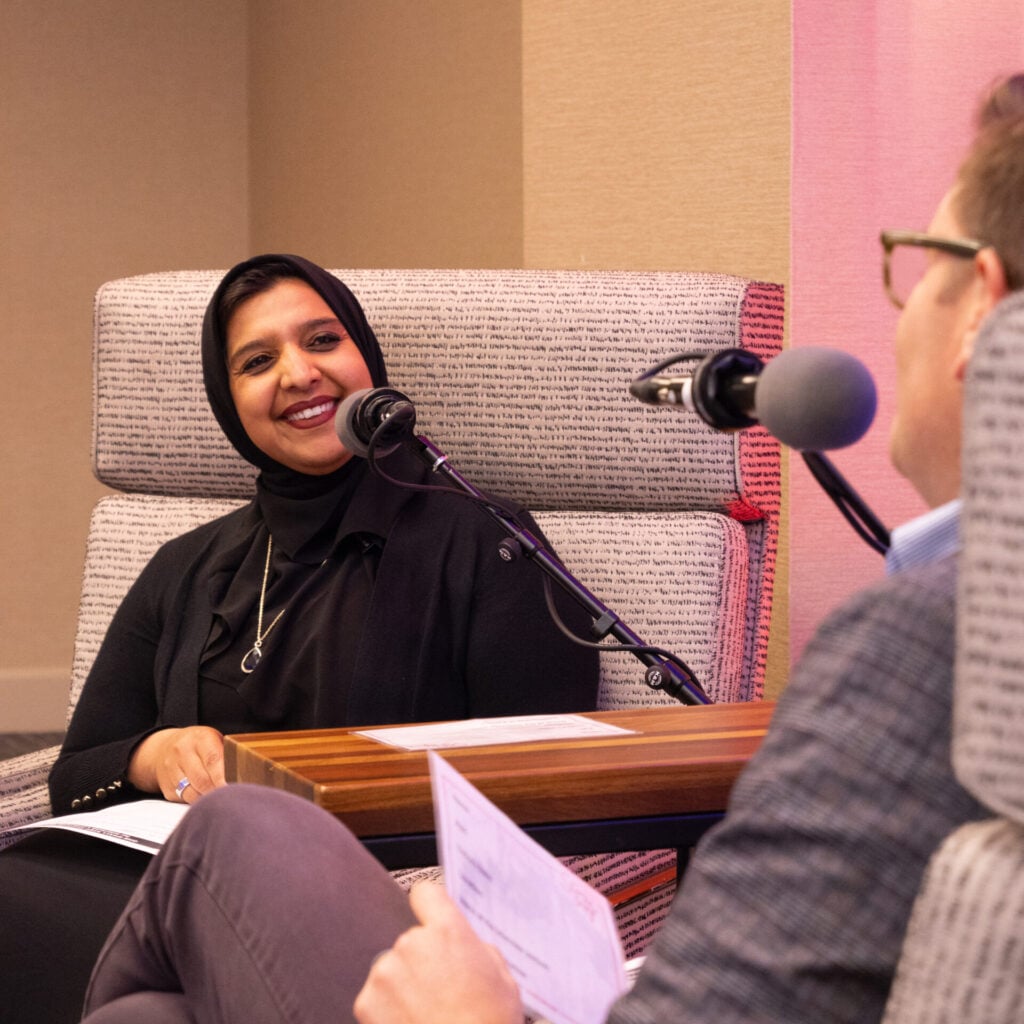
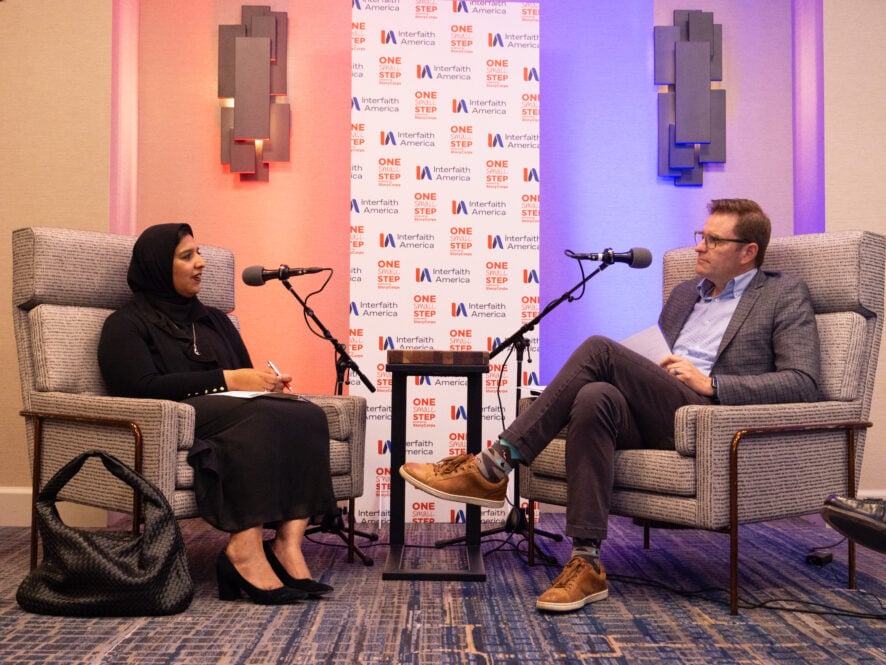
IA network members joined StoryCorps One Small Step for 30-minute, one-on-one conversations across lines of difference. These kinds of conversations happen every day among students, co-workers, and family members in America, and the Interfaith Leadership Summit is a space where participants can learn to seek them out with the purpose of respecting diverse identities, fostering meaningful relationships, and cooperating for the common good.
Listen to Sumreen Ahmad and Paul Lambert’s full conversation for more about on their journeys to championing religious inclusion at work, how their own workplace experiences have informed this work, and how pluralism has led to positive outcomes in specific workplaces.
Sumreen Ahmad and Paul Lambert are both longtime advocates of faith inclusion at work.
As a consultant at Accenture with nearly two decades of experience building systems and leading change management, Ahmad is an expert in creating inclusive workplace cultures.
At Brigham Young University’s Wheatley Institute, Lambert studies and teaches pluralism and human flourishing. With a background in international relations, he works with global corporations on religious pluralism’s role in economics and business.
Though advocating for faith at work was not what either set out for a career in, both Ahmad and Lambert come to this vocation by way of their own religious convictions.
Ahmad’s parents told her, “your faith will be the path to serve humanity.”
After nearly five years of thinking about faith inclusion at work as a way of building efficient systems, she “had this aha moment.” She realized it was her Muslim faith that instilled in her the very values — “tenacity, patience, accountability, stewardship” — that helped her succeed in corporate settings.
“It became this leadership imperative for me to say it’s not just about building utilitarian materialist systems. It’s actually about creating space for people where they can come and show up in an authentic way, the best version of themselves, without having to leave what’s most sacred to them at home,” she said.
“It’s actually about creating space for people where they can come and show up in an authentic way, the best version of themselves, without having to leave what’s most sacred to them at home.”
While teaching international students with questions about the unique role of religion in America, Lambert approached this work with curiosity about the potential of the American experience — and “not just the American experience, but the human experience”— if pluralism advances.
Motivated by his own faith commitments as a member of the Church of Jesus Christ of Latter-day Saints, he emphasized how church doctrines teach “not just a commitment to Jesus Christ, but also principles like agency, and accountability, and love towards one another.”
“If [faith] is what drives me, surely it’s driving other people, whether they’re coming [at] it from the same doctrine, or teaching, or truths, or ideas,” he said. “This matters. It’s brought so much light into my life. I recognize that someone’s lived religion, be it my own or a different one, is such a great source of light and strength and meaning.”
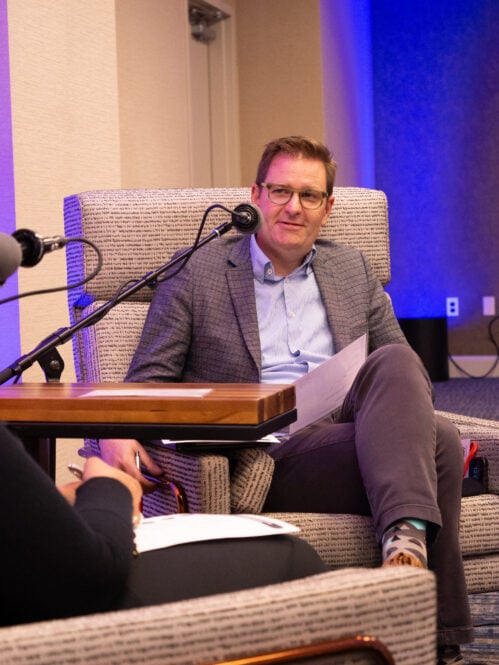
While it is principally the values of their own faiths that keep them invested in the work of advancing pluralism, Lambert and Ahmad are quick to point out that data makes a compelling case for religious inclusion in the workplace, too.
“A rich, religiously healthy environment brings tremendous public good when we’re talking about civic engagement, whether we’re talking about healthy families, healthy schools, higher education — on really every area you can measure within human flourishing,” Lambert said.
“A rich, religiously healthy environment brings tremendous public good when we’re talking about civic engagement”
The challenge then becomes, Ahmad notes, changing the narrative, especially in a “highly polarized world.”
“It’s about behavior, not beliefs,” she said, emphasizing the importance of seeing the humanity in fellow citizens, neighbors, and coworkers. “There’s so much power in understanding the purpose of the person and seeing the common cause that we have as humans within the same society.”
Lambert points to their own friendship as evidence of pluralism in action. “Sumreen, you and I have known each other for a long time. We are not of the same faith, but we work together very well,” he said. “It isn’t a ‘mine or yours’ choice. We can build and live together.”
Rachel Crowe
Rachel Crowe, Staff Writer for IA Today, tells compelling stories about interfaith cooperation across diverse communities and supports our narrative programming. She is a graduate of Gettysburg College where she earned a BA in English with a Writing Concentration and a German Studies minor.