I’ve spent much of my adult life concerned about the religious freedom of Catholics in the United States — and that fear has increased over the past two years.
When I was an undergrad at The George Washington University, I led a prayer vigil outside of the White House to protest the contraceptive mandates by the Obama administration, which curtailed the religious freedom of Catholic religious orders. I’ve spent much of my career promoting a vision for religious liberty for all, while making room for the distinctive nature of each religious faith — including my own Catholic faith.
At this moment, I am concerned about the ways that immigration enforcement threatens religious freedom, especially after President Trump’s own religious liberty commission overlooked these concerns during their recent report.
We don’t need a partisan response to the Trump Administration’s attacks on Catholic institutions and individuals — we need a consistent public witness to protect religious freedom for all.
Defining religious freedom
The Vatican document “Dignitatis Humanae” states that religious freedom “has its foundation in the very dignity of the human person”. The US Conference of Catholic Bishops describes religious freedom in two parts: Freedom from coercion related to practicing one’s faith and the freedom acting in accordance with one’s beliefs. The bishops clarify: “Religious freedom means that not only individuals but also families, communities, and institutions enjoy the space to live out religious convictions.”
These definitions provide clear guidelines for what religious freedom means and the ways in which this important freedom has been threatened.
Targeting Catholic institutions
At the state and federal levels, Catholic charitable organizations are being attacked by government actors who oppose their work. The Department of Homeland Security has also cancelled contracts with multiple local Catholic Charities organizations, citing contested claims about compliance with ever-changing federal regulations. The state of Texas has also launched what has been called a “fishing expedition” against Catholic Charities of the Rio Grande Valley and launched an investigation into the Annunciation House shelter network. One judge described the Texas Attorney General as acting “without regard for due process or fair play.” Additionally, the Trump Administration’s pared-down and combative posture on refugee resettlement caused the USCCB — one of the nation’s premiere immigration organizations — to shut down its refugee resettlement program altogether.
The federal government is even trying to seize a century-old Catholic pilgrimage site — including a 29-foot statue of Jesus Christ the King — to build the border wall. The Diocese of Las Cruces is suing to stop this eminent domain of their property.
For those of us with a broad interpretation of the First Amendment’s Free Exercise clause, these attempts to shut down Gospel-inspired charitable works are a chilling threat against religious freedom.
Access to the Eucharist
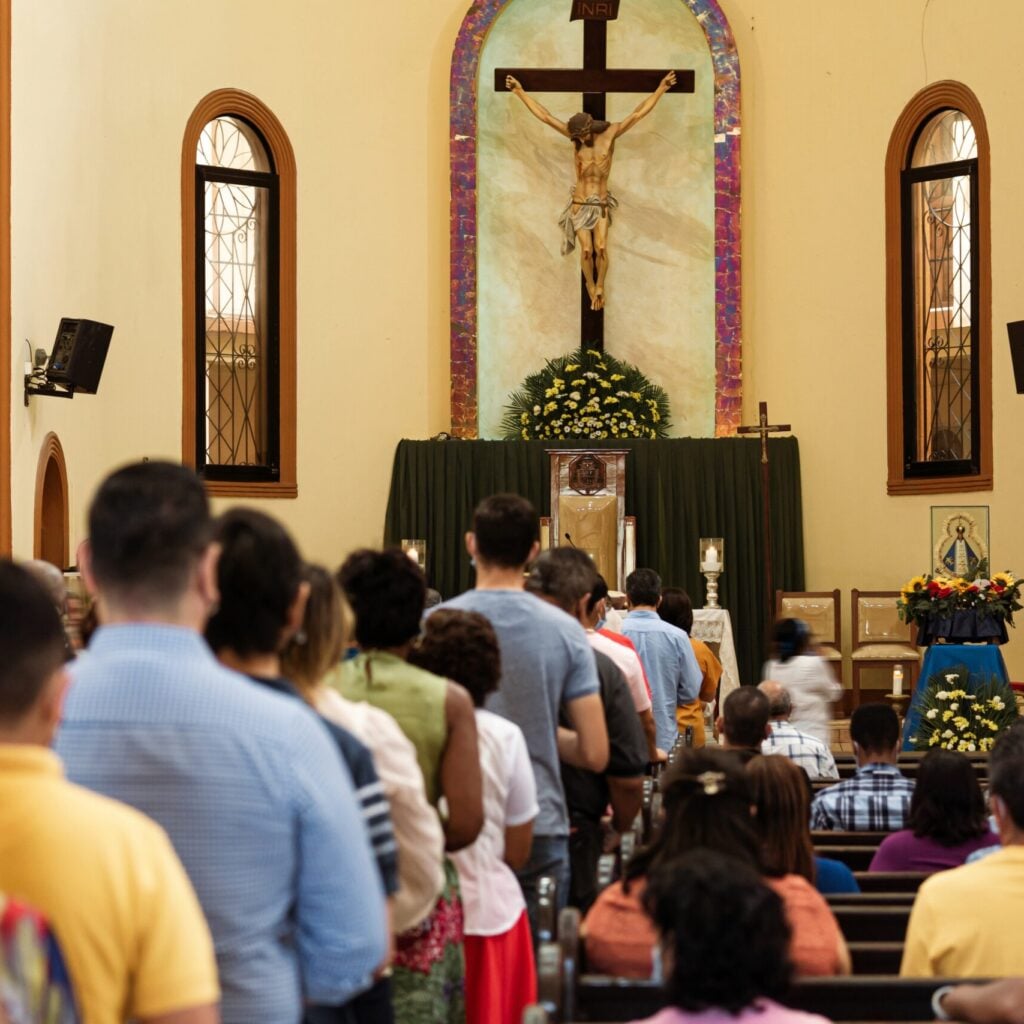
Perhaps the most important threat to religious freedom comes not from the actions against Catholic institutions, but against individual Catholics. The Catholic Church teaches that the Eucharist is the “source and summit” of our faith. No matter the differences that Catholics have politically, each of us understands the importance of our weekly encounters with Christ in the Eucharist and communion with each other.
But the new immigration enforcement regime is keeping many Catholics from the sacraments. In one of the most shocking cases to date, Immigration and Customs Enforcement detained a Catholic religious sister and registered nurse — in full habit — on her way to Mass. Following outrage from multiple members of Congress from both political parties, she was released.
This was not an isolated incident. It is part of a pattern that has separated Catholics from Jesus in the Eucharist. In the first weeks of the Trump Administration, officials rescinded the sensitive locations policy that prevented immigration enforcement in houses of worship. Multiple people have been detained outside of churches since that time. People in ICE detention have been denied access to the sacraments, prompting lawsuits and public protests. And dioceses across the country report plummeting mass attendance numbers among Latino parishioners. The Archbishop of Washington went so far as to call last year’s spike in immigration enforcement a campaign of “terror.”
The need for bipartisan courage
Let’s be clear: neither political party has a perfect record on religious freedom. For their part, Democrats at the national and state level have targeted pro-life sidewalk counseling, prayer vigils, and pregnancy resource centers. Some state and local officials are attempting to force priests to break the seal of confession.
This isn’t about partisan politics — and shouldn’t be.
It is especially incumbent on Catholics to call out their own side of the political aisle — or at least the side that will listen to them most. At this current moment, the Church needs those Catholic leaders who value their proximity to power — such as Minnesota Bishop Robert Barron in his service on the president’s religious liberty commission — to provide private counsel and public witness in defense of their Church. As Vice President J.D. Vance continues his book tour about his own Catholic faith, it is fair for American Catholics to wonder what his own conscience says about these challenges to Catholic religious freedom.
If Democrats are back in the White House in the coming years, the Church will need a stronger progressive Catholic voice that challenges the Democratic Party on their own religious freedom deficiencies.
Our first freedom should not fall prey to partisan politics; it should be the shared priority of Catholics of all political stripes. Catholics are not alone in our defense of this freedom. Hate is on the rise against Muslims, Jews, and other religious traditions, and threats to the faith-based nonprofit sector abound. All Americans — of all faiths and of no faith — should be clear-eyed about these threats to the freedom of religion and conscience and find our own ways to push back.
Chris Crawford
Chris Crawford is Senior Director of Civic Strategies at Interfaith America.