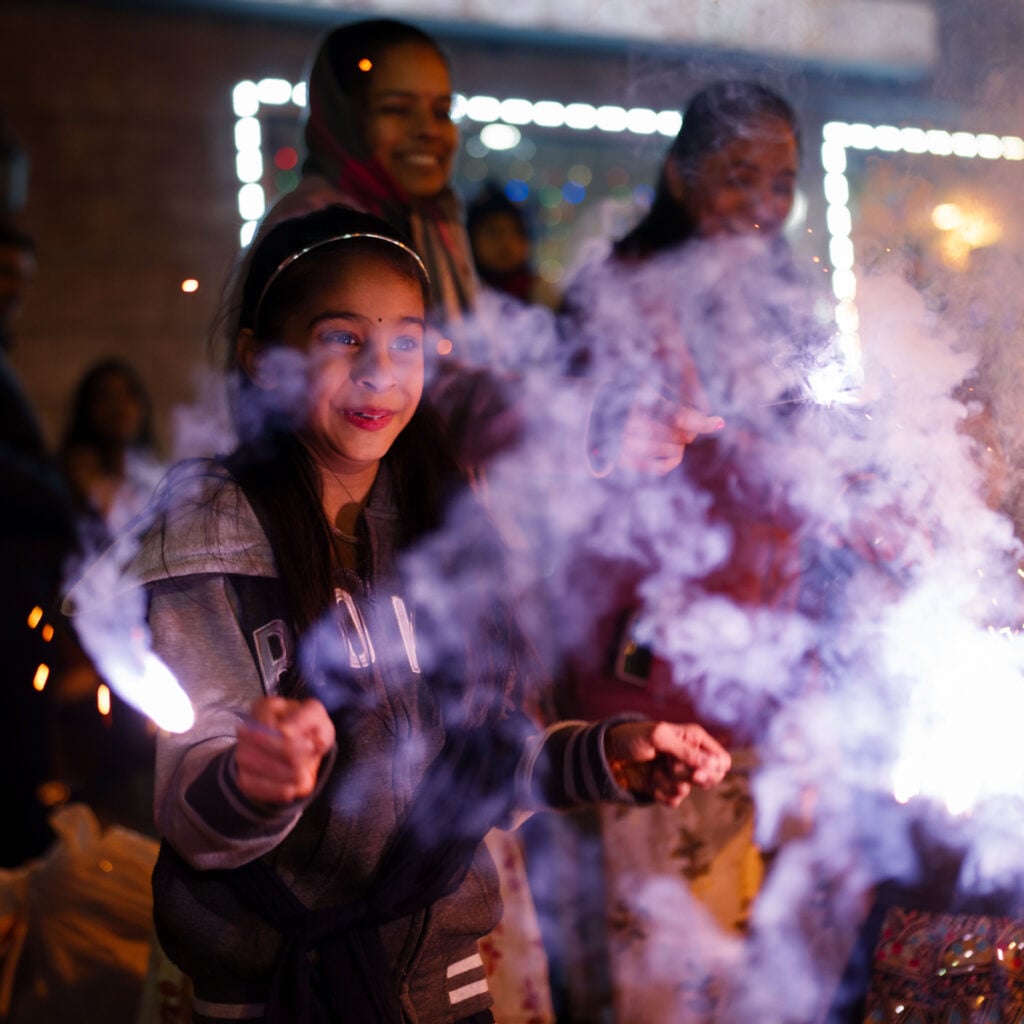
JERSEY CITY, NEW JERSEY - NOVEMBER 12: A girl holds a sparkler as they celebrate Diwali on November 12, 2023 in Jersey City, New Jersey. Diwali, also known as Deepavali, or the ''festival of lights'', is a popular Hindu festival that symbolizes the spiritual "victory of light over darkness, good over evil, and knowledge over ignorance." (Photo by Adam Gray/Getty Images)
Diwali is the festival of lights, which comes from the Sanskrit “Deepavali,” meaning “row of lights.” Observed by over one billion people each year, the festival is considered one of India’s and the Hindu diaspora’s most widely celebrated holidays.
The festival of lights is commemorated not only in many Hindu traditions, but also by Sikhs, Jains, and some Buddhist communities. Observances of Diwali include lighting lamps to signify the triumph of light over darkness and good over evil.
MUMBAI, INDIA - OCTOBER 30: People hold fire cracker as Indians celebrate the annual festival of Diwali on October 30, 2016 in Mumbai, India. Diwali, the festival of lights, is one of Hinduism's most important festivals dedicated to Lakshmi, the Hindu goddess of wealth (Photo by Allison Joyce/Getty Images)
These include the Hindu tale of Rama — an incarnation of the god Vishnu — and his triumph over demon Ravana, the Jain celebration of the enlightenment of the 24th spiritual teacher, Mahavira, and the Sikh observance of the day Guru Hargobind and 52 other men were released from prison.
“Perhaps these diverse origin stories of Diwali point to a shared argument that Indian culture is making about the world: that good — whether as one of the many avatars of Lord Vishnu, an enlightened Jain prince, or an imprisoned guru — will necessarily triumph over the evils of demons, injustice and ignorance,” she writes.
Just as the cultural and religious stories surrounding Diwali are diverse, so are the ways the festival of lights is celebrated or commemorated.
Some Hindus celebrate Diwali as a five-day festival, beginning with Dhanteras — this year on Friday, Nov. 6 — a day for cleaning and decorating homes.
Lakshmi Puja is on Sunday, Nov. 8, and considered the third and main day in many Diwali celebrations, when earth lamps, or diyas are lit and temples visited.
In some traditions, the festival ends on day five, on Tuesday, Nov. 11, called Bhai Dooj, Bhai Tika, or Bhai Bij, which is a day to honor the sacred bond between brothers and sisters.
Some Diwali celebrations include lighting fireworks, eating sweets, getting together with family, dressing up in nice clothing, and worshipping while other traditions avoid loud displays and focus more on meditation and fasting.
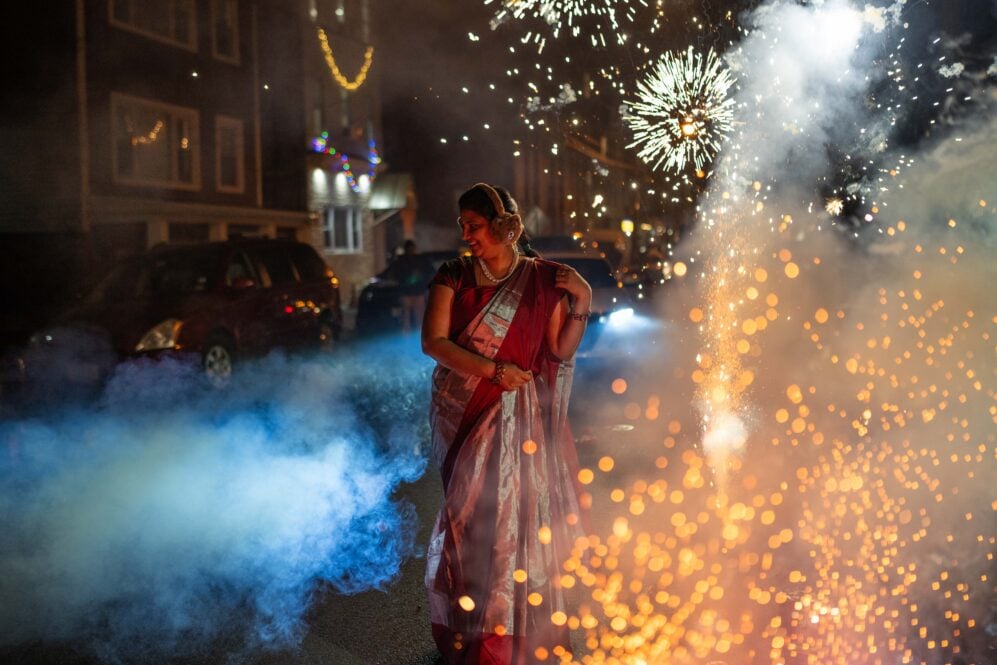
JERSEY CITY, NEW JERSEY - NOVEMBER 12: A woman stands amidst fireworks as they celebrate Diwali on November 12, 2023 in Jersey City, New Jersey. Diwali, also known as Deepavali, or the ''festival of lights'', is a popular Hindu festival that symbolizes the spiritual "victory of light over darkness, good over evil, and knowledge over ignorance." (Photo by Adam Gray/Getty Images)
Interfaith Resources & Stories
IA Emerging Leader Tahil Sharma, reflects on Diwali’s message of hope and justice and recounts the experience of attending a 2022 White House Diwali celebration.
“For years, my small apartment became a gathering space for Hindus, Muslims, Sikhs, and Christians as we observed Deepavali,” writes former IA fellow, Raja G. Bhattar.
The Power of Light is a shared theme across religious traditions in Hindus for Human Rights’ 2025 interfaith Diwali message.
Rachel Crowe, Staff Writer for IA Today, tells compelling stories about interfaith cooperation across diverse communities and supports our narrative programming. She is a graduate of Gettysburg College where she earned a BA in English with a Writing Concentration and a German Studies minor.
Interfaith America seeks contributions that present a wide range of experiences and perspectives from a diverse set of worldviews on the opportunities and challenges of American pluralism. The opinions expressed herein do not necessarily reflect those of Interfaith America, its board of directors, or its employees.
In honor of the Semiquincentennial, Interfaith America is excited to share a positive vision of our nation's future — out of many, we can become a new whole.
Subscribe to customizable email newsletters with articles, podcasts, events, resources, and grants from Interfaith America. We equip leaders to cooperate across differences for the common good on campuses, in communities, and in workplaces.