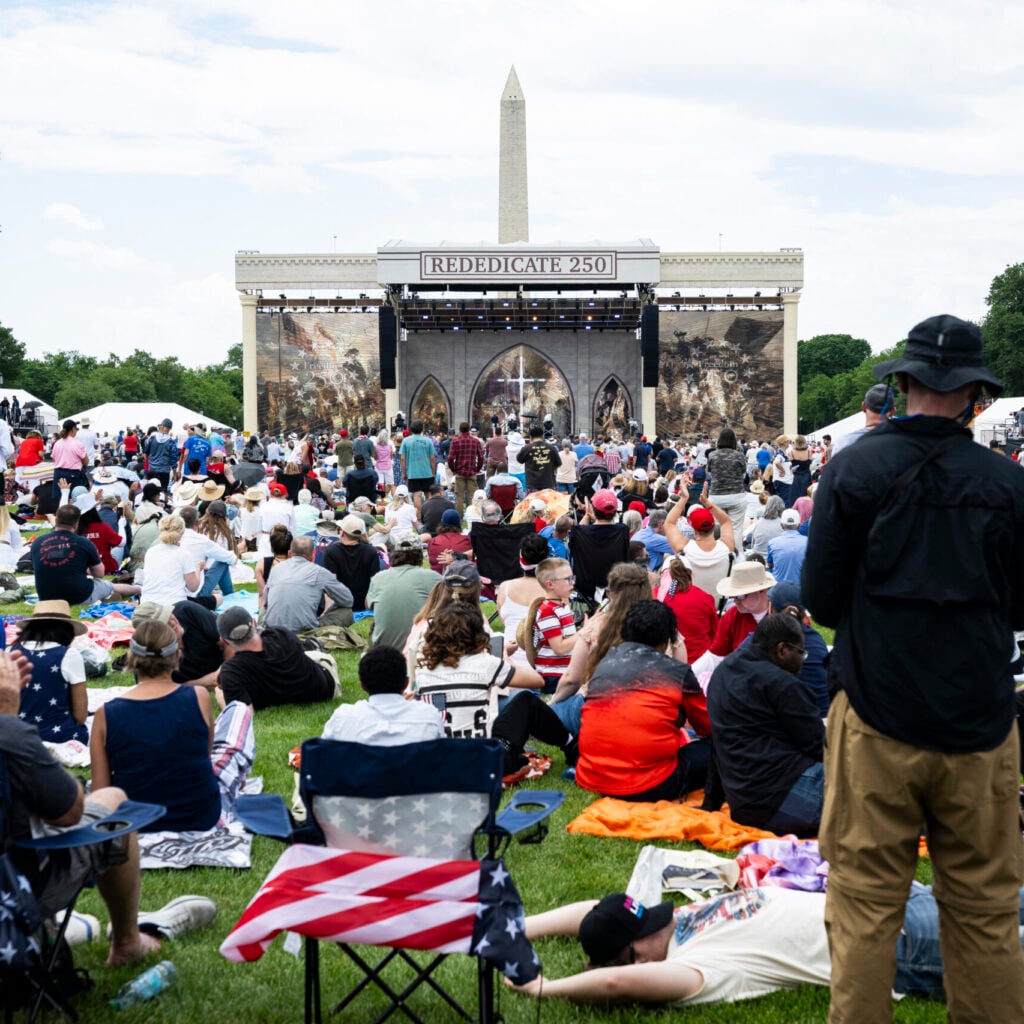
As part of America’s 250th anniversary birthday celebrations, leaders in Washington have posted an “America Prays” initiative, which hosted a “National Day of Prayer and Repentance on the National Mall” in May. In case you missed it, it represented a narrow slice of American religion and sought to claim divine favor for many of the Trump Administration’s policies.
That said, I have a confession that may unsettle some of my pluralist colleagues: I love many of the resources in the “America Prays” handbook.
The “First Prayer in Congress” from 1774 offers a valuable sentiment: “Be Thou present, O God of wisdom, and direct the councils of this honorable assembly; enable them to settle things on the best and surest foundation.”
The Jewish blessing offered for President Washington’s inauguration is equally powerful:
“Common sense, knowledge, and insight, bestow upon the head of our state,
May he act justly toward us, gladden our hearts, and bring us joy,
May he lead us on an honorable path,
May he continue, even into old age, to serve as our leader and judge.
May those who govern us do so with purity of heart and honor.”
Our national purpose also shines through Franklin Roosevelt’s D-Day Prayer and Martin Luther King Jr.’s 1963 prayer.
There is nothing wrong with Americans taking time this year to thank God for our blessings, repent our personal and collective failings, and ask for favor for our country.
It is not that these efforts focus too much on faith, but that they focus too narrowly.
So, what is the problem? It is not that these efforts focus too much on faith, but that they focus too narrowly. On our 250th birthday, we should broaden our view of history and better express our common purpose. America’s beautiful heritage is one of welcoming people of all faiths to contribute and creating the conditions for each to be able to freely express their beliefs. When the government focuses on “rededication” or “revival” with a narrow lens that feels driven by political beliefs — as it has consistently done this year — it betrays the very real contributions of people across religious traditions.
At first glance, a call for a state-supported Christian rededication might not seem like a problem for those of us who are pro-life, theologically conservative Christians, but this approach to faith in public life is limiting — even dangerous.
As Michael Wear, President and CEO of The Center for Christianity and Public Life recently wrote, “revival” is not going to come from government. The levers of power and the actions of politicians are poorly fit for creating a rededication toward the divine.
When politicians see themselves as a driver or source of religious revival, they are blurring the line between God and Caesar — which never ends well. Or, as the late Sen. John McCain joked in 2008, “Maverick I can do, Messiah is above my pay grade.”
Additionally, if the government expresses such narrow favor regarding religion, it causes harm to all others. If the government will only support, partner with, and contract with those who express political and religious alignment with them, they are going to disadvantage many faith communities. We have seen this in the way that the current federal government has taken sharp actions against Catholic, Lutheran, and Jewish nonprofit organizations who it deems insufficiently loyal to its immigration agenda. It’s all too easy to imagine the ways that ideologically driven faith initiatives from the federal government could one day disadvantage the very organizations that are in favor today.
The First Amendment instructs the federal government to avoid establishing a national religion and to allow for the free exercise of religion. Government’s secondary responsibility is to listen to and partner with communities of all backgrounds to promote the common good. In doing so, the government should avoid all forms of bias — whether it is anti-Christian, antisemitic, or anti-Muslim — in favor of representing the vast network of systems of belief in our country.
George Washington got it right when he wrote to the Congregants of Touro Synagogue in Newport, R.I.:
“May the Children of the Stock of Abraham, who dwell in this land, continue to merit and enjoy the good will of the other Inhabitants; while every one shall sit in safety under his own vine and figtree, and there shall be none to make him afraid.”
Religious liberty was at the top of the founder’s agenda and was their inheritance. It is ours, too.
If now is a time for rededication and revival, let it be toward this deeply American sentiment. Religious liberty was at the top of the founder’s agenda and was their inheritance. It is ours, too.
Chris Crawford is the Senior Director of Civic Strategies at Interfaith America.