
As part of its civic strategy, Interfaith America hosts conversations with faith and civic leaders about their perspectives on religious pluralism and religious freedom — two values that IA empowers leaders to support and promote.
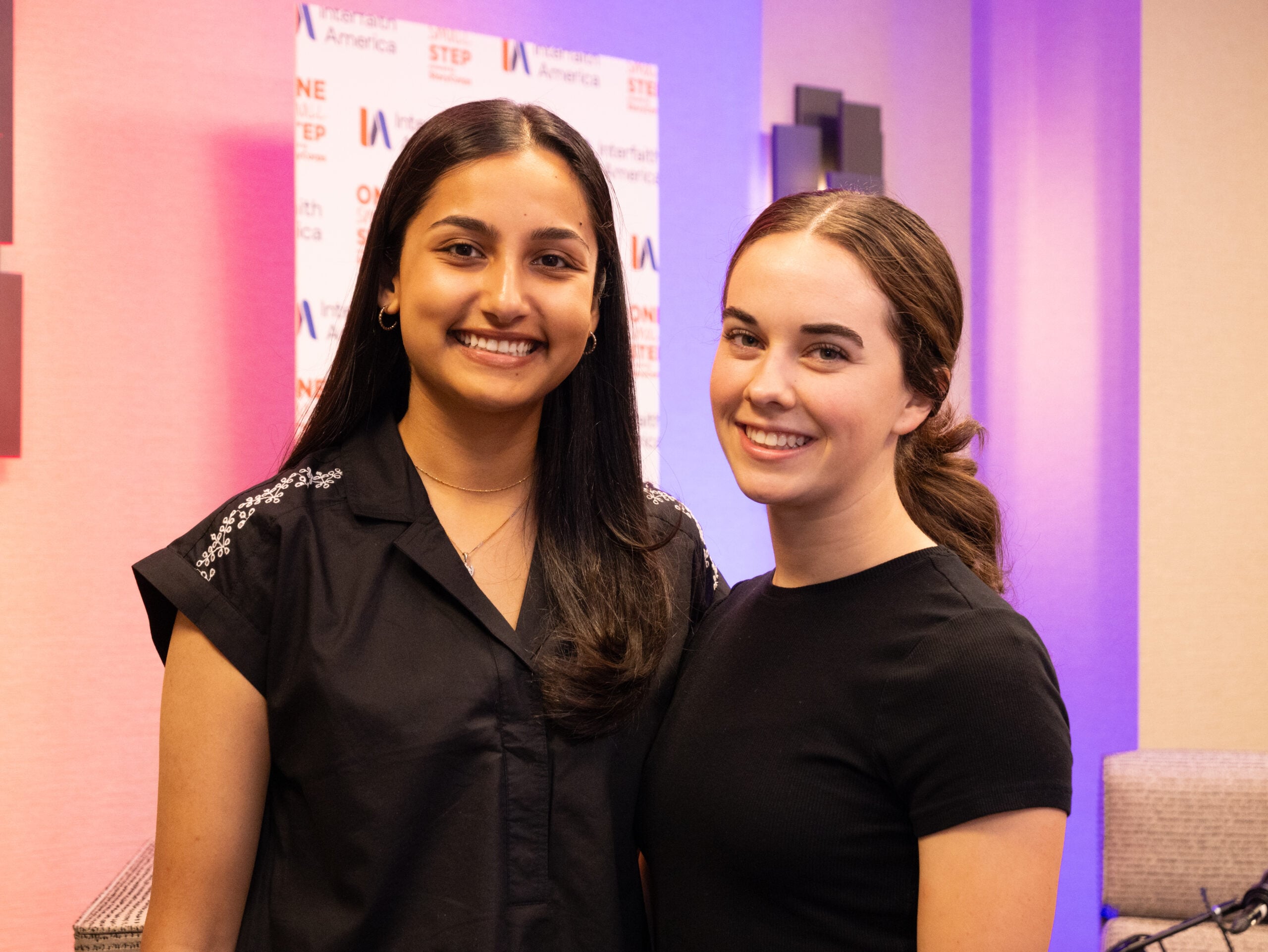
Interfaith America Senior Director of Civic Strategies Chris Crawford interviewed Sister Nancy Usselmann of The Daughters of St. Paul about her experience as a religious sister focused on media evangelization. She is the Director of Pauline Media Studies, a ministry that promotes media mindfulness catechesis for lived discipleship within the context of culture, education, and faith formation.
Editor’s note: This interview has been edited for length and clarity.
Chris Crawford: Given the media focus of The Daughters of St. Paul, you value both freedom of the press and freedom of religion. How do you think about these freedoms?
Sister Nancy Usselmann, FSP: Religious freedom is crucial. It is so important that there’s that opportunity and that freedom of speech and freedom of the press, the freedom to communicate ideas and beliefs. Without that, we wouldn’t be able to do the mission of evangelization in and through the media if we didn’t have that opportunity for religious freedom. We have sisters from all over the world, including in some nations where the freedom of the press or freedom of religion is rather suppressed and oppressed. They had a hard time doing the mission because there was a threat to religion, or that there was no freedom of the press. Being an international congregation, we’re well aware of the gift of religious freedom and freedom of the press.
Crawford: How do you think about your Catholic media ministry in the context of a pluralistic media environment?
Usselmann: We’re in a niche market of Catholic media and communicating to a Catholic audience. There are several millions of Catholics in the United States, at least. Being in Hollywood, it can be surprising to people to see a nun at film premieres or red carpet events. I am the lone Catholic and definitely the only nun on the carpet. I get varying perspectives on it. People are looking at me like, “Why the heck is she here?” I’ve heard some actors say, “I love this. Why is a nun here — this is great.” Or they come to me and say, “You know, I’m Catholic!” So, in a very secular environment, I think because we live in a culture and in a nation that prizes religious freedom, there’s no threat, really. It’s just surprising or exciting that a nun is there!
Crawford: I just have to note: You’re being modest. I know the “some actors” you are talking about include George Clooney! I’ve seen the video!
Usselmann: Yes, he kept looking at me and said, “Sister, what do you think?” Every time [another reporter] asked a question, George Clooney would look over at me and say, “Don’t you think, Sister? Don’t you think that’s right?” Gosh! I can’t imagine what his producer was thinking.
But this is the reaction I get from a lot of actors and producers and directors. I’m trying to bring out the depth of the story. Other interviews ask questions like, “What does it feel like to be revered?”, or “What are you wearing?” Or, “What does it feel like to be a sex symbol?”
The actors and actresses are artists. They want to share their craft. They want to share the depth of the story that reaches down deep into the human person. And they’re surprised when I ask questions that speak to that depth — even to the depth of spirituality… They love to talk about that, whether they’re practicing a faith or not.
Crawford: We often hear that bridgebuilding within faith traditions is even harder than bridging divisions across faith traditions. How do you think about this type of polarization?
Usselmann: It’s a really big struggle, because our faith and our faith values are intertwined with social values and social needs. Our faith should have something to say about the society and the way things are run and the way we work with the poor, the way we address other people, the way governments use funding for various social needs and social issues. But we are always going to have different perspectives of how that should happen.
Not that I think we disagree on the overall principle; the difference comes in how we do it. We’re always going to have this to some extent because we’re human beings, we’re going to have different perspectives. But I think even more than ever, it’s going to require us to take a step back before we say something, before we communicate, before we express ourselves, to be aware of what we are communicating, how we’re communicating it, and why we’re communicating it. Social media has kind of been the catalyst for creating more polarization because now we can just anonymously just respond to somebody, our opinion with absolutely no filters. I don’t know if we’ve caught up to that with our human values in the sense of, how do we have discourse with others?
Crawford: You operate in a Catholic context, but you’re also in a country where others have a right to different beliefs. How do you think about this in your day-to-day work?
Usselmann:. I’ve connected with so many different people who are not Catholic, but we have had open conversations, first of all, about the industry itself. Where is it going? What about faith-based media? We have had wonderful conversations.
I think it’s essential as a communicator, you can’t be just focused only on yourself. Even if we are about communicating the gospel and helping people to recognize or come to know Christ, to come to have an encounter with him, we’re not pushing it. We’re throwing it out almost as like seeds. And people have the freedom to listen to it or not, right? There’s no coercion happening. It’s really about free speech: put it out there. If there’s someone that it resonates with, then great.
I think that’s kind of the beauty in the sense of being in a pluralistic society, but a society that prizes freedom, especially freedom of religion and freedom to communicate. We shouldn’t feel offended by that. I don’t feel offended by whenever somebody communicates something. I’m like, “That’s great. But it’s not what I believe, but I respect that.”
Crawford: As we approach the 250th anniversary of the founding of our country, what are you hoping to see in the years to come?
Usselmann: I would love to see [it] a little bit more God-focused-on. Not that we put religion and force it into everything, but that there is a recognition that there’s a higher truth than my own. There is the truth, there is a natural law that we can follow…. I would just like a recognition of that in our world, in our culture — to kind of bring it back in some ways [to a focus on God] — while respecting everyone. Every religion wants to be able to express itself, wants to be able to communicate its message. But it’s problematic when it becomes where it’s forcing everyone to be a certain way. We can’t force faith on anyone, but we can present it. We can show it for what it is …There is a certain level of what’s right and wrong on a natural law level too, besides a supernatural level.
Let’s focus on what we have in common as a human family too, as human beings who all desire the freedom to live our lives, to grow, to have better lives. And I think that freedom is so crucial. And that’s what makes the United States so beautiful and so unique in the world, because it does prize that ability to have that freedom to live, to grow, have freedom of religion, to have freedom to better my life. I’m afraid in so many situations, there’s downplaying of that freedom. We have to bring it forward again: that this is what’s the beauty of the United States and the gift that we have living in this country, everyone living in this country. We have that freedom and we can’t take it for granted.
Chris Crawford is a lay cooperator with The Daughters of St. Paul, the religious order of which Sister Nancy is a member.