As part of its civic strategy, Interfaith America hosts conversations with faith and civic leaders about their perspectives on religious pluralism and religious freedom — two values that IA empowers leaders to support and promote.
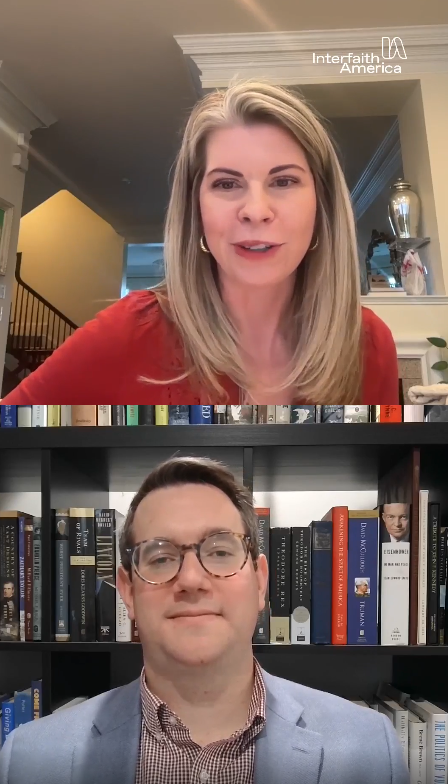
Interfaith America Senior Director of Civic Strategies Chris Crawford interviewed Cherie Harder, President of The Trinity Forum, former Senior Counselor to the Chairman of the National Endowment of the Humanities, and former Director of Policy and Projects for First Lady Laura Bush.
Editor’s note: This interview has been edited for length and clarity.
Chris Crawford: Given how much of your work and background have to do with history, how are you thinking about this “America 250” moment?
Cherie Harder: It’s hard to deny that we are in a difficult and contentious time in our country right now and there [are] many aspects of our current time that we’ve seen before and many that our founders and framers foresaw and directly addressed both in our founding documents and in a lot of correspondence that accompanied those documents. The appeal of populism, including authoritarian populism, is nothing new. It’s something they anticipated, they were very familiar with, [and] was really at the forefront of their minds.
Andrew Jackson comes to mind. There were many people that thought there was serious overreach by [Franklin D. Roosevelt] with the court packing scheme and with other things that happened. The attempts to overstep some of the traditional bounds — that’s not new. I think it’s something that has been corralled to at least certain degrees of success in the past.
What is new is the influence of social media and other technology. To be pulled towards the kind of fragmentation and loneliness and division — that really presents new challenges. So, I think we’re facing some challenges that are, I won’t say they’re “old hat,” but they are perennial to the human condition. But some of the ways that those challenges manifest, as well as the conditions that can make them particularly potent or hard to resist, are new to us.
Crawford: How do you respond to the claim that our democracy was fatally flawed from the beginning because of the way that it lacked inclusion and allowed slavery to continue, for example?
Harder: I certainly want to affirm part of the premise of your question, which is there were absolutely deep injustices at the beginning. The contract did not extend to all Americans. It extended only to a very small percentage of Americans. There were not only huge injustices that were seen and tolerated, but I think it’s fair to say there were remarkable blind spots on the part of — I think almost undeniably brilliant and wise — set of founders.
Where I would dissent from the people who reason that ergo the project itself is irredeemably flawed is that our framers did leave us really a remarkable construct that allows progress in the sense of being able to continue to not only just discern and recognize injustice, but address it. I will note that throughout our history often when those injustices have been addressed, it’s not been by trying to overthrow the framing of our country, but by appealing to it. The Seneca Falls Declaration is basically just quoting the Declaration [of Independence] and rephrasing it – and holding up a mirror to the men in power at the time to say, “You say you believe this and yet you’re not living up to this.”
The other area where I would dissent is that there’s kind of a utopian instinct at the basis of that, that somehow, we can get it perfectly right. I think the founders were onto something with the way that they understood human nature, which is self-interest, [that] our own biases do affect the way that we see things. If the founders had their own blind spots – and they certainly did – it would be kind of silly as well as rather arrogant to assume that we don’t have our own blind sports today.
Crawford: The topic of Christian nationalism is getting a lot of coverage right now. I’d be interested in any reflections that you have on that topic.
Harder: People mean different things by it. There are some people who seem to think that Christian nationalism is faith having any impact on the public square. And that’s a definition I would definitely dissent from. The thing that I think is far more concerning is Christian nationalism is more of a syncretism. I do think you see people very overtly and vehemently advocating for exactly that. One of the things we have learned from our American experiment is that the separation of church and state, as well as the protection of the free exercise of religion, [are] a really powerful combination that enables faith to flourish in the public square without being coercive. That’s what we should be striving for. There will always be people who will want to harness and channel the authority, power, and credibility that faith allows for their own ends. And there’s huge danger in that. The Christian nationalism that aims for that is a real threat and a real danger. It is also a real distortion of the Christian faith itself.
Crawford: If someone came up to you on the street and said to you, “I have a belief in Christian virtue and I’m not sure how that should cause me to relate to my neighbors who are not Christian,” how would you respond?
Harder: I would start with: what are the two great commandments that Jesus gave? Love the Lord your God with all your heart, mind, soul, and strength. The second is love your neighbor as yourself. I think it was Aquinas who said that to love your neighbor is to will their good. And that includes willing their good as someone distinct from yourself. So part of loving your neighbor is getting to know your neighbor; it is hoping for good things from them, becoming interested in them, listening to them, paying attention to them.
So many of the Christian virtues are not necessarily something set apart from the rest of the world, but part and parcel of just life on earth.
There’s a lot of pluralism that really depends on the virtues. I recently heard a speaker talk about a survey that found that young men’s aspirations boiled down to making money from crypto, gambling, and porn. And that’s really depressing if your vision of the good life revolves [these things], that is wanting wealth without adding anything of value or wanting sex on demand without investing anything in a relationship. Democracy and pluralism can’t sustain this level of entitlement because it’s a demand for goods without contributing anything. When that kind of demand for goods then gets mapped onto our demands of government, where we think government doesn’t work unless it gives us immediate social goods without friction …You are not preparing for the friction that happens when you have neighbors who are different from you. It’s going to take time and patience and accommodation and forbearance and grace. Without those, it’s basically impossible to live well with difference. And we’re an increasingly diverse country. It will require more of those virtues, more of a certain kind of civic character to be able to sustain a liberal democracy or pluralism itself.
Crawford: There are people who claim that virtues are nice, but we are not in a normal situation. We are in a high stakes environment where virtues like mercy and compassion do not apply. How do you respond?
Harder: You definitely hear that, don’t you? And you hear it not just on one side, but you hear it really on both sides. I would point to Martin Luther King, Jr. He did such incredible work on this. Part of what he addressed was a threat to him and his people far greater than what people are facing who make these claims about virtue. It was not a matter of turning the other cheek and backing down, it was a matter of lovingly pushing back. He fought against injustice and fought for equality, but he did it in a way that kept open possibilities for enemies becoming friends. And that’s a very different instinct than what you see a lot of today, which is a desire not just to win, but a desire to dominate, humiliate, and obliterate. And that desire to dominate and humiliate — even if you won a short-term battle, you often make an enemy that way. I think we also have to recognize that we’re fighting for justice as opposed to fighting for the domination and humiliation of our neighbors.