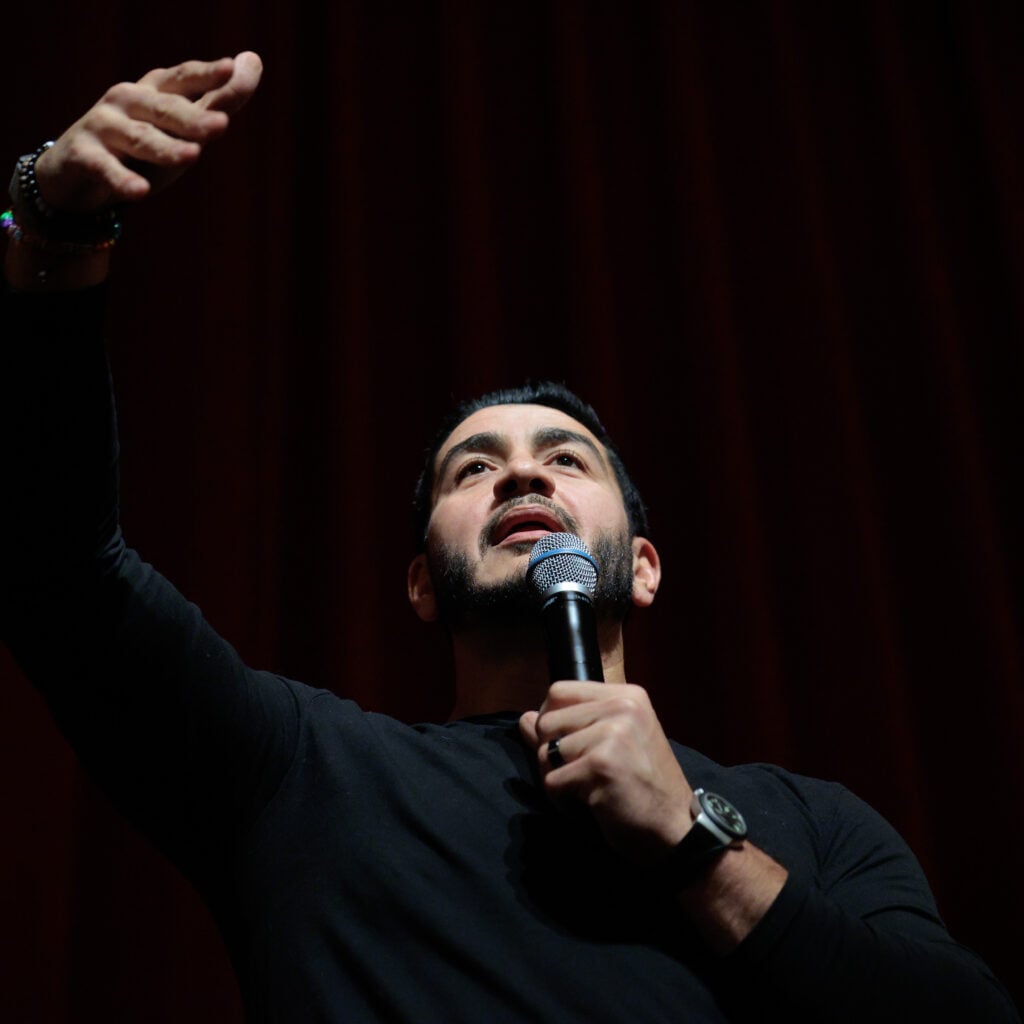
MUSKEGON, MICHIGAN - OCTOBER 11: Michigan Democratic Senate candidate Abdul El-Sayed speaks during a campaign event at the Frauenthal Theater on October 11, 2026 in Muskegon, Michigan. A progressive former public health director, El-Sayed has been polling ahead of his Republican opponent and former U.S. Rep. Mike Rogers, but the lead remains within the margin of error. El-Sayed could become the first Muslim elected to the U.S. Senate from a state that has not elected a GOP senator in 32 years. (Photo by Chip Somodevilla/Getty Images)
When a man identified as “Tommy” pressed Abdul El-Sayed at a town hall in Caro, Michigan, to disavow the Muslim Brotherhood, the Democratic Senate nominee answered without hesitation: yes.
He then challenged the premise of the question, asking whether the man was assuming that, because he is Muslim, he must have “dual loyalties.” After the exchange went viral, reports emerged that Tommy was a former political staffer.
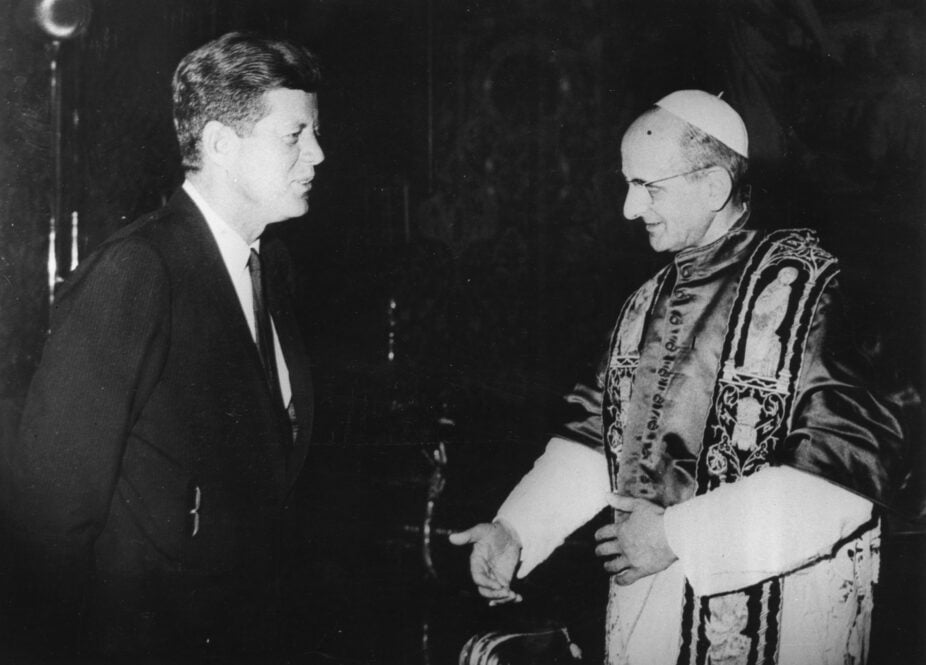
“I’m not running to be a Muslim senator,” El-Sayed said. “I’m running for the U.S. Senate and happen to be Muslim.” He was evoking John F. Kennedy’s original line a room of Protestant clergy in Houston in 1960 when they wanted to know whether a Catholic president would answer to Rome, “I am not the Catholic candidate for president. I am the Democratic Party’s candidate for president, who happens also to be a Catholic.”
2nd July 1963: US statesman John F Kennedy, 35th president of the USA, during an audience with the newly-elected Pope Paul VI at the Vatican. Kennedy, on an official visit to Italy, is the first Roman Catholic to be elected president of the USA. (Photo by Keystone/Getty Images)
I first heard that story when I was eight, sitting in the back of the car and flipping through a book about the presidents. When I got to Kennedy, my father proudly piped up that he was the first Catholic president. I could hear the joy in his voice, so I asked why that was special, and he told me the same story El-Sayed told this weekend, about a candidate who had to stand in front of his fellow citizens and assured them that his faith did not make him untrustworthy.
My father explained that we lived in an America where too many of our neighbors looked at religious differences and saw a threat rather than something the country could be proud of. I still remember asking him, on that same car ride, whether he thought another Catholic would be president soon. He sighed, took a beat, did the calculus every parent does about whether to be honest with a child about a hard thing. My father said, “Pray to Saint Jude —that might be an impossible cause.”
Thirty years later, when Biden was elected, I reminded him of that conversation and heard him laugh over the phone. “Honestly, it’s a miracle,” he said. “Chalk one up for St. Jude.”
Memories like this help us recognize an old accusation when it returns in a new form. Speaking to reporters in Flint the day after the town hall, El-Sayed described the charge of dual loyalty as something with “a long history in our politics,” aimed at people who “might pray a little bit differently.” Kennedy made the same argument to those ministers in 1960 by reminding them of their own past, pointing out that Virginia’s harassment of Baptist preachers had led to Jefferson’s statute of religious freedom, and warning that while a Catholic might be the target of suspicion that year, in other years it had been Jews, Quakers, and Baptists.
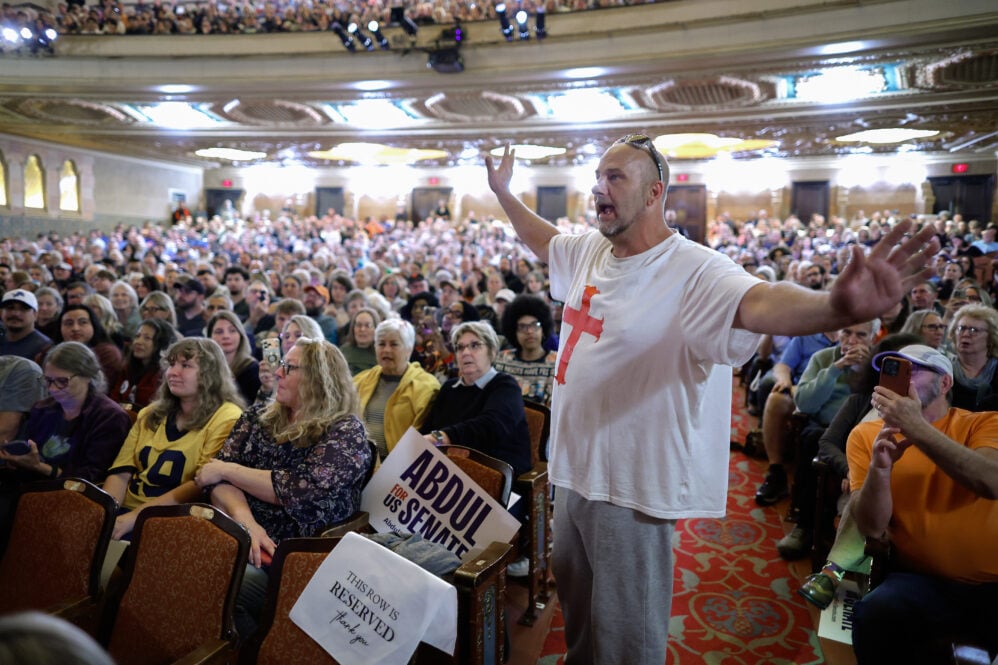
MUSKEGON, MICHIGAN - OCTOBER 11: A man calling himself James interrupts Michigan Democratic Senate candidate Abdul El-Sayed during a campaign town hall event at the Frauenthal Theater on October 11, 2026 in Muskegon, Michigan. Eventually removed from the theater by police, the man had attempted to crash another campaign event with far-right agitator Jake Lang a day earlier in Hart, Michigan. A progressive former public health director, El-Sayed has been polling ahead of his Republican opponent and former U.S. Rep. Mike Rogers, but the lead remains within the margin of error. El-Sayed could become the first Muslim elected to the U.S. Senate from a state that has not elected a GOP senator in 32 years. (Photo by Chip Somodevilla/Getty Images)
El-Sayed asked the man in that town hall to have the same kind of historical memory that Kennedy asked of those ministers — a willingness to see that the religious freedom often taken for granted had been won by people their own forebears once distrusted. The country’s commitment to it has been extended slowly and unevenly, often only after the communities on the outside insisted repeatedly that they belonged.
Remembering both parts of that history — the long record of suspicion and the record of Americans who kept pushing past it — is what keeps either one from passing for the whole story. The suspicion has moved from one community to the next across our history, and those of us whose families once lived under it have a particular calling to speak up when it lands on someone else, even if we share little in common, disagree on deeply important things, or pray a little differently.
Standing together does not have mean endorsing a candidate, and it does not require Michigan’s Muslim, Jewish, and Christian communities to set aside the real disagreements that are straining their relationships this year. But it does mean refusing the premise that a person’s faith is evidence against their love of the country or worth as a citizen. El-Sayed told the man in Caro that the Constitution is “the guiding light” for him and asked his interlocutor to consider why he was asking the question at all. What conclusions had he jumped to based solely on an assumption that a differing creed meant you don’t value being a citizen in the same way.
But we can take some encouragement from how this story has gone before. When I was eight, my father couldn’t honestly say whether another Catholic would ever be president again. By the time one was, the old question about whether a Catholic would answer to Rome has largely fallen away. History doesn’t promise that the suspicion El-Sayed faced this weekend will fade the same way, but it shows that it can. It tends to fade fastest when people are willing to ask themselves the question he put to the man in Caro.
When someone’s faith makes us wary of them, it is worth asking what we actually know about that person, and worth remembering that community after community once asked to prove its loyalty here has gone on to help shape what loyalty to this country looks like.
Susan Haarman
Susan Haarman is a Director of Campus Partnerships at Interfaith America.
Interfaith America seeks contributions that present a wide range of experiences and perspectives from a diverse set of worldviews on the opportunities and challenges of American pluralism. The opinions expressed herein do not necessarily reflect those of Interfaith America, its board of directors, or its employees.
In honor of the Semiquincentennial, Interfaith America is excited to share a positive vision of our nation's future — out of many, we can become a new whole.
Subscribe to customizable email newsletters with articles, podcasts, events, resources, and grants from Interfaith America. We equip leaders to cooperate across differences for the common good on campuses, in communities, and in workplaces.