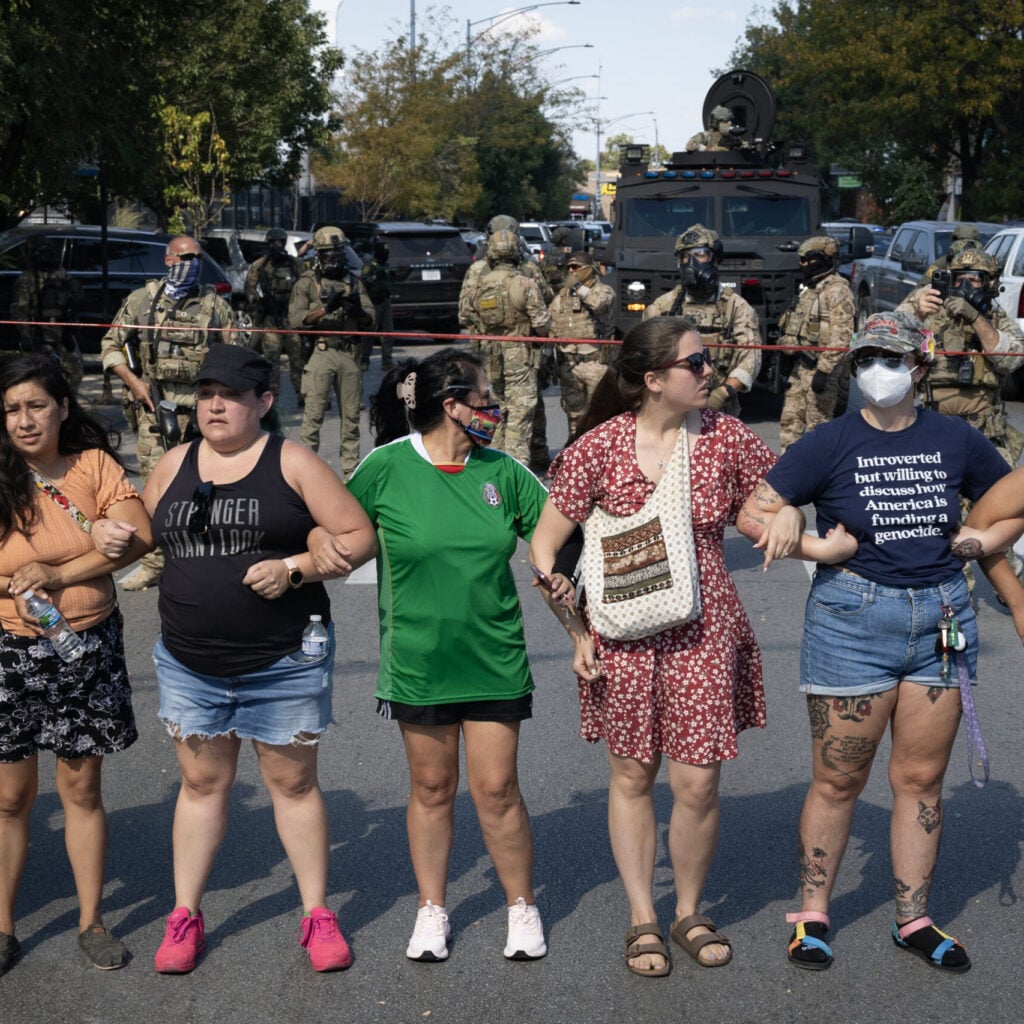
CHICAGO, ILLINOIS - OCTOBER 04: Community members and activists confront Federal law enforcement agents for reportedly shooting a woman in the Brighton Park neighborhood on October 04, 2025 in Broadview, Illinois. Residents of the city have become increasingly concerned as Operation Midway Blitz continues in the Chicago area, an operation designed to apprehend and deport undocumented immigrants living in the area. (Photo by Scott Olson/Getty Images)
I’ve lived in my neighborhood, Rogers Park, on the far north edge of the lake in Chicago, for nine years now. After a childhood with lots of moving around, it’s the longest I’ve ever lived in one place. Building real, enduring community here has been one of the great gifts of my life.
Every time I walk to the store and hear a classmate from my kid’s school yelling, “HI ANNABEL’S MOM!”, or go past the bar where I first met a now friend or hear someone who has spotted me across the street say, “What’s up, Pastor!”, it feels to me like a genuine miracle. I am grateful and surprised every time.
But recently when I walk around my block, I am haunted by sad and angry memories as well as joyful ones. I am seeing absences and hearing the lost voices of people who aren’t here anymore.
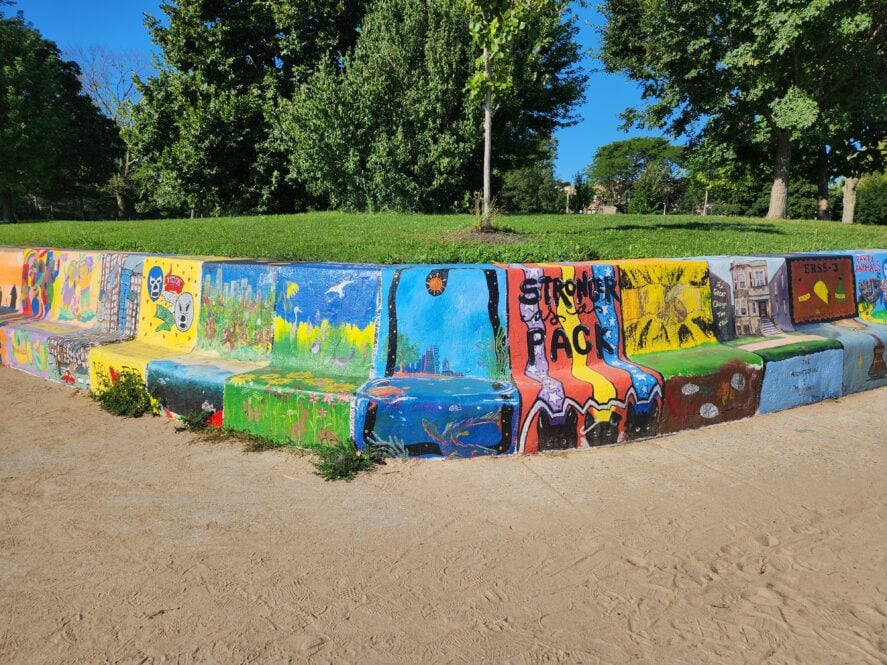
Chicago, IL, September 7, 2026, brightly painted concrete sea bench at Loyola Beach in the Rogers Park neighborhood, featuring community artwork created during the annual Artists of the Wall Festival. (Shutterstock/ChicagoPhotographer)
Last year’s Department of Homeland Security Operation Midway Blitz campaign to terrorize immigrants and those who love them devastated all of our city and suburbs. Rogers Park was hit hard. Someone was kidnapped from the alley behind our apartment. A corner where everyone gets their tacos is now also one where two neighbors were taken in the early days, torn away from community even as neighbors ran to the street just north and south trying to find a way to stop it. Here’s the apartment where a friend called a fellow faith leader in desperation, whispering as masked men stalked her door. One day, we lost ten people.
Almost everyone in our community, and in many communities across Chicago and the country, spent some part of the last year hiding in fear, mourning the taken, doing new and often risky things to try and protect each other, or all of the above. Many of us still are. I got notice of a kidnapping five blocks away this morning. The campaign to hurt and destroy has not ended.
To continue to live, to continue to serve, to ever make new realities of love and liberation emerge out of dangerous and hateful presents, we must continue to hope.
But if there’s one thing my faith has taught me, it’s that to continue to live, to continue to serve, to ever make new realities of love and liberation emerge out of dangerous and hateful presents, we must continue to hope. So, I have added some new stops to my walks.
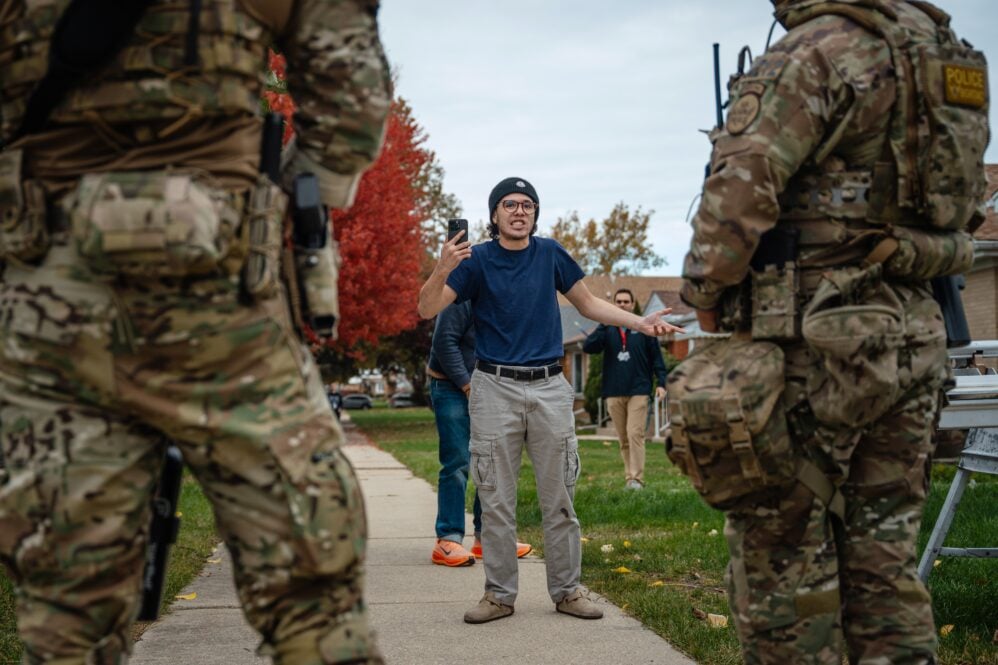
CHICAGO, ILLINOIS - OCTOBER 31: A young man confronts federal agents after they arrested a worker at a home in his Edison Park neighborhood on October 31, 2025, in Chicago, Illinois. Agents gave him two warnings and threatened to arrest him for interfering with their operation during President Donald Trump's administration's "Operation Midway Blitz," an ongoing immigration enforcement surge across the Chicago region. (Photo by Jamie Kelter Davis/Getty Images)
Here is the corner where every day, Rogers Park folks of every possible age and job and culture and life took turns standing with whistles to make sure people felt safer to go to the food pantry. Here is the sidewalk where parents would meet up with other parents’ children, once strangers and now given the most trusted task, to walk kids home so they could go to school when it was too dangerous for their loved ones to leave the house. Here, here is the place I ran to with church friends when we were in the middle of worship and heard whistles just outside our sanctuary door, to try and make noise loud enough that God Godself might hear our cry and send the cruel cowards in the ICE vehicles away.
That day was the same day I later learned the church across the street realized agents were waiting outside their door for worship to let out. An urgent call went out to the whole neighborhood, and people of every religion and mostly no religion at all showed up to hold hands, form lines, walk congregants to their cars, and prevent the planned attacks from taking place.
The next day, neighborhood organizers, completely religiously unaffiliated, texted asking if we could help find out the worship schedules for all at risk neighborhood faith communities. They wanted to (and did!) organize people who weren’t a part of those services to stand outside at all times of coming in and going out, so this could never happen again.
CHICAGO, ILLINOIS - OCTOBER 31: Volunteers in bright green vests walk the business corridor to monitor the streets during a Halloween trick-or-treat event in the Little Village neighborhood on October 31, 2025, in Chicago, Illinois. Families brought children in costume to local businesses for candy as Little Village, a predominantly Mexican neighborhood and major cultural and commercial hub for Chicago's Latino community, worked to keep the celebration safe despite heightened fears. (Photo by Jamie Kelter Davis/Getty Images)
People came together, putting aside whatever else could have separated them, and put their hearts and bodies on the line to protect each other.
Our corners are stalked by pain and loss. Nothing can change that or take away our devastation. But they are also constant reminders of the truth of our community — that people came together, putting aside whatever else could have separated them, and put their hearts and bodies on the line to protect each other. People chose community over fear. They chose courage over silence. They chose to believe in and build a neighborhood where we all can live together, rather than one where we choose groups to kick out one by one until one day there is no one left.
This is my faith. This is our country. This is our city, and our neighborhood, Rogers Park. A place where all people are of value. Where we defend each other. Where when someone tries to take us apart, we work to stay together. That is the community I know. And that is the community we will keep building.
Rev. Hannah Kardon
Rev. Hannah Kardon is the Pastor of United Church of Rogers Park, a United Methodist community in the greatest city in the world, Chicago. She lives in Rogers Park with her husband and two children where she bakes frequently, is a public library power user, and loves to run into a new friend.
Interfaith America seeks contributions that present a wide range of experiences and perspectives from a diverse set of worldviews on the opportunities and challenges of American pluralism. The opinions expressed herein do not necessarily reflect those of Interfaith America, its board of directors, or its employees.
In honor of the Semiquincentennial, Interfaith America is excited to share a positive vision of our nation's future — out of many, we can become a new whole.
Subscribe to customizable email newsletters with articles, podcasts, events, resources, and grants from Interfaith America. We equip leaders to cooperate across differences for the common good on campuses, in communities, and in workplaces.