
In 2023, Dr. Anna Boneberg and I were privileged to receive the Religion and Health Curriculum Grant from Interfaith America to create a new undergraduate course that married both our passions: religious studies and nursing.
Through this course, we garnered feedback from our nursing students at D’Youville University, and advocate for the incorporation of simulation as a transformative pedagogical tool to foster heightened cultural and religious awareness among learners.
Inspired by the efficacy of simulation-based teaching and fueled by our shared commitment to advancing religious literacy and intercultural communication skills, my colleague and I seized the opportunity afforded by the grant to craft a course with dual objectives: enhancing students’ comprehension and openness regarding religious diversity, and equipping them with the communication tools necessary to engage sensitively with patients on challenging topics while respecting their religious belief in a nursing context. For those unacquainted with simulation, it constitutes a pedagogical approach that replicates real-world scenarios in controlled environments that serve as a safe learning environment. Widely adopted across health-related disciplines, simulation offers learners the invaluable opportunity to apply theoretical knowledge in a safe setting, such as practicing medical procedures on lifelike manikins.
In our course, RS189: Living Well: Religious Competency and Healthcare Decisions, students are divided into two cohorts: those directly engaged in the simulation and those involved through observation from the dedicated debriefing room. The observation group observes the simulation unfold via live streaming on the classroom monitor. We hired simulated patients (i.e., professional actors/actresses) to increase fidelity (the level of realism to the simulations). Before the class, I met with the simulated patient and discussed their role, religious identity, and the ethical issue. The goal is for the simulation to reflect the world we live in, where they may encounter in clinic a patient that will refuse/challenge/question medical treatments due to religious beliefs and provide learners with the tools to respect the beliefs of the patient whilst conveying the prognosis and treatment clearly.
For example, in our simulation on Jehovah Witnesses and blood transfusions, I prepped our simulated patient to take on the role of a conservative Jehovah’s Witness faced with a health emergency. The students were tasked with conveying the prognosis and a treatment plan that included surgery, which may involve a significant loss of blood. The surgeon will not perform the surgery unless the patient agrees to a blood transfusion or bloodless medicine.
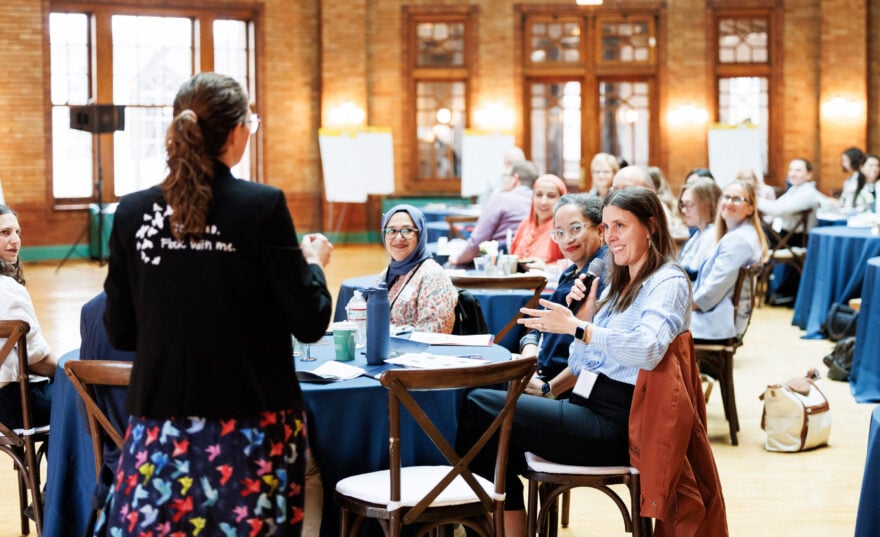
Following the simulation, all students convene for a debriefing session. My role in the debriefing classroom was to facilitate to help foster empathy and knowledge on a myriad of sensitive issues for religious patients, as well as to help students improve communication skills, and knowledge about the religions in our community.
Despite my years of teaching bioethics and religious ethics courses, I have never seen such genuine engagement and growth in compassion in my students as I did in this course. From the refusal of antidepressants on religious grounds to in vitro fertilization, cochlear implants, and abortion, our students confronted challenging topics head-on, learning not only about different religious perspectives but also how to provide competent and compassionate care in these scenarios.
One particularly memorable simulation tasked the students with role-playing an ethics committee convened to decide the fate of a critically ill preterm infant. Each student assumed a vital role, from primary nurse to attending physician, while I acted as the ethics committee chair and a simulated patient portrayed the hospital chaplain. After thorough preparation, including readings and lectures, students faced the scenario: parental disagreement over withdrawing medical care due to religious beliefs. As we deliberated, the actress challenged the students to consider the parents’ faith and the importance of respecting their values. Ultimately, my student’s collective decision emphasized being clear with the family the prognosis of the child was not compatible with life along with providing the option and support system for hospice care in a home setting, reflecting both medical necessity and religious sensitivity.
Some of the nursing students shared their feedback on participating in the course:
- Vanessa Miller (Class of 2028): My peers and I had some very emotional moments and deep conversations when handling topics which allowed for us to get closer and thus strengthen our program. It was a safe space to make mistakes and reflect on what we could have done to improve which is really important in simulation. Simulations allow us to make mistakes and learn from them before entering their field. As health care professionals we may not necessarily agree with the patient or know how to handle every situation but it is our job as health care professionals to provide the best possible care and this class definitely prepares us for that.
- Elena Mendez (Class of 2028): This class helped me to learn about verbal and nonverbal cues, diversity in religion, biotechnology, medical errors, and much more. This is crucial because it relates to the topics we will cover as medical professionals and provides us with information and understanding about how to approach various scenarios and appropriate role models to follow in order to provide a patient with a sense of security, comfort, and respect, while also treating them with compassion
If you are interested in learning more about this course or the simulations, please contact Dr. Walter N. Sisto at sistow@dyc.edu.
Dr. Walter N. Sisto is a Professor of Religious Studies in the Health Humanities and Social Sciences Department at D’Youville University. He received his Ph.D. in Systematic Theology from the University of St. Michael’s College in Toronto, Canada. Dr. Sisto has published extensively on a wide range of topics related to theology, bioethics, and healthcare.
Dr. Sisto’s research interests include religious diversity in healthcare, bioethics, and the work of the Russian Orthodox theologian and philosopher, Rev. Sergius Bulgakov, with a particular focus on his concept of sophiology. He is the author of three books and multiple articles on these topics.
Dr. Anna Boneberg is a Clinical Assistant Professor at the Patricia H. Garman School of Nursing, D’Youville University. She recently completed her EdD in Nursing Education at Teachers College, Columbia University. Her research focus is on active learning strategies including simulation and gamification.