
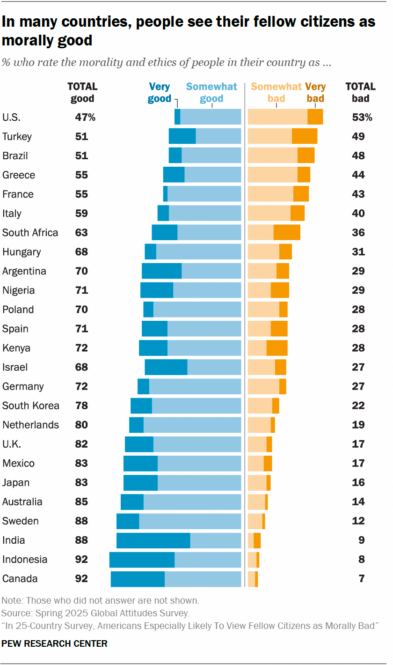
According to a Pew study released in March 2026, out of the 25 countries surveyed, Americans were the only ones who believe a majority of our fellow citizens are morally bad. We may not have always felt that way about one another, but the finding is pretty devastating. It suggests that many of us have lost our basic willingness to assume good intentions on the part of our neighbors.
There could be a number of reasons for this sad statistic. The drive toward authoritarianism is at least partly to blame; those seeking to consolidate power in the hands of a select few always seek ways to pit fellow citizens against one another. By scapegoating minority groups and sowing mistrust between different communities, ill-willed politicians can present themselves as the heroes who will save us from the problems they have themselves manufactured.
One of the ways that some politicians choose to emphasize our differences is along religious lines. The antidote to religious division is religious pluralism — embracing the fact of religious diversity in our midst. We Americans are a religiously diverse lot, and our comfort with that diversity — and other forms of diversity as well — will be what allows us to overcome those divisions.
There will always be things we disagree on, between and even within our communities. The goal is to find a way to shine a spotlight on the values we share and the solutions that will both unite and serve us all — and to refuse to fixate solely on that which divides us.
Fortunately, America’s founders provided us with incredible building blocks to pursue a strategy of religious pluralism. As America marks its 250th anniversary, we have an opportunity to celebrate these freedoms and to foster an even more pluralistic America in our next 250, one that seeks to truly realize our founders’ ideals. We must do this in three ways:
- Embracing religious pluralism as a value, by seeking to create a society that truly includes people of all religious and nonreligious backgrounds.
- Recognizing that religious pluralism can only thrive through protecting religious liberty, as enshrined in the First Amendment to the U.S. Constitution.
- Acknowledging that true religious liberty is only achieved when all people are free to live out their consciences without fear for their safety or well-being.

The American approach to religious liberty is one of the most amazing things about our country.
The American approach to religious liberty is one of the most amazing things about our country. Our founders envisioned a nation in which individuals could pursue their own consciences, choosing their own religious beliefs (or lack thereof) without compulsion. In America, religion can be fully expressed in the public square, but the state is expected to stay out of religious matters. A person’s religious identity has the potential to be far more authentic in America than in many other places because there is no political expectation to conform belief to the will of the state. Or at least, that was our founders’ dream, though it has certainly been flawed in its realization.
Discourse around religious liberty appropriately centers around the two protections enshrined within the First Amendment: the Free Exercise Clause that ensures freedom of belief and practice, and the Establishment Clause that ensures freedom from undue government intervention. Both are constantly under attack by those who would seek to impose their religious views on others, and both require constant vigilance and protection.
These fundamental First Amendment rights can only be realized for all if individuals and communities have the freedom to live without fear of violence because of their religious beliefs and practices. This kind of freedom is typically not a part of any discourse on religious freedom in the United States, since freedom from hate-motivated violence is not protected under the First Amendment, but elsewhere in our legal system. To be sure, federal agencies concerned about international religious freedom would certainly negatively assess a country with a prevalence of hate-motivated violence against houses of worship, individual religious minorities or the nonreligious. We must be willing to look inward and similarly align the lived reality of all Americans with the intentions of our legal protections for religious freedom. Americans must be able to enter our houses of worship freely and visibly and be able to publicly identify our beliefs without fear of bodily harm.
We must embrace this three-fold understanding of religious liberty:
As we look ahead to America’s next 250 years (insha’Allah, or God willing, as we would say in my own tradition), we must embrace this three-fold understanding of religious liberty:
First, we must recognize that religious pluralism is essential to our ability to come together to solve shared problems, a necessary ingredient of any democracy.
Second, we must zealously guard our First Amendment guarantee of free exercise of religion and resist the equal prohibition against the establishment of religion, along with any group’s insistence on using the government to impose its own religious views on another.
Finally, we must ensure that the lived reality of all people in America is aligned with these values, and all are able to live free from fear.
As imperfect as the last 250 years have been in our nation’s history, there is much to celebrate. And there will be still more to celebrate at our 500th anniversary, if we insist on getting there together, as a nation e pluribus unum — out of many, one.
Maggie Siddiqi is Senior Advisor at Interfaith Alliance, a network of people of diverse faiths and beliefs from across the country working together to build a resilient democracy and fulfill America’s promise of religious freedom and civil rights not just for some, but for all.
Build with Us
Interfaith America equips leaders to cooperate across differences for the common good. Sign up to receive free resources, funding opportunities, and event invites in your inbox!