During the 2024-25 school year, several cases at intersection of religion and education have risen through local and national courtrooms, from a Louisiana dispute over the Ten Commandments being placed in public school classrooms, to a suit challenging whether a Catholic charter school in Oklahoma should receive taxpayer funding, to a debate in Maryland over religious exemptions from public school lessons including books featuring LGBTQ+ characters.
As pending litigation prompts conversation about the separation of church and state and the freedom of religious expression in the classroom, Interfaith America connected with Chicagoland area schools that offer innovative religious diversity curricula and demonstrate the power of teaching about religious pluralism. These programs prove that “religion in schools” ought not be indicative of devotional study, binary assertions or discordant communities. In their own unique ways, these schools and educators offer more nuanced understandings of a diverse array of faith traditions with attention to lived experiences of people of faith.
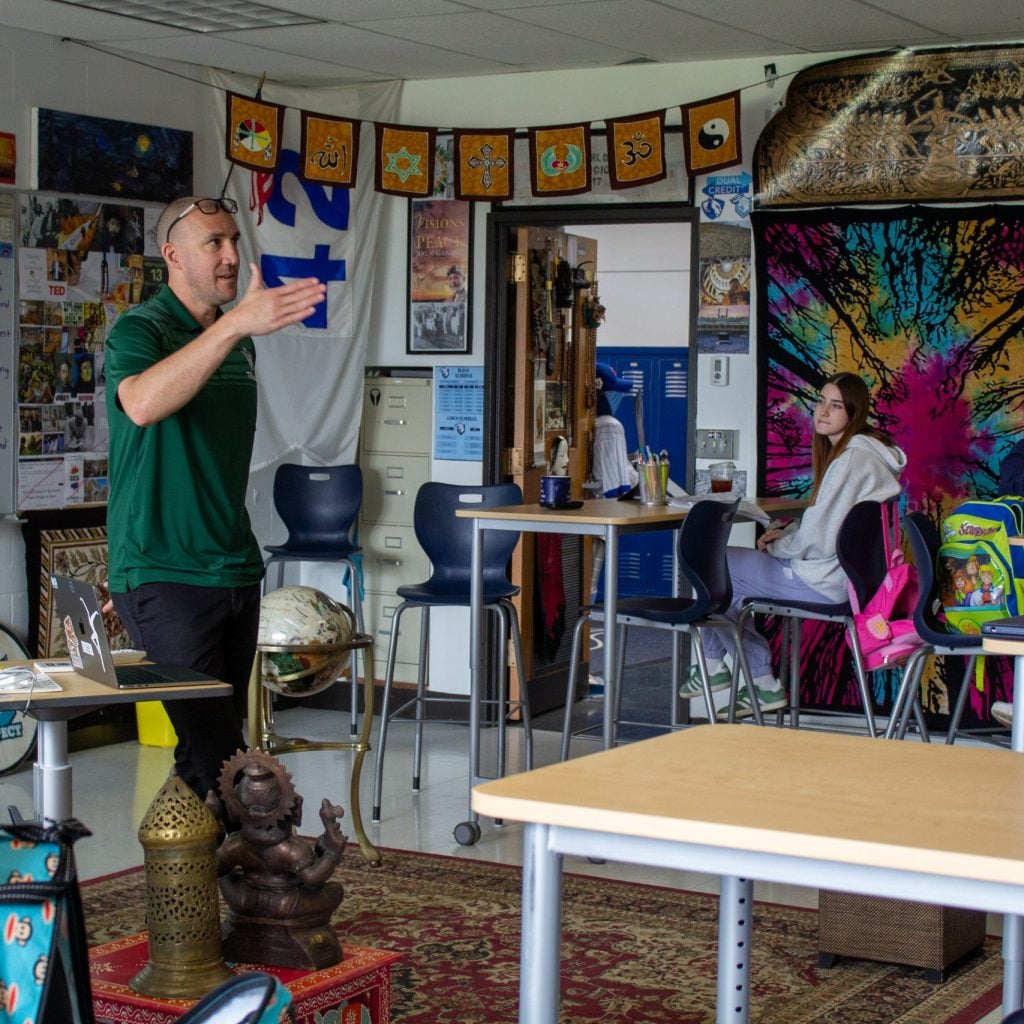
Mount Prospect High School’s College World Religion class is a highly sought-after elective course for seniors. This year, as in a typical year, more than 130 seniors at the suburban public high school in Mount Prospect, Illinois enrolled in the class, and there was a sizable waitlist to join.
The course’s popularity can be attributed, in large part, to the leadership and encouragement of its teacher and curriculum developer, John Camardella, referred to by his students as “Cuba.” This nickname, he explained during a second period class one Friday earlier this spring, he earned when first hired at Prospect High in 2003 while finishing up his undergraduate research on the first of nearly two-dozen international trips he’s since taken in pursuit of religious studies.
“I took this class because I heard about it from past students,” one senior shared, “I had cousins who went here and talked about how amazing Cuba was. And I really wanted to get to know him as a teacher and just as a person.”
“Because religion is an important thing in my life, I was interested in hearing about other religions…”
Several students also cited their own faith backgrounds as reasoning for interest in an elective religion course. For one, it wasn’t despite his own religious identity that he enrolled in a class that explores religious diversity and the cultural and historic significance of other faiths, but precisely because of it. “I went to Catholic school all my life,” he shared. “Because religion is an important thing in my life, I was interested in hearing about other religions, but also, like, just see what’s similar and what’s different.”

Since 2003, Camardella has built a flourishing religious studies curriculum at Prospect High and aided in the expansion of similar programs in schools across the United States. College World Religion is now offered as a dual-credit course in conjunction with Eastern Illinois University, where Camardella also serves as adjunct faculty. During his tenure at Prospect High, he matriculated through Harvard’s Religion and Public Life (RPL) Fellowship, and helped develop additional guidelines for religious studies as part of the National Council for Social Studies’ C3 framework standards.
Student-centered learning and the adoption of RPL’s Cultural Studies Method position College World Religion to explore the internal diversity of religious traditions and allow students to think critically. It also equips them to enter college classrooms or work settings where they can respectfully engage with one another across difference.
“I would say that what we do in our academic setting is realize that religions don’t speak. People do.”
“I think a lot of times when people talk about religion specifically, they put agency in the institutions. They put agency in the religions.” Camardella shared, citing the mentorship of Associate Dean of RPL, Diane Moore, and religious scholarship of Donna Haraway as inspiration for this mode of understanding. “I would say that what we do in our academic setting is realize that religions don’t speak. People do.”

In contrast to polarizing discussions of what it means to “teach religion in schools” in a deeply divided political landscape, Prospect High models constructive engagement of religious diversity and a commitment to the academic study of religion, creating space for students to bring their whole selves and experiences to the classroom with a common goal of understanding, and not necessarily agreeing.
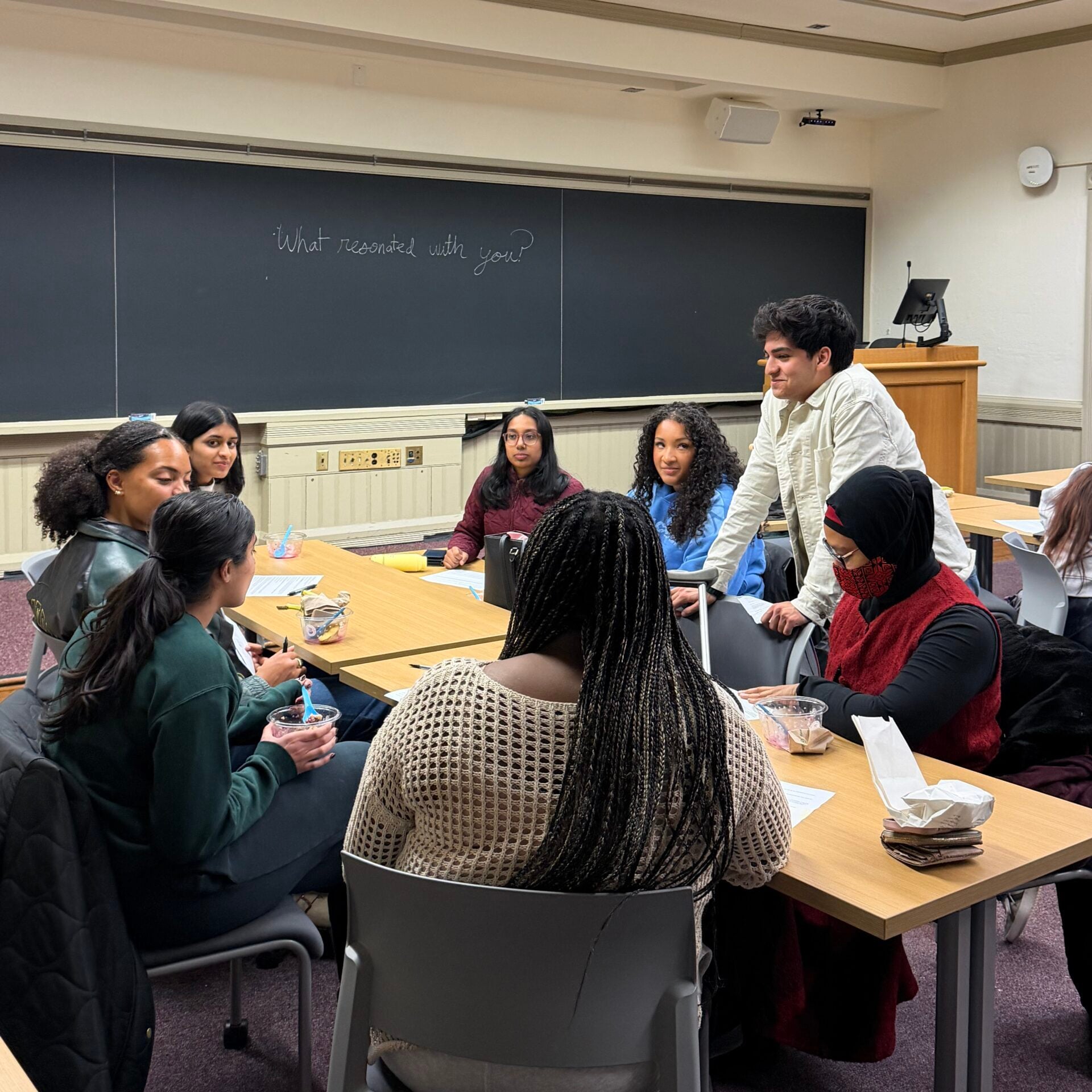
When asked what motivated them to take World Religions, one student remarked: “This class is very discussion based. I feel that we kind of learn off of each other, on top of the curriculum. And I feel like that’s just not something you get as much from other classes.”
As the Prospect High World Religion seniors looked to commencement this spring, the course’s final project invited them to pursue a case study research paper and presentation relevant to their own personal interests. In high school environments of this digital age, where there is a temptation to withdraw from community and avert attention to any number of platforms vying for teens’ attention, this model encouraged them to channel their curiosities — inspired by future career pursuits, pop culture interests, and two semesters engaging with case studies of diverse faith traditions — into the work.
Case study topics in Prospect’s second period class ranged from portrayals of Muslim women in Western media, to the indigenous origins of lacrosse, to the very subjects pervading contentious school board discussions: faith practices taught in school and religiously motivated book bans in K-12 settings.
Met with the challenge of reintroducing Prospect High’s unique curriculum to new administrators, parents, and district community members over the years — especially in an era of increasing ideological polarization — Camardella is committed to the work of engaging his community at the local level.

In addition to his responsibilities at the high school, Camardella is working as a teaching assistant for Harvard’s extension school, regularly instructing graduate-level courses for public educators, and consulting organizations and educational institutions building their own curricula. He also offers free lectures on religious studies for parents and community members.
“It really lowers the temperature,” he stated, in reference to the effectiveness of sessions, which he has offered every three weeks for the past 10 school years. They help to subvert what he describes as “this inherent belief that we’re doing something nefarious here, or like, anytime religion is dealt with in schools, there’s some hidden agenda” and inspire his transparency about the course and the concerted effort to make public-facing presentations through his website, engagement with media, and annual live streams where his classes present their final project research.
“What gives me hope is that we have kids who are willing to sit with each other and engage and talk”
Prospect High, its surrounding community, and the countless other schools and institutions that have adopted a similar commitment to religious literacy speak to the promise of pluralism and the future of cooperation for the common good. “What gives me hope is that we have kids who are willing to sit with each other and engage and talk,” shared Camardella. “I think most of them are aware that peace and justice is a worthwhile endeavor to spend your life working towards. Not agreement, but understanding, so that all people can live in peace and a just society.”