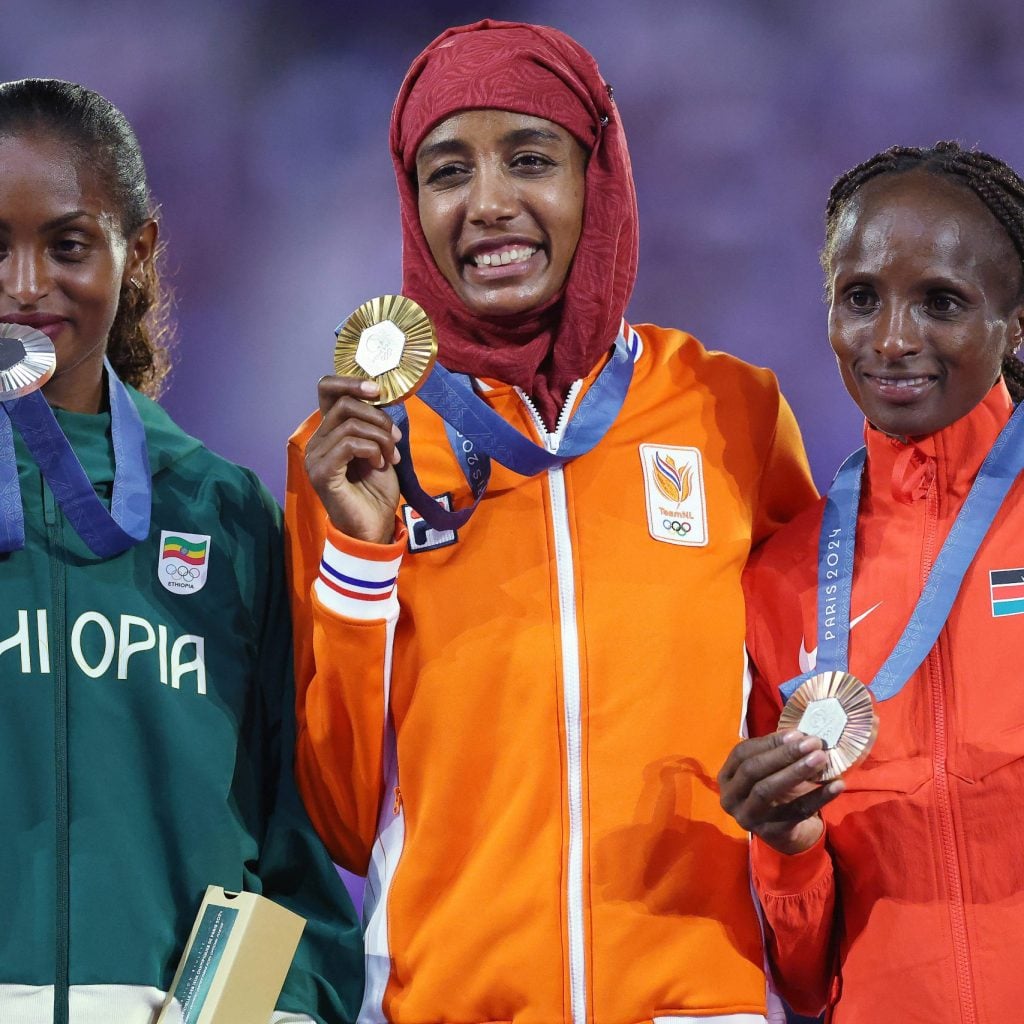
There has been no end to the incredible stories of this year’s Paris 2024 Olympics. Türkiye’s Yusuf Dikec stole the show with his low-tech, casual shooting style, winning a silver medal in the 10m air pistol mixed team event with partner Sevval Ilayda Tarhan.
Gymnast Simone Biles and her “redemption tour” dominated the games’ week one (and two). Egypt’s Nada Hafez made it to the round of 16 in women’s individual saber fencing competition while seven months pregnant. USA Today made the case that middle and long-distance runner Sifan Hassan of the Netherlands (who originally hails from Ethiopia)’s Olympic feat was the greatest in the history of the summer games, medaling in the 5K, the 10K, and eking through in the final minutes of the grueling marathon on the last day of the games to take the gold – all three races run within 142 hours of each other.
One of my favorite images from the last few Olympics has been the juxtaposition of the Egyptian women’s beach volleyball athletes playing opposite whatever country they come against, wearing hijabs, leggings, and long-sleeve T-shirts while opponents often wear bikinis. Given France’s ban on hijabs and the wearing of religious symbols and clothing in the public sector, it felt incredibly satisfying this year watching Egyptians Marwa Abdelhady and Doaa Elghobashy compete in all-black against Spain on August 1.
“I want to play in my hijab; she wants to play in a bikini,” Elghobashy said in this article. “Everything is OK if you want to be naked or wear a hijab. Just respect all different cultures and religions.”
But for France, the last few decades have seen the country’s ongoing targeting of religious visibility, especially when it comes to Muslims and Muslim women and how they dress, all in the name of laïcité, or the constitutional principle of secularism. And as the Paris 2024 Summer Olympics placed the country squarely in the world’s spotlight, the hijab ban enforced upon the host nation’s Olympics team just wasn’t a good look on the international stage.
Problems began even before the Opening Ceremonies when it was reported that French Olympic sprinter Sounkamba Sylla wouldn’t be permitted to participate because of her hijab.
The 26-year-old member of France’s 400-meter women’s and mixed relay teams wrote on Instagram before the start of the games, “You are selected for the Olympics, organized in your country, but you can’t participate in the opening ceremony because you wear a headscarf.”
A compromise was reached after consultation with the French Athletics Federation, the French Ministry of Sports, the Paris Olympics organizers, and the French luxury brand Berluti (which made the uniforms for the French team). So, what was Sylla allowed to wear instead of the offensive hijab? A cap.
Which begs the question: Why was a cap OK and not a hijab? Why do the optics of certain types of headwear and clothing matter? And also, why does the intent behind wanting to dress modestly matter so much in France?
French basketballer Diaba Konate, who helped take the University of California, Irvine, to the NCAA tournament this year for the first time since 1995, sat on the sidelines because she couldn’t play for the French national women’s team in her hijab. Meanwhile, the German gymnastics team debuted full-body suits for their athletes competing in the Olympics, saying modest options should be available to athletes.
In 2024, why is this even an issue? Why are visual representations of faith an anathema to France’s fierce love of secularism? When hosting the biggest international sports competition, should an athlete’s choice of a certain kind of uniform, whether stemming from a personal preference for bodily modesty or wanting bodily modesty rooted in religious convictions, matter when hosting the biggest international sports competition?
I spoke with Rim-Sarah Alouane, a researcher in comparative law with the University of Toulouse who has studied and written numerous analytical pieces on the history of France’s hijab, niqab, burkini, and abaya bans.
She said several issues are at play. “You have the anti-Muslim racism and hijab shenanigans going on in France, but on top of that, we have to address misogyny and women’s rights. Muslim women are like guinea pigs – [France] tests the restrictions out on them.
“[And then there is] selective feminism, which is extremely harmful to women of all minority backgrounds, not just Muslims. I find it quite triggering and ironic how women will say we need to free women from patriarchy and wearing the headscarf, and at the same time [they] impose patriarchy by saying you have to dress a certain way,” Alouane said. “At the end of the day, it’s about women’s rights, women’s agency. … So, it’s not about laïcité. If you can accommodate a Muslim female athlete in the opening ceremonies with a cap, then it’s not about laïcité. It’s about political will.”
France is unusual in Western democracies in its ongoing efforts to define and control cultural expression, Alouane said.
In an article she wrote last year detailing the history of the country’s banning of religious dress and expression in the public sector, she said, “A national argument over how Muslim women [in France] should look had raged since the beginning of the 1990s when several female Muslim students were expelled from state schools for wearing a hijab because the coverings were incompatible with the principle of laïcité, … [which] is central to the French identity.”

France’s history of suppressing religious freedom (which disproportionately affects Muslim women) goes back to its history of deep animosity and suspicion towards the country’s relationships with the Roman Catholic Church, Alouane explained to me in a previous interview I did with her a few years back. In understanding this push-pull history between religion and a secular state, one can gain a greater understanding of why hijab ban amendments and laws, as well as a rise in Islamophobia, has been a constant issue in France, especially in the past two decades.
Beginning with the hijab in 2004, the French government has banned (in various sectors of public life) the niqab (2008, 2010), burkini (2016), hijab in sports competitions (2022), and abaya (2023). In the lead-up to the 2024 Paris Games, I (along with so many others) wondered how they would address their hijab ban when athletes from around the world arrived for two weeks of Olympic competition. In France, it is up to the individual sports federations to decide on hijab (and religious clothing) bans, Alouane explained.
For example, she said, the French Football and Basketball Federations have such bans, while the French Handball Federation does not.
France couldn’t impose hijab, and other religious or modest dress bans upon international athletes. But for French Olympic athletes wishing to wear hijab (or other religious symbols as part of their athletic uniform)? No such luck.
“It shows how France is still going after the visibility of Islam when, for most [other] countries, it’s a non-issue,” said Alouane. “Australia has hijabi Olympic athletes; the U.S. has had them in the past. There is clearly a double standard. And at a time when the games are supposed to celebrate gender parity, it just doesn’t sit well.”
I gained more knowledge about hijab bans in France and around the world during my nearly six years as the director of content and blog editor at Haute Hijab, where the company launched a #CantBanUs campaign in September 2020 in conjunction with the release of its first-ever sport line of hijabs. “Part of our company ethos is empowering Muslim women,” said Haute Hijab marketing manager Noor Suleiman, “and so one of the things we researched and learned about was hijab bans in sports.”
Over the next four years, the Haute Hijab team worked with several sport’s governing bodies to educate them about the functionality of sports hijabs, helping to change the rules around religious headwear for a few high school sports nationwide. In covering these stories and reporting on hijab bans and the problems around forced hijab-wearing, I wondered how France would reconcile its hijab ban with international athletes who chose to wear hijab at the 2024 Olympic Games.
The “how” was answered months before the start of the games, with one set of standards for French athletes and another set for all other Olympic athletes. “How is imposing non-religion on someone any different than imposing religion? The same thing they hate and claim to combat (outward expressions of religion in the public square) is literally what they’re doing by banning visible Muslimness,” said Suleiman.
With the Olympic games at a close, this story will die down, and France will emerge from the games relatively unscathed, with its bans untouched. But I remember a Open Letter written to the French Basketball Federation on March 8, 2024, International Women’s Day. It was signed by more than 80 athletes and allies, including American Olympic fencing medalist Ibtihaj Muhammad and WNBA’s Breanna Stewart. It urged France to overturn its hijab ban and uphold international human rights standards and laws.
“I love basketball, my family, and my faith,” French basketball player Konte said in the letter. “It would break my heart to give up any of these, and yet that is what the current French Federation of Basketball guidelines are forcing me to do.” Konte’s hand was forced to choose, and she missed out on the Olympics in her home country. That is a travesty to the motto of the Olympic games: “Faster, Higher, Stronger – Together.”
But perhaps, in what felt like a bit of temporary redemption, the most lasting image from these games, one that feels especially apropos given France’s bans on hijab and religious clothing in the public sector, will be of Hassan, who received the last Olympic gold medal on the last day of the games. She chose to wear a maroon hijab with her bright orange tracksuit, creating a striking image and statement in France.
It was nice to see Hassan receive her medal with grace and respect, beaming with a beautiful smile—that was the optics of poetic justice at its finest.
Dilshad D. Ali is a Senior Columnist for Interfaith America Magazine.