Of the eight primary pagan sabbats observed in the Wheel of the Year, the best known is Samhain (pronounced SOW-wen). You probably know it by its more popular name: Halloween.
These days, the secular celebration of Halloween is marked by pumpkin carving and trick-or-treating. Brought over to America by Irish immigrants in the late nineteenth century, the celebration slowly became secularized, losing much of its original meaning in the process. Samhain originated as a Celtic festival, and it marked the beginning of the Celtic New Year. In the modern pagan celebration of sabbats, Samhain is the third and final harvest festival, falling after Lughnasad in August and the autumn equinox in September. It is the halfway point between the equinox and the solstice, a point of transition between one season and the next. It is also the point where the Triple Goddess — a figure found frequently in pagan circles — becomes the Crone, the third incarnation beside the Maiden and the Mother.
Like its sister holiday across the calendar, Beltaine, Samhain marks a time when the veil between this world and the next is said to grow thin. Fairies, goblins, and spirits of the dead were thought to walk among the living, often leaving mischief in their wake. The masks and costumes now worn on Halloween originated with a need to trick these devious spirits into leaving you alone by making them think you were one of them.
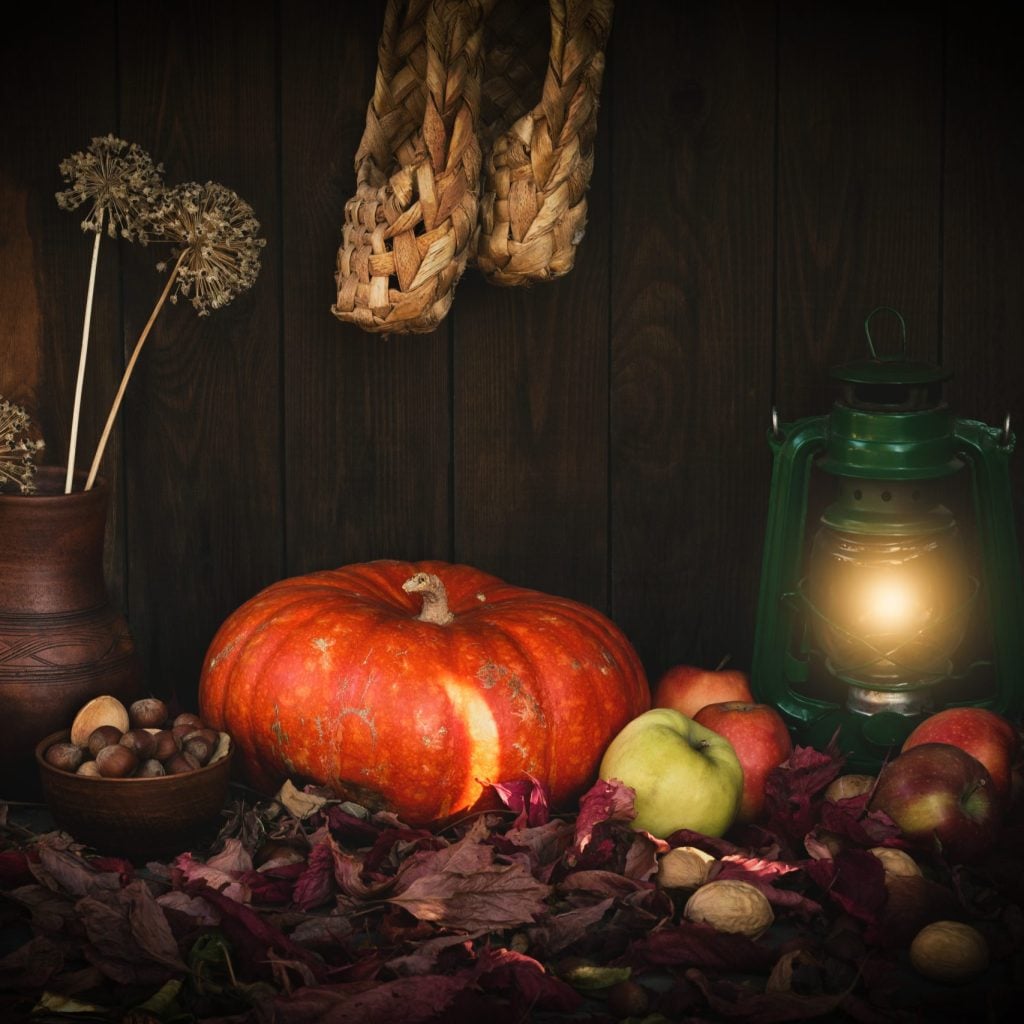
For modern pagans, this thinning of the veil is something to be honored. In the lead-up to Samhain, many pagans decorate their altars with pictures of deceased loved ones, symbols of the underworld (like pomegranates), animal bones, and lots and lots of candles. I usually decorate my own altar with a black altar cloth and fallen leaves from our neighborhood trees. Covens and circles often hold feasts, honoring the long tradition of food for the dead by leaving an empty place for spirits and ancestors. Other pagans use the night of Samhain to practice divination using mirrors, Tarot cards, runes, and other tools.
In many ways, Samhain is a holiday about memory.
My own Samhain practice is usually a solitary one, but I once attended a Samhain circle many years ago. The leader of that circle had set up different altars around her house and asked attendees to bring photos or objects representing loved ones who had died. I brought photos of my grandparents to set upon that particular altar, placing them amongst photos of deceased friends and family of other attendees. It is the first time I can remember feeling that Halloween was not fun or frightening, but sad. Each of us proceeded through the house, moving from altar to altar, in their own silent contemplations of the past.
In many ways, Samhain is a holiday about memory. During this time, we remember those who have gone before. For some, that contemplation can be a fraught one. It’s something I’ve long struggled to reconcile about this particular sabbat. Not everyone has good memories of our ancestors, and not all deeds done in the past deserve honoring. It’s tempting to turn away from such memories entirely. But between choosing to ignore the painful parts of our past or facing them, I still think it better to face them. In the solitude of Samhain night, after the trick-or-treaters have gone home and the last flames have burned out in the jack-o-lanterns, it’s worth at least acknowledging the past, if not honoring it, so that we can learn from it.
Samhain is a moment to look both forward and back, as the Wheel of the Year turns towards its darkest time (at least in the Northern Hemisphere).
This year, as I celebrate Samhain, I’m seeking a way to acknowledge the past with consciousness and clarity. Samhain is a moment to look both forward and back, as the Wheel of the Year turns towards its darkest time (at least in the Northern Hemisphere). I will lay out my altar with fallen leaves and photos of my lost loved ones, and I will consider how I got here, how we got here, and how I can help make the world a more just and equitable place moving forward. I will honor those ancestors who shaped who I am, and I will remember that acknowledging something happened is not the same as paying homage to it. I will put on my finest witch’s hat, hand out lots of candy, and compliment lots of costumes. And I shall wish everyone who comes to my door a Happy Halloween.
Julia Pillard is a writer and pagan living in Colorado. She received her master’s in English literature from the University of Colorado at Boulder, where she studied the gothic literature of the eighteenth and nineteenth centuries. Julia also writes fiction as J.C. Pillard. Find her work at jcpillard.com.