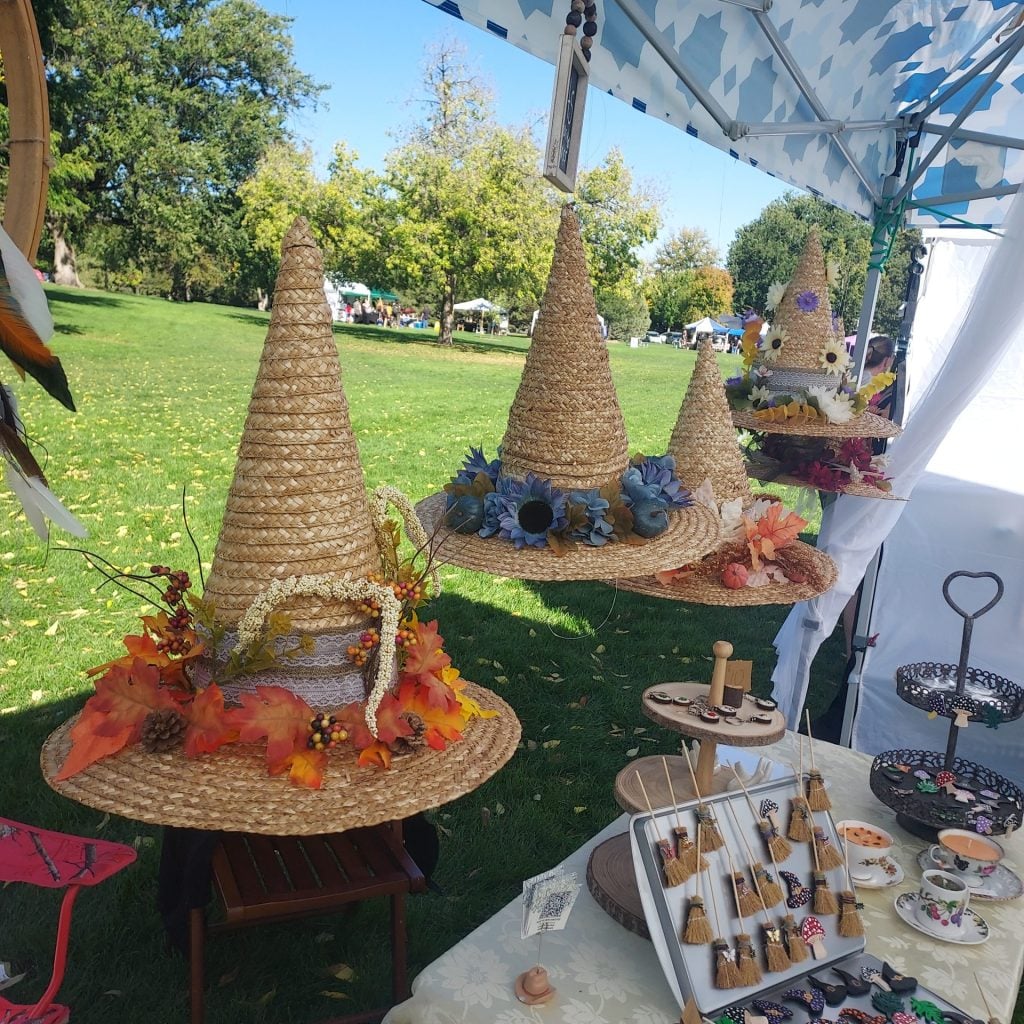
It is a warm day in October, the sun hot in a near-cloudless sky, when I get out of my car near Fort Collins City Park. I’m wearing all black — purely by happenstance — and I can feel the heat bearing down on me as I walk towards the sound of drums and flutes and people talking. Cresting a hill, I catch sight of canvas tents, witches’ hats, and a few food trucks. The hallmarks of the annual Fort Collins Pagan Pride event.
I’ve been to a few of the Fort Collins Pagan Pride Days over the years. The first time I stumbled into it purely by happenstance. Since then, I’ve tried to attend more regularly. Being a solitary practitioner of paganism, it’s one of the few times during the year that I’m able to connect with the local community, and perhaps pick up some incense and candles to refresh my altar.
“There is a thriving pagan community between Cheyenne, Wyoming, and Greeley, and all along the front range down to Denver,” says Jordan Beard. He’s the organizer behind the Fort Collins Pagan Pride event, a jovial man in a tie-dye shirt and a ready smile. “There’s quite a variety of us, and there’s quite a number of us. I think [events like this] are a great thing for the community, particularly for newbies who don’t know where to find a circle for themselves.”
Jordan started Fort Collins Pagan Pride about a decade ago, after volunteering with Denver Pagan Pride. He had some ideas to change the Denver event, and while the organizers of that pagan pride weren’t interested, they did propose that he start his own event up in Fort Collins. The first Fort Collins Pagan Pride took place in Civic Center Park before quickly growing larger and moving to Library Park. “At the time, we were actually the weekend after Bohemian Nights,” Jordan tells me, referencing the large music festival that takes place in Fort Collins each year in August. “One of our big things is to always do a trash pick-up after our event, to make sure we don’t leave any trash behind. We ended up actually picking up Bohemian Nights trash, like, the entire day. So, the city really loved that, because they continued to schedule us the week after the festival every time.”

Then, three years ago, the event became so big it had to move again, this time to City Park. One of the challenges in the move was building a stage, since the event frequently features live music. Jordan tells me, “Fort Collins is big on a free concert. Getting people in is pretty easy when you’re offering live music in the middle of the day.” The goal — with the music, the vendors, and the food trucks — is to attract not just pagans, but people from outside the community as well. “One of our biggest elements is not just helping the pagan community connect, but also to educate non-pagans about what paganism is and what it is not,” Jordan says.
The question of “what it is not” comes up a couple times during my walk through the park. Gwen Heifner, who is a priestess with the Church of Witchcraft in Lincoln, Nebraska, tells me, “We get a lot of negative ideas of what people think witchcraft is…Outside of these festivals, we hear, is this evil? No!” She laughs. “Mostly it’s community and self-help. That’s, like, half the spells that people do.”
The good news from Jordan’s perspective is that many non-pagans who come to these events are very positive and want to engage in a dialogue. He tells me a story of a father whose kid had recently converted to Wicca. After visiting the event and talking to different vendors and circles, the father approached Jordan. “He tells me, ‘I’ve had such a great time learning this stuff’,” Jordan says with a smile.
Later, when I ask Jordan if he wants to make the event bigger, he replies enthusiastically that he does. “This is a very large park, we can expand. If you ever go to the Denver Pagan Pride event, it is much larger than this in space. They will have hundreds of vendors and four or five workshop areas. I’d like to get as big as that.”
At the end of our interview, I ask Jordan what he’d like people to know if they’re thinking about attending a pagan pride in their area. He pauses for a moment before answering. “I would like them to know that they’re going to meet some very interesting and very fun people. I would like them to know that it is not only okay but encouraged to ask questions.” Then, he laughs.
“And I would like them to bring their sunscreen and a water bottle,” he says. “Safety first!”
Julia Pillard is a writer and pagan living in Colorado. She received her master’s in English literature from the University of Colorado at Boulder, where she studied the gothic literature of the eighteenth and nineteenth centuries. Julia also writes fiction as J.C. Pillard. Find her work at jcpillard.com.