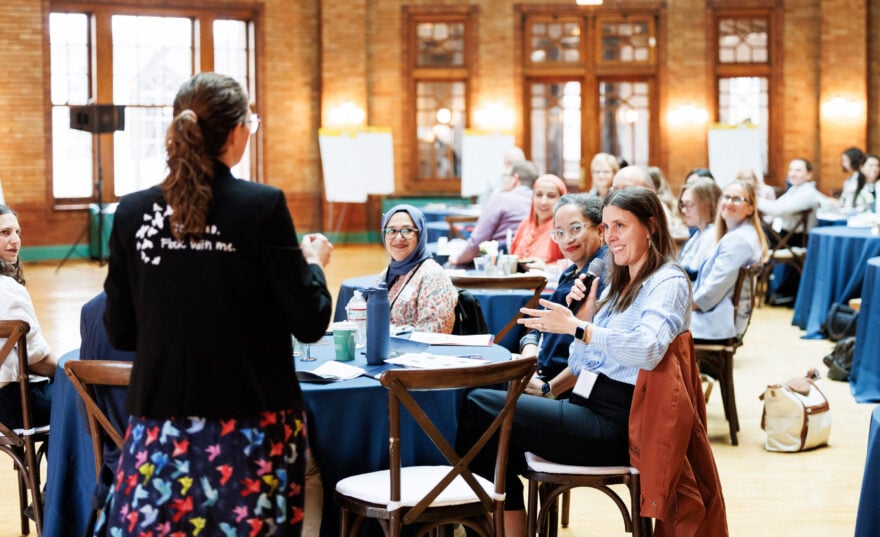

Sumreen Ahmad shared this speech at the gala dinner at the Religious Freedom & Business Foundation’s Dare to Overcome conference on May 21 at the Catholic University of America in Washington D.C.
Thank you for the opportunity to share some reflections this evening as we celebrate the incredible contributions of faith inclusion in our workplaces.
Since starting in this journey almost two decades ago, I believe it is safe to say that the world around us has shifted dramatically.
At its inception, faith inclusion wasn’t launched with a strategy deck.
It started with one person’s desire to hold a Bible study.
With travelers seeking prayer space while working in a new city.
With support to accommodate people’s schedules to support Ramadan or for those observing Sabbath, simply seeking room to honor what is sacred.
It began because people saw a need — and chose to fill it.
And it grew. Slowly. Steadily. Authentically.
At Accenture, we are living proof of what’s possible.
With nearly 12,000 members across dozens of chapters, with ERGs that span Christian, Muslim, Hindu, Jewish, Sikh, Buddhist, Baháʼí, and None/Atheist/Agnostic voices, we built a blueprint for what true intra- and interfaith inclusion looks like in practice.
And yet, today, we find ourselves at an inflection point.
Where the words diversity, equity, inclusion, belonging go from unfamiliar… to foundational… to, now in many spaces today, contested.
The world feels more polarized than ever. Fear, suspicion, and division threaten to erode the fragile progress we’ve made. And some of us — myself included — have asked hard questions:
After decades of work, I am left to wonder: Have we truly moved the needle? Have we truly succeeded? Has our impact endured?
There are moments that make us doubt — when a prayer space goes unused because an employee doesn’t feel safe to show their beliefs.
When silence follows a faith-based hate crime.
When policies are in place, but the culture still whispers: “Don’t bring that part of yourself here.”
When our commitment to dignity is tested by fear.
These moments matter. They test our sincerity.
Admittedly, I was in one of many of my own moments of crisis in January 2024 – where I found myself weeping in front of the Prophets mosque in Madina – questioning how after committing so much of my career to creating spaces for people to see each other beyond the harsh stereotypes we are fed – that my own colleagues could not see past the piece of clothing that was on my head to what was actually in my head. And how was it that I could find myself spending so much time having to hear my own co-workers justify their belief that all Muslims are terrorists and deserve to be wiped off this earth?
And in that moment of despair and uncertainty — I had to ask myself not only where do I go from here – but more importantly – pushed me to dig deep to question why did I even began?
As the cold breezes of the Madina winds blew perspective and humility through me, I was abruptly reminded of my own teachings. That this is neither about me, not the outcomes. Not to win arguments or fall into last word syndrome, or even impose my personal beliefs. Rather that the Prophetic journey of transformation was one of character refinement and renewal of intention.
My reflections not only from that moment — but a conviction reaffirmed from two decades of lived experience and interactions led me to the following reset:
Faith inclusion will endure.
Not because it is strategic.
Not because it is expected.
But because when anything is rooted in sincerity and intention, it will transcend policy, it will transcend politics, but more importantly will speak directly to our shared humanity.
As a Muslim, I was taught early on: “Your actions are judged by their intentions.”
That’s why I believe this work cannot — and should not — be performative.
It must be sincere. Grounded in purpose. Driven by the desire to serve, not just to signal.
And this isn’t a belief unique to Islam.
In Christianity, the Gospel of Matthew says: “By their fruit you will recognize them.” In that faith is lived through action — in love, justice, and humility.
In Judaism, the call to tikkun olam — to repair the world — demands that belief and action go hand-in-hand, especially in the face of injustice.
In Sikhism, the principle of seva, or selfless service, teaches that the highest devotion is in uplifting others without expectation — exemplified in the shared tradition of langar, where everyone eats together as equals.
Across these and many other traditions, we are called to rise above ourselves — and lead with virtue in service of the greater good.
So I remind myself not of the big corporate ambitions, reliant on CEO memos or dependent upon executive orders, but instead in the day-today moments — what does this look like in a polarized workplace?
It shows up when your colleague, who during a tense discussion, reminds the team that every voice holds dignity — and models the radical empathy their faith teaches.
It’s when your teammate who notices the newcomer feeling isolated — and without fanfare, ensures they feel seen, included, invited. That is seva in action.
And it’s when your manager who leads visibly and unapologetically from their faith, even in difficult times — is defending not only their own beliefs, but those of others, because the dignity of work is a shared value.
It shows up when your collective efforts create an environment where we can courageously challenge systemic bias — not out of defiance, but out of duty to pursue justice and equity.
These are the everyday acts of courage, of compassion, and of quiet integrity that remind us: leading from a place that honors interfaith inclusion to achieve true pluralism is not just a concept — it’s a calling.
Pluralism is not about erasing difference. It’s about navigating it — with respect, dignity, and grace.
It’s about understanding that our faith is not just personal, it’s powerful.
Not just a source of solace, but a source of leadership.
Now, I’ll be honest, this moment is not easy. And yet, the answer is not to retreat.
It is to recommit , more intentionally than ever.
I started in my corporate career with a stern reminder by my father, who told me, “Your faith will be your path to serving humanity. If your work is not grounded in your faith, you’re not serving your purpose. Because only when you serve, do you truly lead.”
That truth has not changed.
Not 20 years ago. Not today. And it is precisely why faith inclusion must endure.
Because it reminds us, especially in moments of polarization, how to navigate difference with dignity.
Because it calls us to meet each other not with suspicion, but with empathy.
Because it challenges us to model leadership rooted in virtue, not vanity.
And here is the truth:
The foundation we’ve built in our shared spaces — across interfaith networks, global chapters, and values-based leadership — is not fragile.
It’s resilient. Because it’s built not on trend, but on truth.
It’s sustained not just by budgets or benchmarks, but by belief.
By Christians, Muslims, Jews, Sikhs, Hindus, Buddhists, Humanists, and seekers alike, all showing up with sincerity.
All striving to lead with purpose.
All anchored to stay true to their own tradition and teachings and yet walking shoulder to shoulder toward a shared future.
So, where do we go from here?
We go back to intention.
We go forward in pluralism.
We continue to build workplaces that are not just diverse, but deeply humane.
Where the sacred is honored.
Where difference is met with dignity.
Where faith becomes not a point of division — but a bridge to deeper understanding.
This is not just about inclusion.
It’s about transformation.
It’s about living from our values and giving others the courage to do the same.
And ultimately, it’s about being what the world so desperately needs right now.
Because when our interfaith communities come together — not just side by side, but heart to heart — we model a better way to lead in our teams, our organizations, our communities and the world. A way that refuses to polarize. A way that listens. A way that serves.
To each of you out there doing this work, remember that you are and can continue to be a force for good. A force for each other. A force for your colleagues, teams and leadership. A force to serve humanity.
Be the change you wish to see in the world.
Thank you.
Sumreen Ahmad is a Director in Accenture’s Talent & Human Potential practice focused on leadership and talent transformation, culture and change management and nonprofit organizational development. She also serves as a Board of Directors Member at Interfaith America. Sumreen was recognized as the Employee Resource Group (ERG) Leader of the Year by the Religious Freedom Business Foundation (RFBF) in 2023.