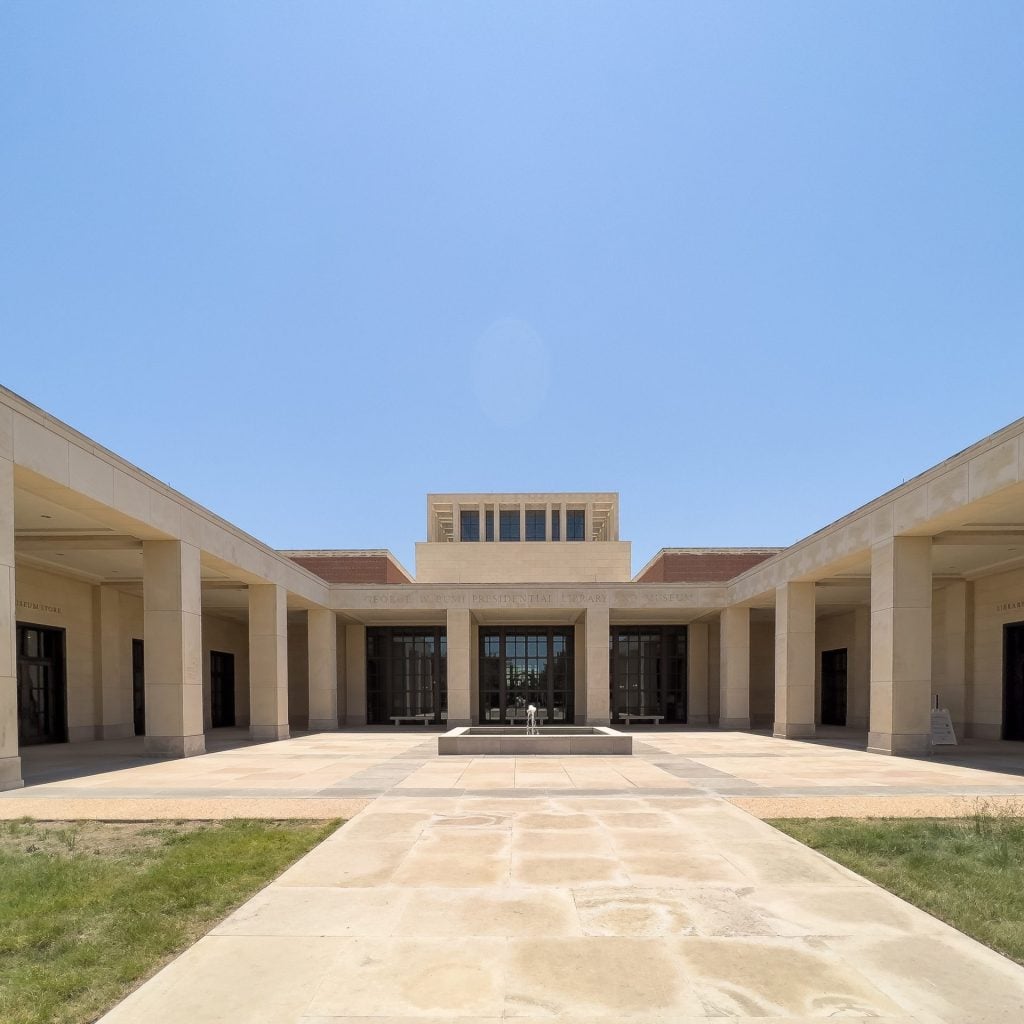
As a Massachusetts native, Chris Walsh’s move from the East Coast to Texas nearly 13 years ago represented more than just a career relocation.
Growing up in a relatively apolitical household in a blue state, gave Walsh a unique advantage when it came to navigating diverse points of view, whether among extended family members with a broad range of political persuasions or in his early career work supporting democratic institutions globally at the bipartisan International Republican Institute (IRI) in Washington, D.C.
“My whole life has really been living in between these two worlds of right and left,” said Walsh, who now serves as the Director of Global Policy at the George W. Bush Institute in Dallas.
Walsh came to the Bush Institute by way of international politics, and, with his experience in democratic governance on a global scale, has in recent years helped guide the Institute’s programming to strengthen democracy domestically.
This includes an initiative called “The Pluralism Challenge,” an online multimedia platform that, as stated on its website, “explores the nature of pluralism and how it’s working in our country.”
The series was born out of an observation by Walsh and Bush Institute colleagues that folks from all different backgrounds – old and young, and from both sides of the political aisle – were expressing a “crisis of confidence” in American democracy and, based on a 2021 survey by Philanthropy for Active Civic Engagement, an ambivalence or unfamiliarity with the idea of pluralism.

The programming is aptly named, and according to Walsh, though it is by no means easy, the work of pluralism is well worth pursuing, and crucial to American civil liberties and freedom.
“Pluralism is important in this moment,” Walsh told Interfaith America, speaking on the significance of cooperation across difference in our current, deeply divisive political context. “But perhaps the reason it’s so important in this moment is because we have forgotten or we have taken for granted as Americans how important pluralism is to every moment, and to the founding, of our country.”
Reiterating the Bush Institute’s understanding of pluralism as “social tolerance” for every kind of person, Walsh points to the more taxing aspects of democracy-building: acknowledging that tolerance ought to extend even to irreconcilable differences and suggesting that societies benefit from diversity of thought — even, and especially, among ideological peers.
He expands on the latter in his recent piece in the Houston Chronicle, How to Escape Groupthink, a contribution to Interfaith America and The New Pluralists’ Together, We Stand project, in which he writes:
Cultivating a sense of personal pluralism – holding views not always consistent with our politics – is one way to navigate tensions as our country recently inaugurated a new president. Doing so helps us to better engage with opponents because we’re not limiting ourselves to a narrow political identity. From there, we can more rationally consider the strengths of opposing viewpoints, acknowledge weakness in our own, and embrace opportunities to meet in the middle.
Walsh has certainly developed a sense of personal pluralism of his own, shaped by his experiences growing up on the East Coast, working in global politics, and practicing his Catholic faith.
“When you’re talking to someone, that person represents themselves. They don’t represent a larger political group. They don’t represent a group of people. You know, I’m Chris from Texas, but I don’t represent all Texans.”
Collaborating with and drawing inspiration from figures like Governors Spencer Cox and Jared Polis and their Disagree Better initiative as well as BridgeUSA’s CEO Manu Meel, Walsh offers his own philosophy for putting pluralism into action. “When you’re talking to someone, that person represents themselves,” he shared. “They don’t represent a larger political group. They don’t represent a group of people. You know, I’m Chris from Texas, but I don’t represent all Texans. I represent Chris’ views. It’s a way to start to depolarize, I think, to take a breath and really reflect on what we’re doing and how we’re engaging in conversation.”
He’s hopeful that, despite how college campuses are portrayed as hotbeds of polarization, the future of pluralism is bright, and young leaders really do want to engage with those who think differently than them, citing former Bush Center intern and Southern Methodist University student, Anna Kelly Zielke, who authored a children’s book about bridging divides.
Walsh is quick to point out that the principles of pluralism – like the sacred values of loving one’s enemy and seeing the image of God and the inherent human dignity in all that his Catholic faith teaches – are, by virtue of human nature, difficult to live up to.
Yet, “anything hard to do is worthwhile,” he said. “Because it takes struggle, it takes sacrifice, it takes reflection — all the things that ultimately help our character formation and help us to be better people.”