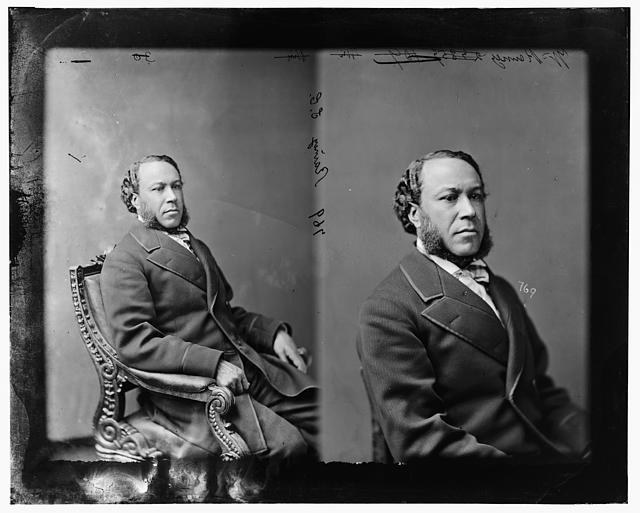
A portrait of Joseph Hayne Rainey hangs in the U.S. Capitol. He sits, composed, in a House Chamber chair, and through the window behind him stands the half-finished Washington Monument. The artist, Simmie Knox, deliberately chose that detail. An incomplete monument. An unfinished nation. A man who refused to wait for either to be ready before he showed up and did the work.
I named my organization after Joseph Rainey for reasons that go beyond his historical milestone as the first Black American to serve in the U.S. House of Representatives. That distinction matters, but his story is not only a story about firsts. It is a story about pluralism in practice: The willingness to work across deep differences to serve the common good — in Rainey’s case, even when he was often unwanted and unwelcome. Still, he worked to ensure that its country kept its word that “all men are created equal.”
Born enslaved in Georgetown, S.C., in 1832, Rainey came from a family that understood self-determination in the most literal sense. His father, a barber, purchased his own freedom and then that of his family. Rainey followed him into the trade and eventually built his own business in Charleston.
After escaping to Bermuda during the Civil War, Rainey returned to South Carolina in 1866 and helped found the South Carolina Republican Party. In 1870, he was elected to Congress and served for nearly a decade.
Rainey did not confine himself to advocating for Black Americans alone, though he did that with force and eloquence. He sat on the Committee on Indian Affairs. He championed veterans’ pensions. He fought for public education and equal protection for all. Debating the Civil Rights Act of 1875, he said, “We do want a law enacted that we may be recognized like other men in the country.” That is the language of belonging, of a man demanding entry into something that should have always included him.
Rainey was a civil rights icon and a genuine pluralist — and there was no conflict between the two. He understood that the American project’s strength lay in its capacity to absorb people whom the powerful had excluded — and let them govern. Tolerating differences was not enough; people needed agency to govern themselves.
The conservative movement has room for this story. The founding impulse of American conservatism is not exclusion. It is ordered liberty, Constitutional fidelity, and the dignity of the individual. Rainey lived that out in a moment when the nation was failing to honor it.
Joseph Rainey’s work is not a relic; it’s a model.
Our nation eventually completed the Washington Monument. The work of pluralism remains unfinished. Rainey understood that there was no excuse to wait. We all need to show up, do the work, and leave the door open wider than you found it.
That is worth commemorating, not just in a portrait, but in practice.
Sarah E. Hunt is the CEO and President of the Rainey Center, and a 2026 Interfaith America Vote is Sacred Fellow.