

Japan’s Shinto Religion is Going Global and Attracting Online Followers
February 9, 2022

(The Conversation) — American Kit Cox, 35, works as an electrical engineer and enjoys biking and playing piano. But what some might consider surprising about Cox, who was raised as Methodist, is that she practices the Japanese religion known as Shinto.
While Cox’s interest in Shinto was originally sparked by her love for Japanese popular culture and media, Shinto practice is not just a phase or fad for her. For over 15 years, she has venerated Inari Ookami, a Shinto deity or “kami” connected to agriculture, industry, prosperity and success.
After several years of study, Cox received a great honor from Fushimi Inari Taisha, one of Japan’s most popular Shinto shrines. She was entrusted with a “wakemitama,” a physical portion of Inari Ookami’s spirit, which is now housed in a sacred box and enshrined in her home altar.
What’s more, Cox has emerged as a leader within a relatively small but growing community of Shinto practitioners scattered around the world. Her goal: to help Japan’s “indigenous” religion go global.
As an anthropologist of Japanese religion studying the spread of Shinto around the world, I met Cox where most non-Japanese people interested in Shinto do – online. Over several years of studying social media posts, participating in livestreams and conducting surveys and interviews, I’ve heard many people’s stories of what draws them to practice Shinto and how they navigate the difficulties of doing so outside of Japan.
Shinto has many faces. For some, it is a reservoir of local community traditions and a way of ritually marking milestones throughout the year and in one’s life. For others, it is an institution that attests to the Japanese emperor’s divine status as a descendant of the sun goddess Amaterasu or a life-affirming nature religion.
But at its core, Shinto is about the ritual veneration of kami.
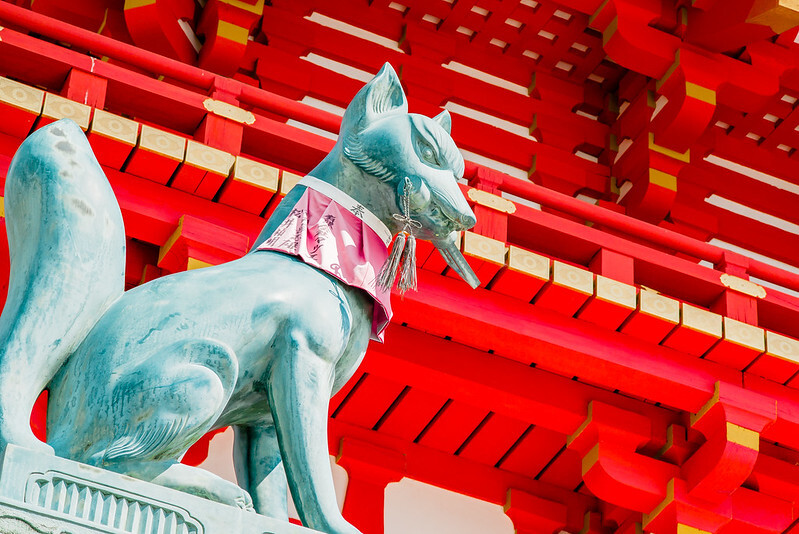
A statue of a fox messenger at the Grand Shrine of Fushimi Inari in Kyoto, Japan. WKC/flicker, CC BY-SA

Petitioners write messages to the Shinto deities on wooden prayer boards. Jelleke Vanooteghem/Unsplash, CC BY