Should a perpetrator of sexual abuse ever be forgiven?
What about those who couch their abuse in or hide their actions behind spirituality, religious leadership, or any sort of faith lens?
Do faith-based abusers who hold a public platform owe those who benefited from their work a public apology?
Should faith communities hide or forgive the sins of abusers?
In the immediate outrage last month following the news that Wisam Sharieff, a Quran instructor at AlMaghrib Institute and Founder of the Quran Revolution program, was charged with child pornography, Muslim American communities grappled with these questions. Sexual abuse is a horrible problem in numerous religions and spiritual groups, and this wasn’t the first time such despicable news roiled Muslim communities. It was perhaps the most obvious and heinous example that elicited immediate and undisputed consequences – an arrest, an FBI criminal complaint, and firing by AlMaghrib.
I’ve reported on these stories for more than 15 years in Muslim American communities, including conducting intimate and painful interviews with survivors as well as partaking in advocacy journalism to center survivors and support their rights within faith and humanity. I’ve seen the lingering aftershocks of such abuse fade too quickly. Too often, religious leadership and faith communities move on from the shock and perpetuate business as usual without substantive, meaningful, and systemic change.
The continuing aftermath and open discussions of the Sharieff case, however, has left me feeling that while systemic change is still lacking, there has been some progress in destigmatizing the way some Muslim American communities react to abuse allegations and believe survivors rather than re-victimizing them.
Some progress, though not nearly enough.
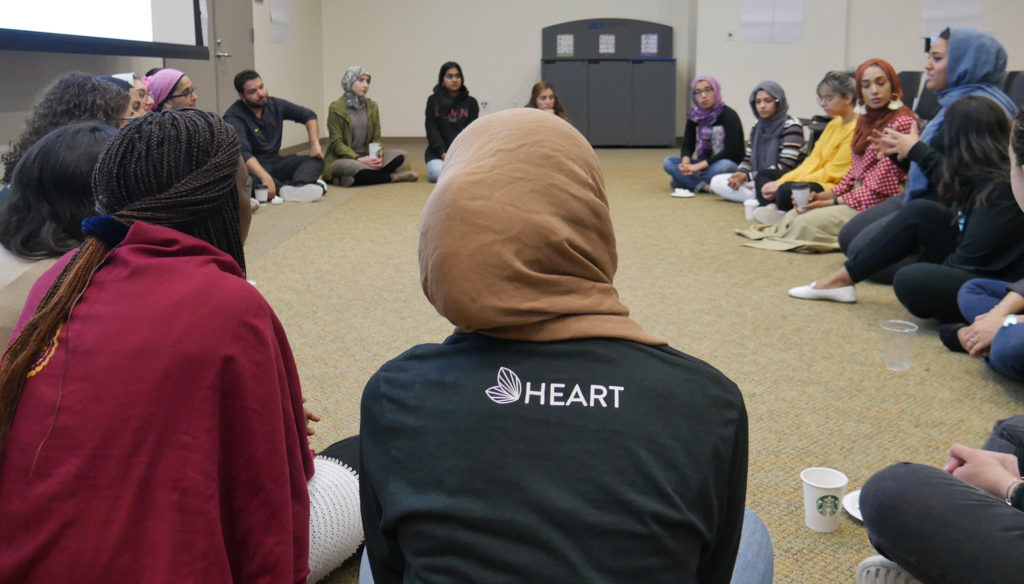
The number one thing Islamic institutions and spaces are getting wrong is that they’re not thinking about sexual abuse from a systemic lens, said Nadiah Mohajir, executive director and founder of HEART Women & Girls, a Chicago-based Muslim organization dedicated to promoting sexual health, combatting gendered violence, and advancing reproductive justice.
“[Islamic Institutions] are not thinking about it as a culture of abuse, and we all are playing a part in enabling that,” Mohajir said, adding that the easy solution when abuse occurs is to “fire the bad guy or create a list of policies. But it’s harder when you hear the masjid uncle make a crass joke or boys doing locker talk. That’s when folks get sensitive. People go through their two-hour training, and hopefully that works, but most of the time it’s not that simple.”
Confronting Sexual Abuse Vs. Covering One’s Sins
The week after news of Sharieff’s alleged crimes and subsequent firing, AlMaghrib responded with a public-facing webinar to address community concerns and share their spiritual agony over disturbing details that emerged about Sharieff’s manipulation of Islam and spiritual abuse in targeting a mother and encouraging her to sexually abuse her child.
Like many others, I tuned in to hear what AlMagrib instructors had to say. One statement from Ustadha Sarah Sultan, a licensed professional counselor and instructor at AlMaghrib, stayed with me: “If we see something, if we notice something … it’s so important to be able to voice that. We pray that it’s going to be a path towards starting to break these cycles.”
She emphasized that nothing in Islam stops Muslims from reporting abuse. “When anything happens that doesn’t feel right, it is not considered backbiting to talk about it, to report it. This is where spiritual abuse comes into play … to use Islamic principles to hide one another’s sins … that perpetuates more harm.
Don’t allow people to ever ever put that doubt in your mind about speaking the truth.”
It may feel like a small thing, but her advice was anything but.
In the weeks following the news about Sharieff, friends and colleagues shared how in various WhatsApp groups and texting groups – whether groups of Islamic school parents, a sisters’ halaqa, or a community brothers – many people questioned the validity of the alleged crimes and the veracity of Sharieff’s wife, who reported him to the FBI. Others, especially those who participated in the Quran Revolution program or had studied under him, were shocked and dismayed. However, a fair amount also fell back on Islamic scripture regarding forgiveness and the covering of one’s sins in public.
It reminded me of the case of Mohammed Abdullah Saleem, an Imam and Founder of the Islamic Institute for Education (IIE) in Elgin, Illinois, who was accused of assault and child sexual abuse nearly ten years ago. (Sharieff did his hifz, or Quran memorization, at IIE under the tutelage of Saleem years ago.) In my reporting of the case back then, victim blaming was rampant coupled with mixed messaging from Muslim leaders, especially those who argued that abusers have the right to make tawba (repent) for their actions.
At the time, Ustadha Zaynab Ansari, who now serves as an adjunct professor at Boston Islamic Seminary and full-time instructor at Tayseer Seminary, wrote a piece discussing whether the act of tawba (repentance) “exonerates the (alleged abuser) from additional culpability toward his or her victims. And does tawba also require a reciprocal effort from the victims to forgive their victimizer?”
The short conclusion from her piece? Victims don’t owe abusers forgiveness.
How Does Forgiveness Come into Play?
Feryal Salem, an Associate Professor of Arabic and Islamic Studies and the Director of Master of Divinity in Islamic Studies and Muslim Chaplaincy Program at American Islamic College in Chicago, has solid thoughts on forgiveness in Islam. I asked her why too often religious leaders and communities, whether Muslim or from any other faith group, are willing to make excuses or advocate for forgiveness for those who engage in various forms of abuse.
“I think the topic of forgiveness is a red herring issue. The real issue at the heart of the matter is a societal one, [like] the tendency to exaggerate the roles of individual religious leaders in the community to a point where some people have based their entire faith on the roles of these individuals. When they err, then these same people are challenged in their faith,” Salem said.
“Being a Quran teacher is not a right. Being an Islamic religious leader is not an entitlement. Tawba, or repentance on matters that don’t concern others, may be a private repentance between them and the individual,” she said. “But when someone has harmed others in the guise of religious guidance, then tawba involves rectifying the harm caused to others.”
She continued to say, when illegal acts are not committed but still tarnish the image of a teacher of the Quran; such individuals should have their platforms removed because of the negative images now associated with their manner of conduct while presenting themselves as Quranic scholars. “But in egregious cases such as Sharieff’s, such individuals should be punished to the furthest extent of the law and must never be allowed near children again,” she added.
However, forgiveness functions differently when one is in a role of religious leadership and their actions have impacted the entire community, Salem explained. “In many cases, their removal from the religious platforms they used to engage in sexual misconduct is the only way to rectify the communal harm that has been caused. They have forever lost the privilege of speaking publicly as religious scholars in egregious cases, such as that of sexual misconduct,” she said.
Salem and I both remembered the example of popular Muslim Scholar and Speaker Nouman Ali Khan (NAK), who was caught in 2017 in a sexting scandal and was accused of luring women into physical relationships under the guise of secret marriages while already married. NAK is considered more in the vein of the “tarnished” Quran teacher who technically hasn’t committed illegal acts, whereas Sharieff falls squarely in the realm of egregious, abusive, and illegal conduct.
With NAK in 2017, Muslim communities on and offline were embroiled in arguments, with some defending him and pushing for his communal forgiveness while others called for accountability and for him to exit the stage from public speaking and preaching. NAK never issued any sort of public apology or addressed the scandal, and seven years later he is routinely invited to speak in mosques and at Muslim conferences and events.
Many find this problematic.
With Sharieff, his alleged crimes have warranted FBI arrest and yet pockets of Muslim American communities still engaged in conversations around forgiveness or questioning the validity of the horrendous charges – something that baffles me.
Part of the problem across religious communities is the pedestaling of religious scholars, leaders, and preachers. This endangers us, as consumers of religious/spiritual knowledge and advice, to fall prey to the kind of spiritual abuse that can come when a dynamic leader holds knowledge and power over others without doing whatever heart work and faith work is needed to keep oneself: grounded, humble, and within appropriate boundaries.
“Another [problem] is the lack of taking sufficient advantage of the countless qualified female scholars available in the Muslim community. While nobody is exempt from fault, the risk of the occurrence of these types of incidents of sexual abuse decreases significantly when women are running Quran programs and teaching girls and boys under the age of 12,” Salem said.
Measuring Progress in Combatting Faith-Based Sexual Abuse
Since the Sharieff criminal charges have become public, AlMaghrib has also stated its intentions to take action with a campaign against sexual abuse and has already begun exploring topics with more programming. As Sheikh Ammar AlShukry, an AlMaghrib instructor, said, “We’re very aware of the pain and the anger that everyone feels, because we feel that pain, we feel that anger, we feel that betrayal ourselves.”
But will this campaign and whatever changes come forth be systemic? Will other Islamic organizations, institutions, schools, and mosques take a hard look at power, privilege around sexual abuse? Will Muslim communities embrace such changes, if they occur?
“I don’t know if there’s any one answer to that,” Nadiah Mohajir told me. “Definitely, we have to interrogate our communities [about] how power and privilege move, which therefore dictates whose voice is credible and whose is not. Communities will mimic what they hear from their institutional leaders and scholars. [Part of facilitating real change] is about finding those key changemakers to champion those messages.”
It would be great if Islamic scholars got on the sexual assault prevention training, Mohajir said. “But within communities, it’s about finding those key people who actually get it and talking to them about how we slowly but surely shift the attitudes [regarding victim shaming, not hiding sexual abuse, holding abusers accountable, sexual health education] among our communities.”
There has been progress in the last decade. I’m thinking of work being done by several Muslim organizations around spiritual and sexual abuse, like Dr. Ingrid Mattson’s Hurma Project. Or the previous work of Alia Salem with FACE (Facing Abuse in Community Environments) in investigating reports of spiritual, sexual, financial, and other forms of abuse. But systemic change around sexual abuse is still lacking, Mohajir said.
“If you look at decades of work in the gender-based violence field … our numbers haven’t changed. The education that we’re doing in the community 100 percent has increased across the board – in secular communities, in public education. We are doing a better job of teaching people about their bodies, about consent, and yet we’re still seeing the same devastating numbers … and that’s because we haven’t shifted the culture.”
There has been decisive condemnation of Sharieff’s behavior in Muslim American spaces and calls for justice. That’s something. But doubts about the abuse and discussions about how a part of justice in Islam is to ask for forgiveness and to be forgiven by God are also happening.
As Mohajir noted, “It’s very interesting … that men who do very egregious things are afforded the chance for forgiveness and their Muslimness is not taken away from them. … We are more willing to condemn a Muslim woman who may not be wearing hijab in the ways you want her to, or a Muslim woman who is advocating for reproductive agency, than someone who is teaching Quran and abusing someone.”
What now? How will systemic change come, when stories of abuse are not only plaguing Muslim communities, but routinely are part of the fabric of other religious communities? Just last month the Archbishop of Canterbury – Rev.Justin Welby, resigned after a report found he hadn’t pursued an investigation into claims of widespread abuse at Christian summer camps, decades ago.
How do we safeguard ourselves from putting religious leaders on pedestals, from the power dynamics of spiritual learning – all the things that can lead to abuse? How do we protect our children and ourselves from falling prey to spiritual and sexual abuse? As Mohajir said, we can do all the things, “like have my kid learn Quran with their teacher in the dining room where I can hear and see them, but the people who engage in abuse can be very creative. I think it’s important for parents to understand who is vulnerable and take the proper precautions and not be afraid of drawing boundaries.”
Without systemic changes and an entire cultural/religious shift around how we think about sexual and spiritual abuse; boundaries, precautions, communication, and vigilance is what we have in our toolbox.
Here are some resources addressing sexual and spiritual abuse, as suggested by HEART’s Nadiah Mohajir and put together by the author. This is by no means a conclusive list.
- Talking to Kids about Sexual Violence
- Power and Control Wheel
- Research papers on spiritual and sexual abuse from The Hurma Project in Muslim North American Communities
- Religious and Spiritual Abuse Toolkit from the Family and Youth Institute
- Responding with RAHMA
- A collection of videos and tools addressing spiritual and sexual abuse from The Hurma Project
- Facts about Sexual Violence in Muslim Communities
- Who Experiences Sexual Violence in Muslim Communities – HEART’s latest research report
- HEART’s Instagram post on spiritual abuse
Dilshad D. Ali is a freelance editor and journalist, a senior columnist at Interfaith America, and the former Blog and Content Editor of The Haute Take, the media arm of Haute Hijab, and covered all things pertaining to Muslim women. Prior to Haute Hijab, Ms. Ali was the managing editor of Patheos Muslim at Patheos.com and the editor of Altmuslim, a microsite at Patheos, as well as blogging on the intersection of faith, family and autism at The Muslimah Next Door. She has covered Muslims and Islam in America for more than 20 years for a variety of media outlets, including Religion News Service, The Atlantic, The New York Times, Islam-Online.net (before it became About Islam), Newsweek, Azizah Magazine, Illume Magazine, Islamica magazine, Nieman Reports, and Beliefnet. Her other passion is autism advocacy, as her eldest son is profoundly autistic. She serves on the Board of Directors for MUHSEN as well as on the Board of Directors for the Autism Society of Central Virginia (ASCV) and served two terms as a governor-appointee to the Virginia Autism Advisory Council. She was honored the Mission Champion for the ASCV in 2022 and as a White House Champion of Change in 2015 on the 25th anniversary of the Americans with Disabilities Act for her disability writings and advocacy work.