All but one of the lights in the sanctuary are turned off. The pews sit in almost total darkness.
The 19th-century Gothic building of Old First Reformed Church in Brooklyn, New York, with its high ceilings, stained glass windows, intricate designs, and epic works of art, is unusually lavish for a denomination known for bare, understated interiors. Also unusual is the use being made of it on this evening.
On May 25, 2024, the stage has been set for Despair Sanctuary, “a drone metal vigil for all who are weary.”
Churches are places of faith, where people commonly go to find hope, to be encouraged and strengthened by the community. As a prayer of St. Francis of Assisi often recited in churches goes,
“Lord, make me an instrument of your peace.
Where there is hatred, let me sow love.
Where there is injury, pardon.
Where there is doubt, faith.
Where there is despair, hope.
Where there is darkness, light.
Where there is sadness, joy.”
But on this night, the church is inviting people in to sow their grief, rage, depression, and despair.

Poetry readings, followed by blaring, ominous music, track the minutes of this vigil. Attendees are invited to take up a calming activity. Coloring and drawing materials are provided, and so are pens and paper for journaling and yoga space. Projected on a screen at the front of the sanctuary are solemn, pensive, and thought-provoking quotes. “We must prefer real hell to imaginary paradise,” reads one line from Simone Weil. “There is no end to what a living world will demand of you,” reads another from Octavia E. Butler.
There is no celebration of the risen Christ. There is no promise of hope made. The only thing reaching for transcendence is the music, a curated playlist of drone metal that fills the sanctuary absolutely and cloaks attendees’ bodies in heavy sound waves. Drone metal is defined by low, distorted guitars with sustained tones, usually anchored on a single note. Playing it at full volume is a powerful, immersive, and cathartic experience. I like to think that sound waves take up all the negative energy in space and cast it into the air, like a great mass of water overcoming poison.

An hour into the vigil, a drone metal trio called Chthonic Rites takes the stage. With guitar, bass, cello, and synth, they play dread-filled, improvisatory music. The sound is mind-numbing. One attendee leaning against a stone wall says he could feel the vibration in his teeth.
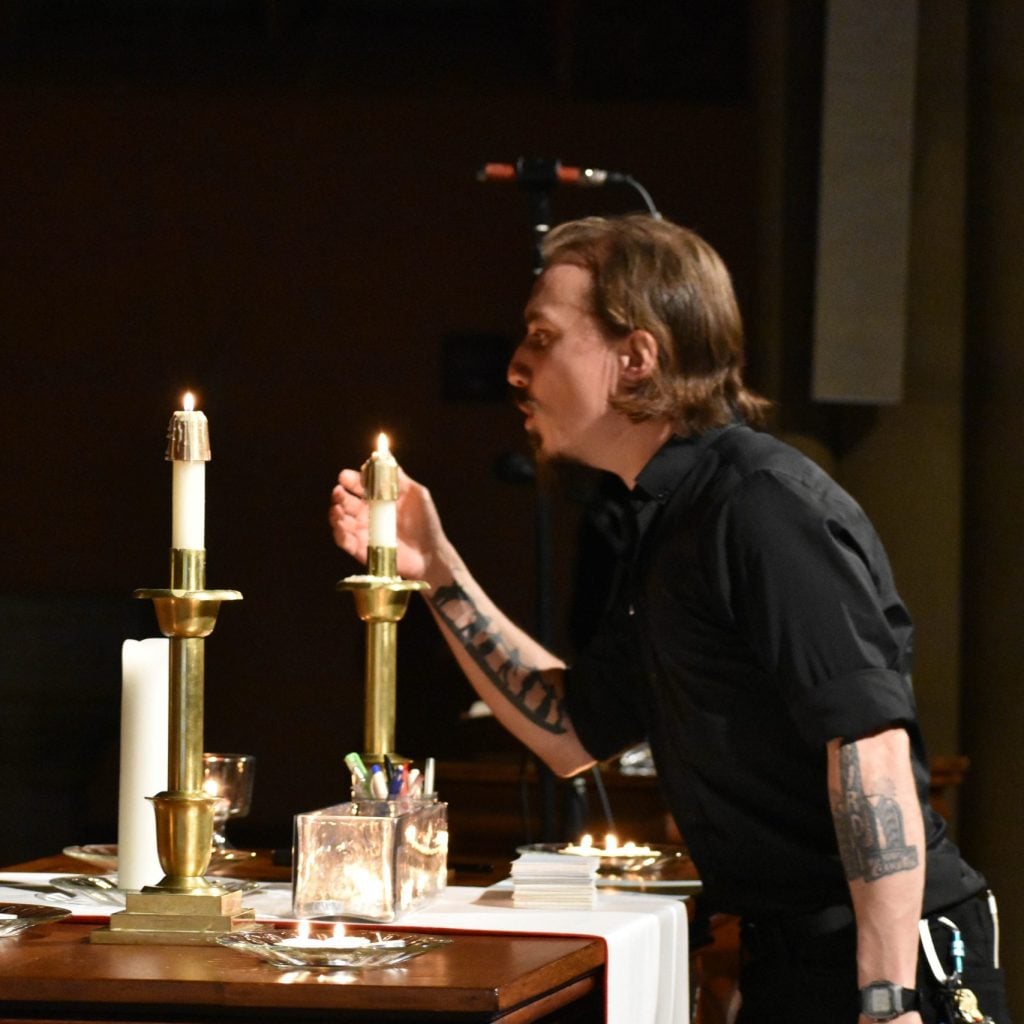
A table with candles and note cards sits in front of the stage. A slip of paper bears a question, “Oh, burden-bearing spirit, what do you carry that was not there before?”
Attendees are invited to write a response to the prompt on a note card. After the vigil, they will tear up the cards and drop them in a compost bucket, which will be taken to Moffat Street Community Garden in Brooklyn and used to make soil for growing food and flowers.
Whether you agree with despair philosophically or theologically, despair is with us. Despair needs no apostles or apologists. It arrives matter-of-factly and meets little to no resistance when it comes. For many of us, the question is not whether we should despair but what do we do with our despair?

How do we believe in human progress in an age of war? How do we hold onto hope when our environment is degenerating before our eyes? How do we believe in change when those fighting for peace and preserving life seem powerless? How do we trust the system when we keep uncovering more of its evils? These questions haunt me. Each day that passes seems to lend more traction to despair.
No, I am told. You must hope. You must believe things will work out in the end. Don’t be like the “doomists” and “doomers,” who cave to cynicism. True power belongs to positive thinking. And so, I strain to conjure up happy thoughts. I establish routines and take up regimens to adapt to how things are.
The previous Despair Sanctuary took place on December 16, 2023. Thanks to a sign outside the church, modest flier distribution, and word of mouth, 40-50 people attended.
There is something very telling about this. During Christmastime – “the hap-happiest season of all!” – all these individuals gathered in the name of despair. One attendee came wondering if she was “the only depressed person in Park Slope” and found instead a sanctuary full of people like her. The fact that they came when they just as quickly could have been some place jolly is a sign that things are seriously not okay.
There is a metal band called SubRosa, and they have a song called “Despair Is a Siren.” At the root of despair is a refusal to accept the way things are. Perhaps it’s not hope we need in the face of despair, but space to hold our despair in community. Maybe by sharing our despair, we can sever our attachment to the status quo and loosen our imagination of what is possible. Or at least, perhaps we can know something of healing by admitting our despair with others and accepting each other where we are.
To learn about the next Despair Sanctuary in November, follow @doomtheology on Instagram or Twitter or sign up for the mailing list.


Jack Amos Holloway
Jack Amos Holloway (he/they) is a writer, music producer, film director, activist, minister, and dog-sitter based in Brooklyn, NY. He is the author of Hands of Doom: The Apocalyptic Imagination of Black Sabbath and the Founder and Creative Director of Morbid Instinct, a film and music collective. Jack plays bass in Chthonic Rites and sings and plays guitar in The Heavens. In 2018, Jack received a Master of Divinity from Union Theological Seminary. You can follow his work on his website or follow him on Instagram: @jack.amos.holloway. Jack is an Interfaith America Emerging Leader.