The Emerging Leaders team is delighted to announce our 2024-2025 Interfaith Innovation Fellows!
This cohort of eleven outstanding interfaith leaders will convene over the next year to leverage their collective knowledge toward shared action as they seek to meet a felt need in their community through an interfaith lens. Together, they will participate in a series of online trainings led by experts and seasoned leaders across America, as well as an in-person retreat in downtown Chicago.
We are incredibly proud of this cohort’s shared commitment to engaging difference, their bold vision for a collaborative and just future, and their dedication to community service.
Our Innovation Fellows were selected from Interfaith America’s Emerging Leaders Network because of their proven commitment to constructive interfaith cooperation and demonstrated ability to make meaningful and longstanding impact in their communities.
You can learn about each of our Innovation Fellows below.
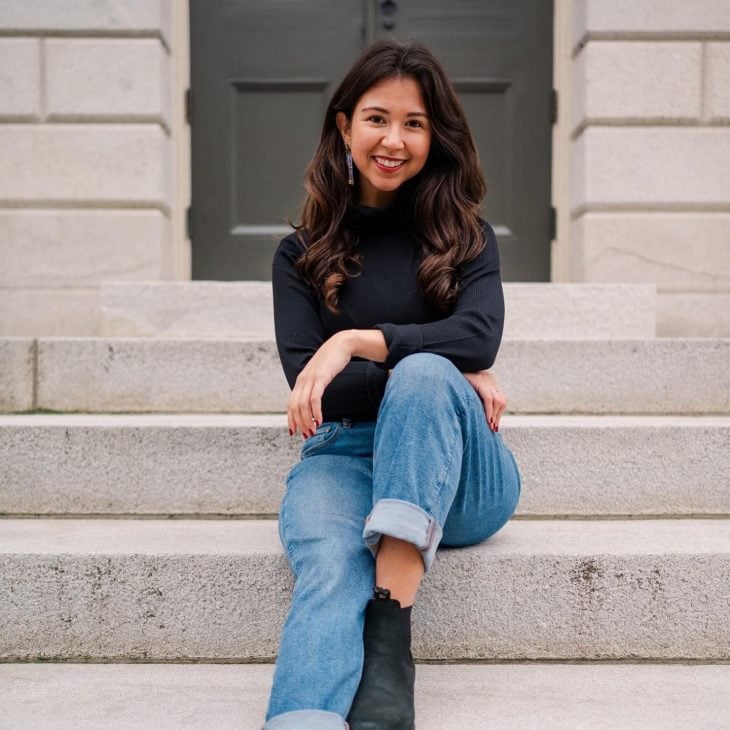
Anna Del Castillo
Spiritual Seeker/Christian
Anna Del Castillo is a Peruvian-Bolivian American leader working at the intersection of justice, politics, and healing. As the Executive Director of Our Own Deep Wells, she leads efforts to address the U.S. mental health crisis and social isolation through soulful, community-centered practices. Previously, Anna served in the Biden-Harris administration as Deputy Director of Diversity, Equity, Inclusion, and Accessibility (DEIA) at the White House. A Harvard Divinity School Dean’s Fellow with a Master of Divinity, Anna focused on public policy, racial justice, and healing. Her activism has earned numerous national accolades, including the IGNITE National Fellowship, Harvard’s Presidential Public Service Fellowship, and COLOR Magazine’s “40 Under 40.” Committed to creating spaces for both personal healing and collective action, Anna believes in the power of combining the two to drive lasting social change.
Through this fellowship, Anna will further develop Our Own Deep Wells (OODW): Awakening Soulful Practices for Wellness. OODW is dedicated to addressing the mental health crisis by offering diverse communities—especially young adults and community leaders—the tools of soulful practices for healing and resilience. By curating a living library of soulful practices and hosting interactive webinars and gatherings, OODW reimagines these practices and soulful gatherings to make them accessible and inclusive for today’s world, with a focus on young adults, LGBTQ+ populations, and systematically excluded groups. With the support of this fellowship, Anna will expand OODW’s curriculum, helping individuals tap into their own inner wisdom and empowering them on their journey toward wellbeing and self-discovery.
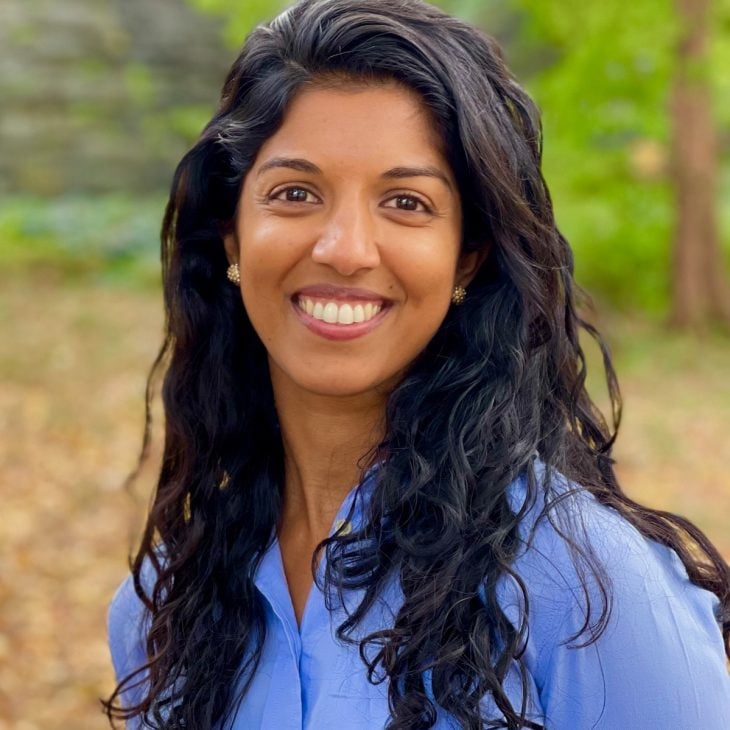
Annah Kuriakose
Indian Orthodox Christian
Annah is a recent graduate of Princeton Theological Seminary where she earned a Master of Theological Studies (Biblical Studies), but her training and interests are wide and interdisciplinary, spanning education, medicine, and theology. Her professional work has been focused on creating equitable access to health and education for underserved populations. While at Princeton, she used her field education to pilot a holistic wellness curriculum at a public high school in Newark, NJ. She also holds an MD from New York Medical College, an MA in Curriculum and Instruction from the University of Mississippi, and a BA in Anthropology from Amherst College. She has served as Program Director for a minority public health non-profit in New Jersey and taught high school math in both the Mississippi Delta and Newark. She currently serves as an active member of her Indian Orthodox church, works with the National Alliance on Mental Illness-NJ, and supports Princeton Seminary’s Institute for Youth Ministry. Convinced of the connections between faith, health, and education, she is always seeking (and creating) spaces to draw them out.
Through the Interfaith Innovation Fellowship, Annah will create a Sunday School curricular supplement for children and adolescents in her immigrant church to address identity development within a faith community that is cross-cultural and trans-generational—both points of pride and points of pain. She will incorporate not only theological competencies, but anthropological and sociological ones as well, which consider socio-cultural and historical locations. Annah’s aim for this project is to equip bicultural young people of faith with tools to identify the positionalities from which they must be agents of change in our world.
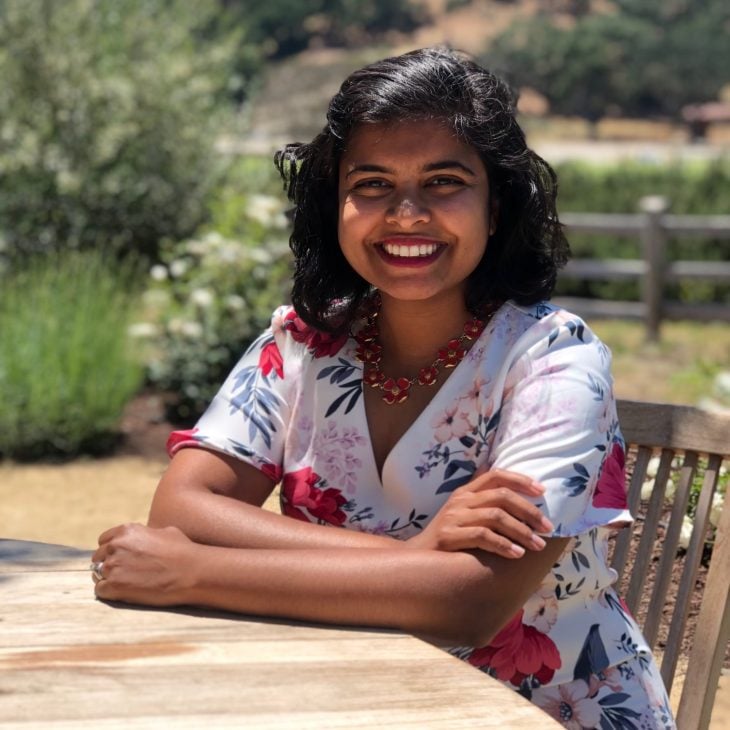
Anu Gorukanti
Hindu/Buddhist
Anu Gorukanti, MD is a public health advocate and pediatric hospitalist at a county hospital in Los Angeles, CA who is passionate about health equity and racial justice. She went to undergraduate and medical school at Saint Louis University and completed her residency at Stanford University. She is passionate about social justice and the role that reflection and contemplation play as building blocks for revolution (as inspired by many theologians, spiritual leaders, and activists before her). She strongly believes that understanding who you are, what you value, and where your values come from can lead to a meaningful and authentic life. In her perspective, social change should always honor and incorporate both the individual and systems-based approach.
Anu’s project revolves around supporting healthcare workers in navigating grief and loss through the creation of an interfaith grief facilitation guide for healthcare workers and virtual grief spaces for healthcare workers. Grief and loss are inherent parts of the job in healthcare, and this was only exacerbated by the COVID-19 pandemic — yet there are few resources available to offer support for processing grief inside or outside the healthcare institutions. By creating a facilitation guide, Anu hopes to empower healthcare workers to foster a reflective process to process grief and loss on their own and with their colleagues. In addition, she hopes to offer communal spaces for healthcare workers across the country to collectively gather and process their experiences through modalities such as poetry and narrative writing. This guide and these virtual spaces will be co-created with the support of a mental health practitioner and interfaith chaplains as well as through the feedback of healthcare workers from a variety of faith traditions.
Read: Starcross Monastic: An Interfaith Sanctuary in the California Coastal Hills

Rev. Dr. Chris RayAlexander
Christian (UCC)/Spiritually Fluid
After a decade in higher education as a professor of Spanish-language literature, history, and culture, Rev. Dr. Chris RayAlexander completed an MDiv at Emory’s Candler School of Theology and dove into a full-time career in interfaith relationship building. His current research focuses on the intersection of pluralism, practical theology of religions, and youth spiritual formation. He is passionate about creating a more humane and unified world through interfaith advocacy, education, and community cultivation. He is Program Director at Interfaith Children’s Movement, a Board Member of Interfaith Atlanta, Support Chair for its youth organization, Interfaith Atlanta Youth (IAY), and the Minister for Interfaith Engagement at First Congregational Church of Atlanta, UCC. Chris serves as an interfaith consultant in his community, and in his free time he translates philosophy as a member of the French Metaphysics Translation Project. He lives in Atlanta with his partner, their son, and a pile of philosophy and theology books that constantly remind him of his own mortal finitude.
Chris’s fellowship project, Building Resilience through Interfaith Contemplative Community (BRICC), recognizes the challenges of environmental hostility, social media toxicity, and performance pressure confronted by young people and responds with contemplative practices aimed at cultivating and enhancing their mental health resilience. BRICC engages high school-aged youth in individual and interpersonal spiritual explorations that foster inclusive, compassionate communities where they can share, spread, and sustain healthier approaches to holistic well-being. Through a series of online and in-person engagements, BRICC’s pilot cohort will learn about approaches to mystical spirituality, practice contemplation and meditation in community, and generate the compassion, resilience, and endurance necessary to maintain their mental and spiritual health while creating new spaces in which to heal, thrive, and proliferate an ethos of care, solidarity, and support.
Read: Young People Leading Interfaith Learning and Conversation in Atlanta

Rabbi Ethan Bair
Jewish
Rabbi Ethan Bair was ordained at Hebrew Union College-Jewish Institute of Religion in Los Angeles in 2011. He has served as Campus Rabbi at USC, Hamilton College and now at Syracuse Hillel and University. In addition, he has served eight years in the congregational rabbinate. As a progressive rabbi, he has long been a social justice advocate and leader in his congregational roles and has been active in creating pluralistic spaces for students on campus. He is married to Prof. Nadya Bair and together they have two children, Chaya Miriam and Emunah Gittel.

Imam Amir Durić
Muslim
Imam Amir Durić serves as the Chaplain and Director of Muslim Student Life at Syracuse University. He is also a PhD candidate at the Maxwell School of Citizenship and Public Affairs, and a pastoral counselor for several Central New York hospitals. His research interest focuses on multiracial religious congregations and contemporary Muslim communities in the United States. Durić has an educational background and extensive experience in Muslim community leadership domestically and abroad. He is deeply invested in interfaith dialogue and cooperation and advocating for the well-being of minority groups. His work was highlighted by being selected as the 2023 Chancellor’s Diversity and Inclusion Award recipient.
Amir and Ethan seek to create a hub of shared learning and understanding for Jewish and Muslim students at Syracuse University and beyond. Through a series of dialogue sessions for both alumni and students, Amir and Ethan hope to build the foundation for shared community, hospitality, and destiny between Jewish and Muslim students. Their vision is bold, and they hope to nurture collaboration and deep relationship with participants. By modeling the world in which we seek to live and inspiring students to take their living and learning into the world, they aim to continue to inspire Jewish and Muslim friendships, understanding and imagination.

Jack Amos Holloway
Christian
Jack Amos Holloway (he/they) is a writer, music producer, film director, activist, minister, and dog-sitter based in Brooklyn, NY. He is the author of Hands of Doom: The Apocalyptic Imagination of Black Sabbath and the Founder and Creative Director of Morbid Instinct, a film and music collective. Jack plays bass in Chthonic Rites and sings and plays guitar in The Heavens. In 2018, Jack received a Master of Divinity from Union Theological Seminary. You can follow his work on his website jackamosholloway.com or follow him on Instagram: @jack.amos.holloway.
Jack’s project, Despair Sanctuary, is a drone metal vigil for all who are weary. It is a secular church service where people of any background can hold negative emotions together. It is an immersive and cathartic experience where attendees are invited to engage in a calming activity, hear poetry readings, listen to heavy music, and witness a live concert. It brings together secular and religious communities, fans of metal music, anyone in need of a place to feel despair or grief, and it appeals to people who otherwise would not go to church. It is an innovative spiritual practice that addresses the mental health needs of a public facing increasingly distressing times.
Read: What Do We Do with Despair? One Community, Despair Sanctuary, Makes Space

Layla Al-Zubi
Muslim
Layla originally hails from the beautiful and vibrant country of Jordan. At Johns Hopkins University, she graduated with a Bachelor of Arts in Writing Seminars with departmental honors and a minor in Islamic Studies. In 2020, Layla received a national fellowship to do ovarian cancer research at the National Center for Advancing Translational Science at the National Institutes of Health and was selected as a Health Disparities fellow. Layla’s unique background culminated in her matriculation at Harvard Medical School. She currently runs her nonprofit Muslim Women’s Health Organization, the first nonprofit focused on Muslim women’s health in the United States.
The goal of Layla’s fellowship project, “Ins and Outs of Our Minds,” is to establish a reflective spiritual cohort focused on community-based self-development for young women of different faiths. The hope is to bring different interfaith groups to learn and lean on each other— which is more important in a time when the world seems divided. This project aims to bridge together people through faith in an innovative way. Layla hopes to release this template and training via her nonprofit, Muslim Women’s Health Organization, to the public as a way for others to institute it in their city, nonprofit, school, or institution.

Rafia Amina Khader
Muslim
Rafia Amina Khader serves as the Director of Religion Programs at Chautauqua Institution, where she oversees the Interfaith Lecture Series, the Abrahamic Program for Young Adults, and online educational offerings for the Institution’s Department of Religion. She has worked in the faith-based nonprofit sector in various capacities for over a decade and has initiated several interfaith projects during this time, including a discussion group for women of faith on the intersection of religion and women’s bodies and as a facilitator for Muslim-Jewish women’s dialogue. Rafia is also an avid writer who is currently working on her first book, a memoir, which explores the themes of religious messages around women’s bodies, the meaning of family and home, and her evolving faith journey as the youngest daughter of Hyderabadi-Indian Muslim immigrants to North America. Rafia earned a Bachelor of Arts in Economics from Benedictine University and a Master of Arts in Religious Studies from the University of Chicago Divinity School.
Rafia’s project aims to revitalize and increase the capacity of the Abrahamic Program for Young Adults (APYA) which invites a cohort of 4-6 emerging interfaith leaders (Jewish, Muslim and Christian) to live and work together for eight weeks in the summer at the historic Chautauqua Institution. At a time when many interfaith relationships have unraveled, coupled with our inability to even agree on common language to describe what is going on in Israel and Palestine today, a reimagined APYA seeks to serve as a model of how to remain in community while embracing our many differences — both religious and political. As part of their internship experience, APYA coordinators participate in the various activities hosted by the Department of Religion in the summer, including the Interfaith Lecture Series, Morning Worship, Mystic Heart Meditation, and CHQ Dialogues to name a few. Additionally, APYA coordinators are tasked to collaborate as a group to create a new program based on mutual interests and vocational aspirations that serves an intergenerational audience. Furthermore, APYA coordinators have the chance to meet one-on-one with selected Interfaith Lecture Speakers and Guest Chaplains. Last summer, the coordinators met with Simran Jeet Singh, Kaitlin Curtice, Rabbi Sharon Brous, Gopal Patel, Dr. Sunita Puri, and Ubaydullah Evans. With its longstanding programs, resources, and support Chautauqua Institution has to offer, the Abrahamic Program for Young Adults has the unique potential to demonstrate the possibility of not only maintaining but strengthening interfaith dialogue and relationships, even amidst deep pain and misunderstanding.

Seedy Njie
Muslim
Seedy Njie, originally from The Gambia, came to the United States as an international student and earned a Master’s degree in Talent and Organizational Development from Queens University of Charlotte. Currently, at a local pharmacy, he leads the Health Game Plan program, collaborating with healthcare professionals to enhance self-management for aging patients. With extensive experience in interfaith work, Seedy excels in fostering unity and mutual respect across diverse communities. His expertise includes talent development, strategic planning, DEI policy implementation, and fostering interfaith collaboration.
Seedy’s project, “Bridges of Faith,” is an initiative that unites diverse religious communities in Washington, DC, to collaboratively address social challenges, with a special emphasis on supporting minority small businesses. The project involves a series of targeted events and workshops structured into phases: building trust, identifying key issues, developing actionable solutions, and implementing sustainable actions. By engaging with broader conversations about race, ethnicity, and culture, this project aims to address community needs through an interfaith lens.

Shivpriya Sridhar
Interfaith
Priya is a third-year Master of Divinity student at Princeton Theological Seminary. Given her own bicultural and interfaith background, she is interested in the politics of religious diversity. Prior to Princeton, Priya worked as a 7th-grade English/Language Arts teacher in Nashville, TN, where her students constantly amazed her by drawing connections between the worlds of literature, [lived] religion, and culture. She earned her BA in Public Policy at UNC Chapel Hill, minored in Global Health at Duke, and completed a certificate in Prison Studies at Duke Divinity School, where she first became involved in prison higher education. In addition to teaching World Religions at two state prison facilities last year and tutoring writing with the Prison Teaching Initiative, she currently works as a chaplain intern with the Department of Corrections. Through the Innovation Fellowship, she hopes to thoughtfully design pedagogies within philosophical/religious education to facilitate narrative reflexivity and dialogical learning for incarcerated adults.
Priya’s Innovation Fellowship project is curricular research, design, and implementation in the fields of world religions, topics in justice, and trauma-informed spiritualities, for [adult] prison education programs. She will be collaborating with colleagues in the Prison Teaching Initiative at Princeton University, as well as drawing from her experiences as a chaplain intern with the Department of Corrections to better understand the diverse educational, religious, and spiritual needs of justice-impacted adults.