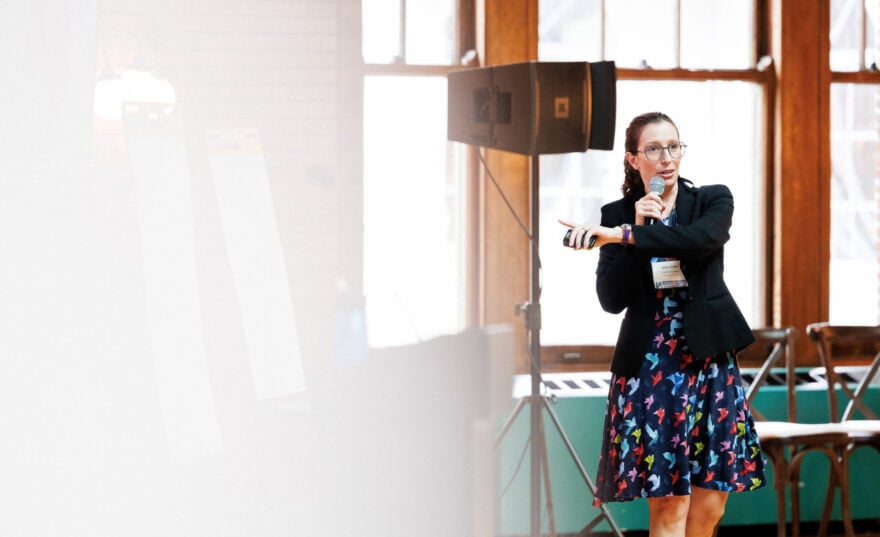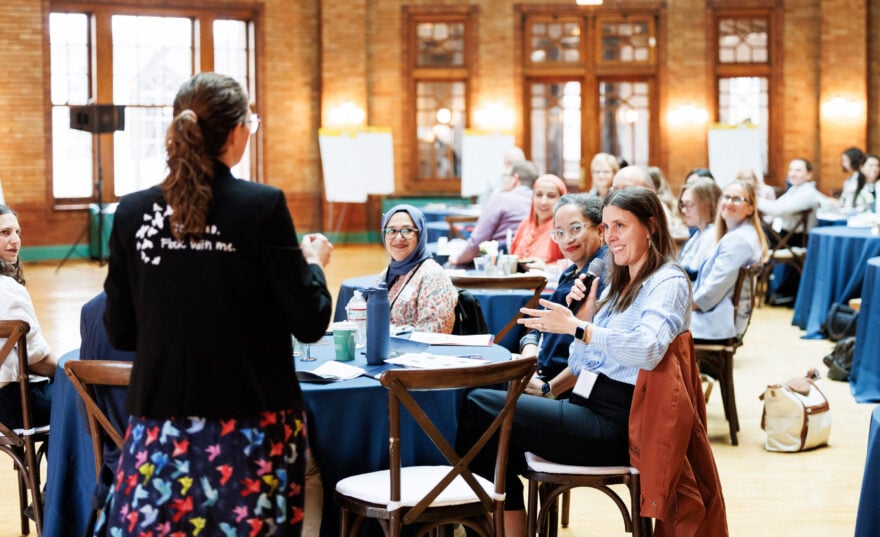

Every first Tuesday of the month, you can find Hope England onstage with a microphone in hand. As an improv comedian and host of “Sober Night Live”, she’s on stage creating a safe space for artists and folks who’ve struggled with addiction, or other challenges, to share their stories, art and comedy.
For Hope, humor and art can be some of the best ways to cope with trauma.
Hope is no stranger to the intersection of trauma and humor. She brings her unique expertise as a Trauma Therapist and Improv Comedian together as the Founder of Humor of Hope, a non-profit that prevents and heals trauma using comedy and improv. Open mic night is the latest in her life mission of bringing people together to laugh, connect, cry, and build community during hard times.
Growing up in a Christian home in Tennessee, Hope had no plans to become a comedian. She shares, “In my family, we didn’t talk about emotions. There wasn’t education around emotional intelligence or feelings. But something that we had was comedy, so we would just make jokes.” She didn’t realize that she used humor as a way to process her own difficult emotions until she went to therapy.
She laughs, “When I got into therapy, my therapist pointed out when things get tough or when there’s an emotion, you always make a joke. But I knew I was funny because I could make my therapist laugh.”
Even though Hope always loved making people laugh, she went to college with the goal to work in healthcare. She started out as pre-med but eventually dropped out to start taking a theater class. During one rehearsal, she struggled to remember her lines to the play and made them up on the spot. After rehearsal, her professor found out she was making her lines and recommended she study improv.
Hope’s life was changed.
After undergraduate, Hope moved to Chicago to study improv and eventually was hired at Second City. Even though she loved her job, she still remembered her dream of working in healthcare and her desire to help people. She started volunteering at Lurie Children’s hospital and began to spend time with kids on the cancer unit.
She remembers, “I would put on the isolation suit, gloves and mask up and start doing improv and comedy with the kids. And it worked. So, I started doing it for all the kids. It kind of turned into this Patch Adams type thing. Every shift I would leave feeling like those laughs really meant something.”
She reflects on a young girl in the hospital who was there by herself, “I played at the threshold of her door and I would act things out and try to get a suggestion from her. Slowly, slowly, she got closer and closer to the threshold of the door until we were playing. Once we started laughing, it shifted something. There was an opening where I could actually work with her.”
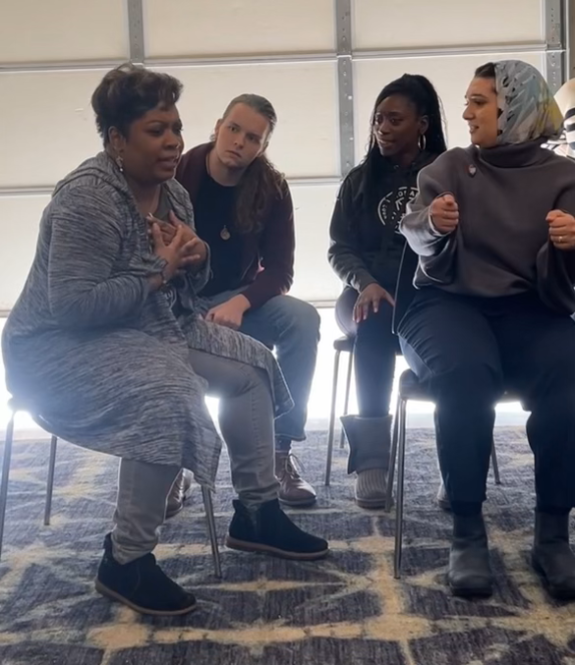
Hope decided to start her non-profit, Humor for Hope, out of her love of bringing comedy and improv to people who really needed it.
Demands for her services grew and Hope was asked to start working with healthcare workers. It was during this experience, Hope realized she needed more training to be able to help people process their grief and trauma.
She went back to school for her degree in clinical counseling psychology, opened her own therapy practice and continued to grow her work with Humor for Hope.
Humor for Hope has since expanded their scope to work in hospitals, schools, and refugee camps across the world. Hope says even while she finds herself in spaces where people don’t speak the same language, humor and comedy remains a great way to build a sense of connection.

She remembers a time when she was in Türkiye working with Syrian refugees who were navigating layers of complex trauma.
She shares, “It took several days for people’s nervous systems to feel safe enough to even start to unravel a little bit. But once the kids found the shared language of improv, you don’t always need words. We’re playing with emotion, somatics, sounds, feelings.”
Holding space for people to share their trauma isn’t easy work. Hope turns to her own spiritual practices as a way to process and care for herself.
“[Spiritual practice] doesn’t have to look a certain way. I don’t have to be in the right posture or say the right prayer or dress a certain way. I learned I have to connect to the thing that lives in me, that I actually see in all of us. And it’s the thing I often find in these moments of tragedy, in these war zones or hospitals or where there is deep loss. We can still connect in these really deep and profound ways through humor in the midst of so much loss and sadness.”
As Hope’s own spiritual practice continues to evolve, from her Christian upbringing to her now blended spiritual practice, she feels at peace knowing that love, humor, poetry, time in nature can all feel spiritual to her. And in the moments when it’s too hard to laugh, Hope assures us it’s okay (and even necessary) to cry too.