
During the 2024-25 school year, several cases at the intersection of religion and education have risen through local and national courtrooms, from a Louisiana dispute over the Ten Commandments being placed in public school classrooms, to a suit challenging whether a Catholic charter school in Oklahoma should receive taxpayer funding, to a debate in Maryland over religious exemptions from public school lessons including books featuring LGBTQ+ characters.
As litigation prompts conversation about the separation of church and state and the freedom of religious expression in the classroom, Interfaith America connected with Chicagoland area schools that offer innovative religious diversity curricula and demonstrate the power of teaching about religious pluralism. These programs prove that “religion in schools” ought not be indicative of binary assertions or discordant communities. In their own unique ways, these schools and educators offer more nuanced understandings of a diverse array of faith traditions with attention to lived experiences of people of faith.
Situated in Chicago’s Edgewater neighborhood, with a view of Lake Michigan out their east-facing windows, are Sacred Heart Schools: The Academy and Hardey Prep. Comprised of The Academy for Girls and Hardey Prep for Boys, Sacred Heart in Chicago was founded in 1876.

Sacred Heart belongs to a wider network of independent Catholic Schools across North America, associated with the Society of the Sacred Heart (RSCJ). Established in France in the early 17th Century by Saint Madeleine Sophie Barat, the RSCJ (French: Religieuses du Sacré-Cœur de Jésus) is a community of women who seek to “discover and reveal God’s love in the heart of the world through the service of education.”
Though it’s not a public institution, and in fact encourages a “personal and active faith in God,” Sacred Heart in Chicago has built a reputation for an inclusive religious studies curriculum and a culture that embraces interfaith cooperation. Fifty percent of the school’s student population is non-Catholic, and 38 percent is non-Christian.
The network of Sacred Heart Schools lists “respect for diverse faiths and an understanding of the world’s manifold religious and spiritual traditions” in its goals and criteria, which are largely shaped by Saint Madeleine Sophie Barat’s desire to “provide exemplary education with the purpose of expanding mind and heart.” This foundational language mirrors two central components of pluralism and interfaith cooperation: respect for diverse identities and religious literacy.
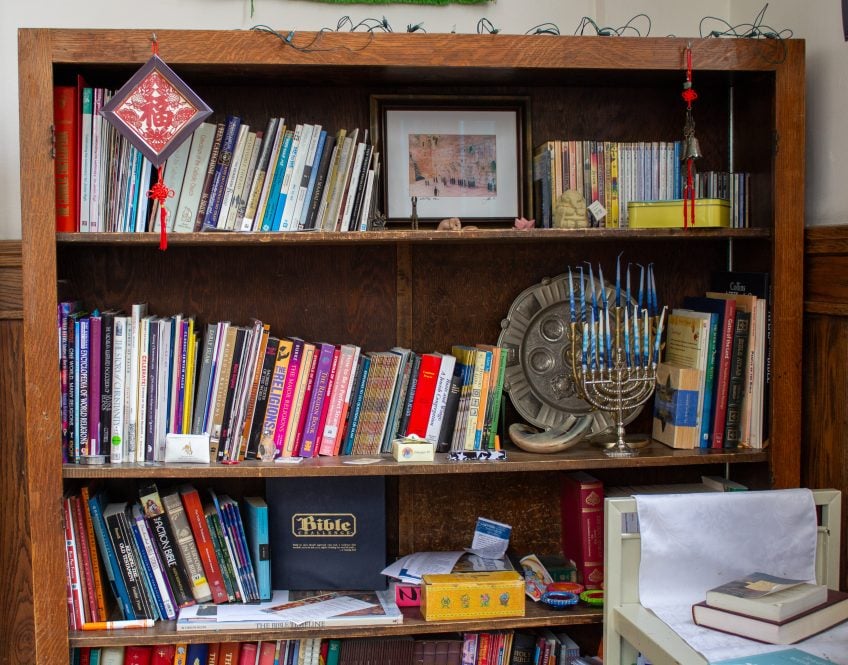
Saint Madeline Sophie Barat herself instructed the nuns who ran the first Sacred Heart school in 1800s France to allow time for Muslim students to observe daily prayers and fasts during Ramadan.
“It’s been a long part of our Sacred Heart School’s tradition to be a Catholic school, but a Catholic school for children of all faiths,” Jackie Beale-DelVecchio told Interfaith America during a visit to Sacred Heart earlier this spring.
Beale-DelVecchio, who holds both Master of Social Work and Master of Divinity degrees from neighboring Loyola University Chicago, has been teaching religion to sixth through eighth graders at Sacred Heart for 16 years.
The school’s religion curriculum, which spans grades K-8, teaches younger students to explore what their families believe at home, while elementary students study elements of Catholicism like the liturgy and sacraments, keeping in mind how Jewish, Muslim, Hindu, or Buddhist brothers and sisters might share similar practices.
When students reach the seventh grade, they learn about world religions. As Sacred Heart’s middle-school religion teacher, Beale-DelVecchio instructs her students on the issue of generalizations about religions and in society. “The antidote to that is knowing about internal diversity,” she said, describing how she teaches students to challenge assertions that begin with “all Muslims believe…” or “all Buddhists think…”
She also points to the importance of historical diversity and the integral role the study of religion plays in understanding who we are as humans. With the benefit of being located in one of the most populous and religiously diverse cities in the nation, Sacred Heart takes Beale-DelVecchio’s students on a yearly field trip to tour local Abrahamic houses of worship in the area, including the nearby Ismaili Jamatkhana, Emanuel Congregation Reform Synagogue, and St. Andrews Orthodox Church — all within walking distance of the school’s campus.

Outside of the classroom, Sacred Heart prioritizes accommodating religious diversity in big and small ways. This can look like anything from holding an annual Interfaith Thanksgiving prayer service to offering alternative options for students who don’t celebrate Halloween. Sacred Heart also provides vegan snacks for the school’s large Ethiopian Orthodox student population during periods that require some students to abstain from animal products, sets up time and space in the library for Muslim students fasting during Ramadan, and renamed their annual Howard and Evanston Community Center Christmas gift-exchange service program to “Winter Joy” to respect the beliefs of a majority of those in the neighboring community they serve.
In a deeply divided culture, parents and students alike have been receptive to both Sacred Heart’s exploration and accommodation of religious diversity. “If there’s any fear that being exposed to all these world religions will confuse children,” Beale-DelVecchio said, “I assure them — and this has happened time and time again — that actually being exposed to all different world religions almost always helps the student become stronger in their own belief, and not in a closed-minded way, but just in a ‘Oh, now that I understand all this. I have a new ownership and a new appreciation for my belief system’ way. It strengthens that more than I think it confuses.”