In an election year rife with tension and division, two governors from opposing parties show that faith — both in their communities and in the democratic process — can be a powerful force for unity.
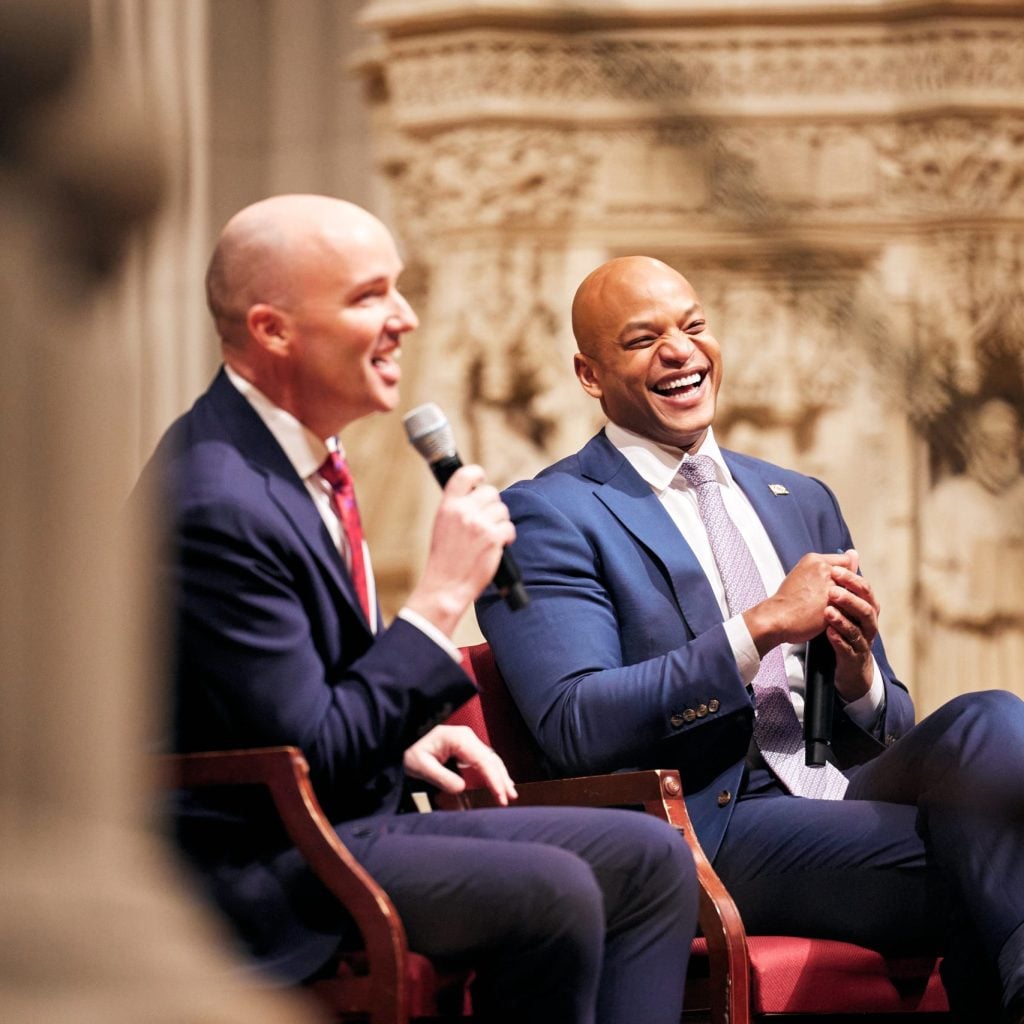
Republican Governor Spencer Cox of Utah, a supporter of former President Donald Trump, and Democratic Governor Wes Moore of Maryland, who backs Vice President Kamala Harris, have recently drawn attention for their advocacy for their preferred presidential candidates.
Despite their political differences, these rising stars in their respective parties have united to endorse a cause that transcends partisanship.
Watch Now
In a video announcement, Governor Cox and Governor Moore endorse the Faith in Elections Playbook, an online toolkit designed in partnership with Interfaith America and Protect Democracy to help faith communities support elections and build cohesion in their communities.
Crafted with the First Amendment and the separation of church and state in mind, the Playbook offers practical steps rooted in existing resources from field leaders while ensuring compliance with local, state, and federal laws. In their endorsement, the Governors express gratitude for the vital work these faith communities are already doing to uphold free and fair elections while also issuing a unified call to action.
The data shows strong public support for the sentiment behind the governor’s message. A June 2024 survey by the United States Democracy Center reveals that 73% of Americans prioritize the integrity of every vote over their preferred candidate winning, and 72% are concerned about misleading election claims. Additionally, 66% of respondents believe political violence has increased in recent years. This widespread concern and the prioritization of a trustworthy democratic process emphasizes the urgent need for initiatives like the Faith in Elections Playbook.
In the video, Governor Cox underscores the shared commitment he and Governor Moore hold, stating, “Governor Moore and I are from different parts of the country, and we disagree on many important issues – that’s how our system is supposed to work. But we’re friends and commit to ensuring free and fair elections that our voters can trust.”
As a practicing Latter-Day Saint, Cox also highlights the vital role of faith communities, noting, “We know that this is going to be a challenging, divisive election season. Religious communities’ work to promote peace and offer their members a place to belong and serve each other is essential for holding our communities together.”
Governor Moore echoes these sentiments, drawing on his family’s legacy of faith and service—his grandfather being the first Black minister of the Dutch Reformed Church. He affirms, “Governor Cox and I come from different political parties, but we both understand the crucial role that religious communities across the political spectrum play in helping ensure that our elections reflect the will of the people.” Moore emphasizes the historical impact of faith in civic engagement, citing leaders like Fannie Lou Hamer, Rabbi Heschel, and Fr. Ted Hesburgh, who were inspired by their faith to fight for voting rights.
The Faith in Elections Playbook: Mobilizing Communities Across the Nation
“To defeat authoritarianism, we need to unite people across political divides. Faith communities have always been, and continue to be, essential in building a broad pro-democracy coalition,” says Chris Crawford, Policy Strategist for Protect Democracy and Playbook co-author. This belief lies at the heart of the Playbook mission.
Since its launch, the Faith in Elections Playbook grant program has distributed over $350,000 in grants to more than 60 organizations across 25 states, empowering each faith community led by their own traditions and convictions to support the election in the following ways:
- Supporting our civic infrastructure with the recruitment of poll workers, poll chaplains, and the establishment of new polling sites and
- Enhancing trust in our elections by countering disinformation, building relationships with election officials, and encouraging dialogue across political divides to reduce polarization.
Faith in Elections Grantee Stories from the Field
Dr. Barbara Williams-Skinner, leading the Faiths United to Save Democracy campaign, is mobilizing hundreds of poll chaplains in key battleground states. “Faith leaders have a unique position of trust in their communities. We are using that trust to ensure that every voter feels safe, informed, and empowered when they cast their ballot,” she says.
A More Perfect Union is utilizing Jewish religious spaces as polling sites and recruiting poll workers, “Our work through the Faith in Elections Playbook is about ensuring that the Jewish community is not just a participant, but a leader in advocating for fair and accessible elections for all,” shares Aaron Dorfman, Founder and Executive Director of A More Perfect Union.
An evangelical ministry in North Phoenix, Disarming Leviathan Ministries, is building trust in the electoral system by inviting local community members and election skeptics to tour the Maricopa County Tabulation and Election Center—a site that has been central to much of the election denialism from last cycle.
The Sikh Coalition uses the Playbook to address participation disparities within the Sikh community. It mainly focuses on the younger generation through an innovative fellowship that encourages students to recruit poll workers and register voters. “We are committed to empowering Sikh youth to take active roles in safeguarding democracy, ensuring that our community is represented, and our voices are heard,” says Yashpreet Singh from the Sikh Coalition.
In Houston, Texas, the Minaret Foundation has brought together a diverse coalition of faith leaders to advocate for religious spaces as polling sites and host dialogues across religious differences. “Our work through the grant is about ensuring that every community, no matter their faith, has a place at the table in our Democracy. The election should not tear our communities apart but serve as a chance to come together to care for our neighbors, even if we vote differently,” says Shariq Ghani, Executive Director of the Minaret Foundation.
The Muslim Civic Coalition is playing a crucial role in mobilizing Muslim communities. Through targeted voter education efforts, they address trust, education, fear, and apathy, empowering these communities to participate more fully in the democratic process.
Mormon Women for Ethical Government (MWEG) empowers women to strengthen elections by combating disinformation and helping communities build relationships with local election officials. Emma Petty Addams of MWEG emphasizes, “Women of faith from our community are well prepared for effective civic engagement. At MWEG, we believe that grassroots engagement in the democratic process, like the strategies outlined in the Faith in Elections Playbook, is essential for building confidence in institutions and ensuring trust in our elections”.
Get Involved!
As Governor Moore puts it, “Our elections rely upon over 1 million everyday people being trained as poll workers to staff our elections…The Faith in Elections Playbook makes it easier than ever to serve in this way, and we are so proud of the thousands of people who have already committed to taking action through their religious communities.”
With the 2024 elections approaching, it’s not just governors or faith leaders who will make the difference—it’s everyday Americans. People of all backgrounds can use their faith to bridge divides, striving to create a more perfect union—one where our differences are celebrated, and every voice in our Democracy is valued and protected.
Take the next step
Watch the video, download the Faith in Elections Playbook, and discover how you can make a difference in 2024.