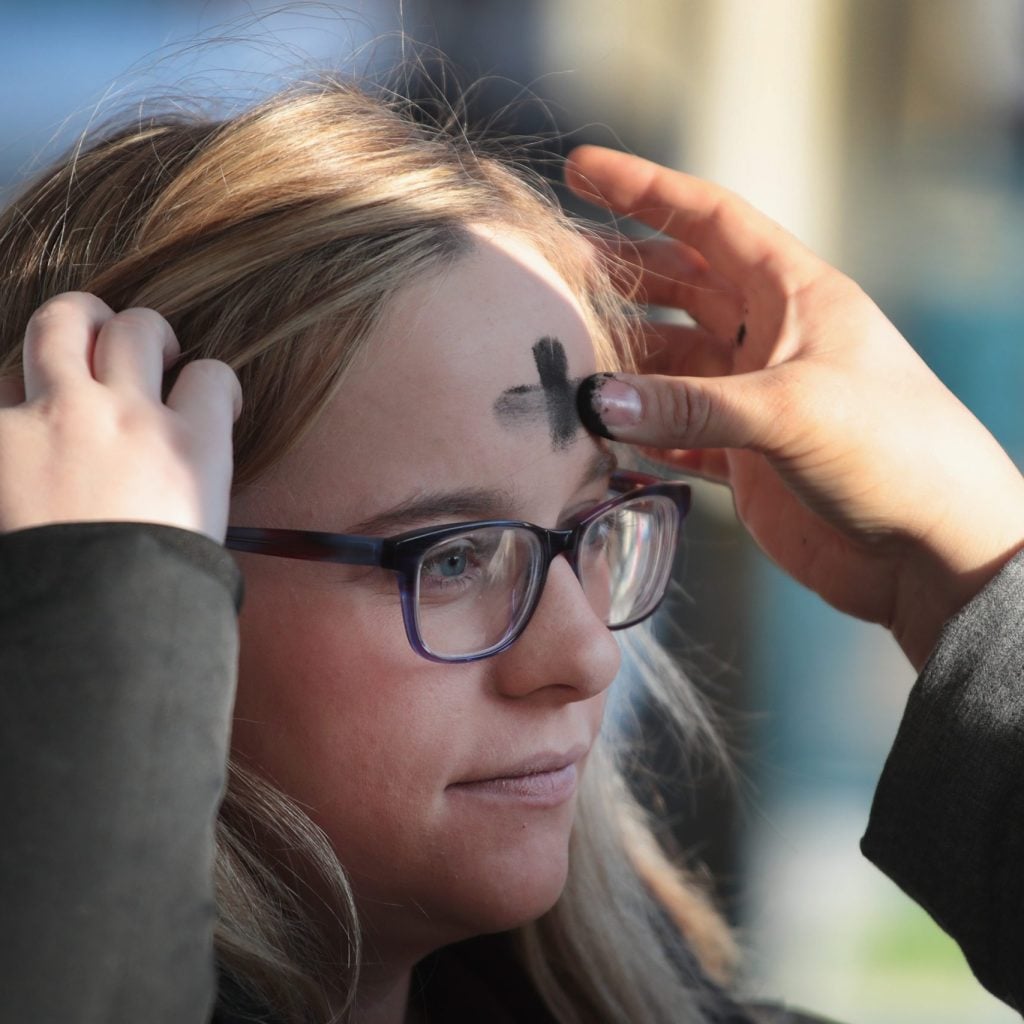
CHICAGO, IL - FEBRUARY 14: A commuter has ashes applied to her forehead in celebration of Ash Wednesday before catching a subway train in the Logan Square neighborhood on February 14, 2018 in Chicago, Illinois. Ash Wednesday is observed by Christians to mark the first day of Lent, which begins 40 days of fasting and self denial which end the Saturday before Easter. (Photo by Scott Olson/Getty Images)
Lent is a solemn, 40-day period of prayer, fasting, and almsgiving for millions of Christians across the world. Observed by certain Christian denominations, including Roman Catholics, Eastern Orthodox Christians, Anglicans, Episcopalians, Methodists, Presbyterians, and Lutherans, Lent is a season of preparation. It takes place during the six weeks leading up to Holy Week, culminating with Easter on Sunday, April 5.
The season of Lent and its themes of self-disciple and reflection are modeled on an account in Matthew chapter four in the New Testament of the Christian Bible, when Jesus was led by the Holy Spirit into the wilderness for 40 days and 40 nights and tempted by Satan three times.
CHICAGO, IL - FEBRUARY 14: In celebration of Ash Wednesday, Jonathan Randall Grant, of the Urban Village Church, rubs ashes on the forehead of a commuter outside of a subway station in the Logan Square neighborhood on February 14, 2018 in Chicago, Illinois. Ash Wednesday is observed by Christians to mark the first day of Lent, which begins 40 days of fasting and self-denial which end the Saturday before Easter. (Photo by Scott Olson/Getty Images)
Ash Wednesday
Ash Wednesday is the first day of Lent for many Christians, and it took place this year on Feb. 18, 2026.
Ash Wednesday is observed in church services that include “the imposition of ashes,” where clergy use ashes — often collected from the burnt remains of the previous Palm Sunday’s branches — to mark the sign of the cross on congregants’ foreheads, stating “you are dust, and to dust you shall return.”
This practice symbolizes humility, mortality, and repentance. Some Christians fast on Ash Wednesday, refraining from eating meat or eating no more food than what amounts to one meal.
Ash Wednesday is preceded by Shrove Tuesday, also known as Fat Tuesday or Mardi Gras, the final day of feasting and celebration before Lent begins.
NEW YORK, NEW YORK - FEBRUARY 18: People walk around with the sign of the cross in ashes on their forehead on Ash Wednesday on February 18, 2026 in New York City. Ash Wednesday is the start of Lent, Christian's 40-day season of prayer, fasting and giving in preparation to honor what they believe is the resurrection of Jesus Christ on Easter Sunday. The cross which is placed on a worshiper's forehead by a priest indicates that a person belongs to Jesus Christ and is grieving and mourning for their sins. (Photo by Michael M. Santiago/Getty Images)
Fasting during Lent
One ritual of the Lenten season is fasting. This can look different across various traditions and individual practices.
Catholics abstain from eating meat on Ash Wednesday and Good Friday, as well as all Fridays throughout Lent.
Some Christians fast by giving up something specific for Lent, such as sweets, alcohol, or screen time. Others choose to take on additional habits, like daily prayer or volunteering.
Orthodox traditions observe the Great Fast or Great Lent — one of several canonical fasts throughout the year, which includes abstention from animal products.
When is Lent 2026?
For some Christians, Lent began on Wed, Feb. 18 and ends on Easter, which is Sun, April 5, 2026.
For Orthodox Christians, who follow a different calendar, Lent began on Clean Monday, or Pure Monday, Feb. 23 and ends on Easter, or Pascha, on Sun, April 12.
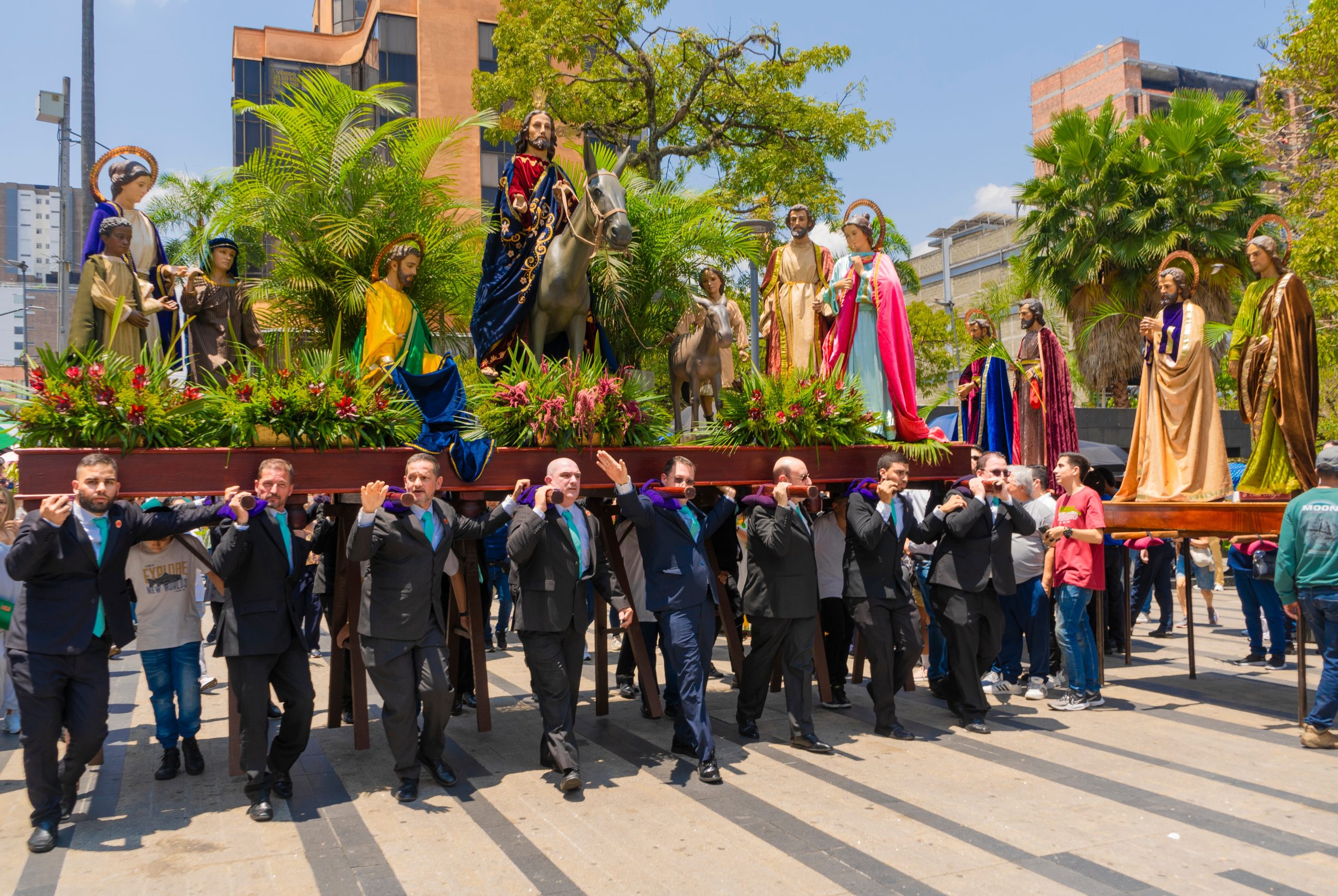
A Palm Sunday procession in Medellín, Antioquia, Colombia on March 24, 2024. (Getty Images / Alexander Canas Arango)
Holy Week
Holy Week, the most sacred and final week before Easter, commemorates the events of the Passion of Jesus Christ, from his arrival in Jerusalem to the final three days before his death and sacrifice on a cross, to his resurrection.
It begins on Palm Sunday, the day of the son of God’s arrival in Jerusalem, when he was greeted by crowds waving palm branches.
At the end of Holy Week are three days known as the Triduum: Maundy Thursday, a commemoration of the Last Supper; Good Friday, the account of Jesus’ death on a cross; and Easter Sunday, the celebratory feast marking his resurrection from the dead and the end of the penitential season of Lent.
Interfaith Resources
Read interfaith leaders’ reflections on the practice of fasting.
Interfaith America’s Chris Crawford reflects on an Ash Wednesday interfaith lesson.
Listen to IA’s Jenan Mohajir discuss the convergence of Ramadan, Lunar New Year, and Mardi Gras.
Interfaith America seeks contributions that present a wide range of experiences and perspectives from a diverse set of worldviews on the opportunities and challenges of American pluralism. The opinions expressed herein do not necessarily reflect those of Interfaith America, its board of directors, or its employees.
In honor of the Semiquincentennial, Interfaith America is excited to share a positive vision of our nation's future — out of many, we can become a new whole.
Subscribe to customizable email newsletters with articles, podcasts, events, resources, and grants from Interfaith America. We equip leaders to cooperate across differences for the common good on campuses, in communities, and in workplaces.