
Thomas Jefferson never referred to himself as a member of the People of the Book, but it’s likely a phrase he would have appreciated. He was, after all, a person of many books. His was always a bibliophile’s faith, defined and transformed by the thousands of volumes he acquired throughout his life, and best expressed through pages he pieced together and bound himself.
Of the 6,487 books from his private collection that Jefferson provided the federal government as the core of a new Library of Congress in 1815, about 300 dealt with religious subjects. The tomes selected for shipment from Monticello to Washington, D.C., included a score of Bibles, a Quran, a history of “heathen gods,” and works by deist philosophers.
Though deism aligned closest with his personal beliefs, it was Jefferson’s copy of the Quran that offers a fuller if more surprising view of how he thought about religion. The edition he owned, The Koran, Commonly Called the Alcoran of Mohammed, was translated by the Englishman George Sale, who, despite being the translator of the primary text of Islam, was hardly sympathetic to it. His position on the faith was that, “Providence has reserved the glory of its overthrow” to Christians.
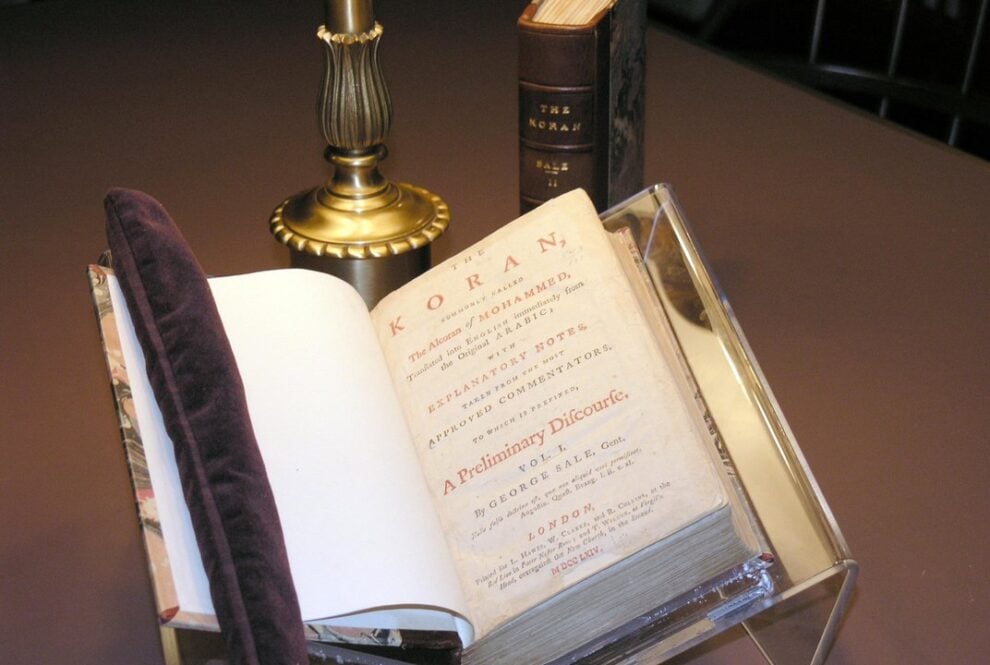
Yet Sale presented the Quran to readers – and thus to Jefferson – not merely in the spirit of triumphalism but as a matter of historical and cultural literacy. “To be acquainted with the various laws and constitutions of civilized nations, especially of those who flourish in our own time, is, perhaps, the most useful part of knowledge,” he wrote. “If the religious and civil institutions of foreign nations are worth our knowledge, those of Mohammed, the lawgiver of the Arabians, and founder of an empire which, in less than a century, spread itself over a greater part of the world than the Romans were ever masters of, must needs be so.”
Jefferson purchased the text in 1765 while a law student in Williamsburg, Va., mainly for the pragmatic reason of gaining a better understanding of global legal systems.
This practical approach to pluralism – acknowledging that the world is religiously diverse and can only be understood as such – would guide Jefferson for the rest of his days. Not long after he put pen to parchment on his Declaration in Philadelphia in 1776, back home in Virginia he began advocating for religious freedom, arguing that “neither Pagan nor Mahamedan nor Jew” should be excluded from civil rights because of their religion.
Jefferson encountered people of varied beliefs more often in books than in one-on-one encounters, but that did not diminish his conviction that the lived reality of religious difference must be protected in order for the new nation to meet the promise of its founding.
As wide ranging as Jefferson’s pluralist library was when it was catalogued in 1815, the book that provides the purest expression of his religious ideas was not among them. In fact, he had not yet created it, and it would not shape history’s impression of his views until long after his death.
A labor of love during his long retirement, the 84-page redacted edition of the New Testament that he called The Life and Morals of Jesus of Nazareth was the product of decades of thinking about scripture, religion and the role of each in society. Around 1820, the 77-year-old Jefferson worked with a penknife and glue to excise sections from the King James Bible, along with the original Greek and translations in French and Latin, and paste them into his own version of the sacred text.
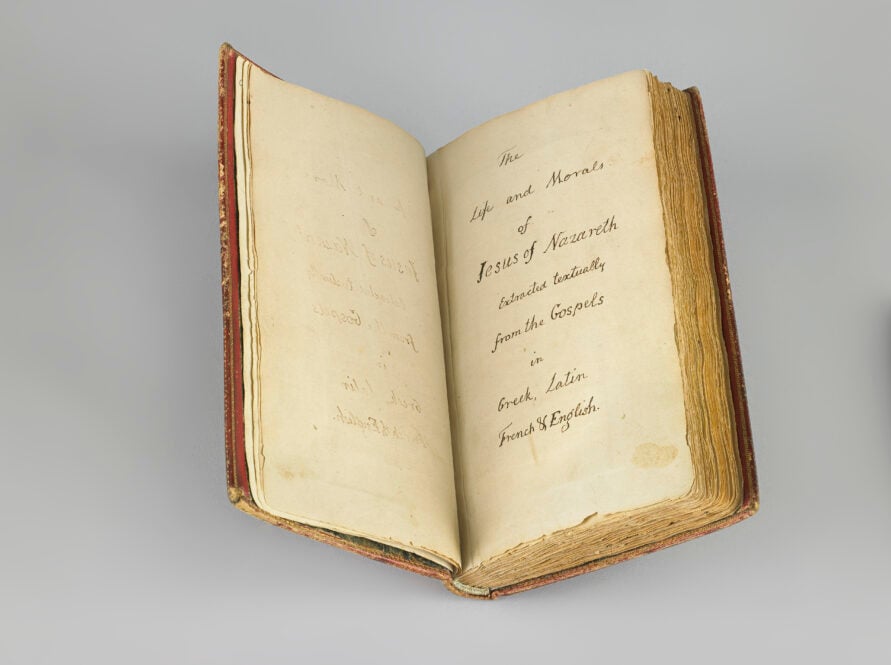
Frequently accused of heresy and even atheism, Jefferson knew that his cutting approach to scriptural interpretation – removing all mention of the miraculous, crafting a portrait of Christianity’s founder as a great teacher rather than God – would be too much to accept for those with more traditional perspectives. He discussed The Life and Morals of Jesus of Nazareth only with a few friends and never imagined it would be widely distributed – let alone known as a book now commonly called the “Jefferson Bible.”
While Jefferson was reluctant to broadcast the most radical of his beliefs, his thoughts on religion in general were no secret. The one book he published in his lifetime, Notes on the State of Virginia, includes a section on religion that captures the purpose and possibilities of matters of the spirit as he understood them.
In Jefferson’s view, the various religions of the world inevitably interact in ways at once contentious and transformative. “Uniformity of opinion,” he argued, was neither desirable nor attainable. “Let us reflect that the Earth is inhabited by a thousand millions of people,” he wrote. “That these profess probably a thousand different systems of religion. That ours is but one of that thousand.”
His argument was not only that those in the religious majority might have something to learn from the margins of dominant faith; he was arguing, in fact, that all faiths are marginal. Each on its own is just one in a thousand. Yet joined together in a community of faiths, and of belief and unbelief, each can somehow become part of something grander – like books sharing space on a library shelf.
Peter Manseau is the founding director of the Center for Understanding Religion in American History at the Smithsonian’s National Museum of American History. He is the author of eight books, including “The Jefferson Bible: A Biography” and “One Nation Under Gods.”

Recommended Next
Build with Us
Interfaith America equips leaders to cooperate across differences for the common good. Sign up to receive free resources, funding opportunities, and event invites in your inbox!