For a Christian Who Grew up Hindu, Life is an Interfaith Journey
January 3, 2023
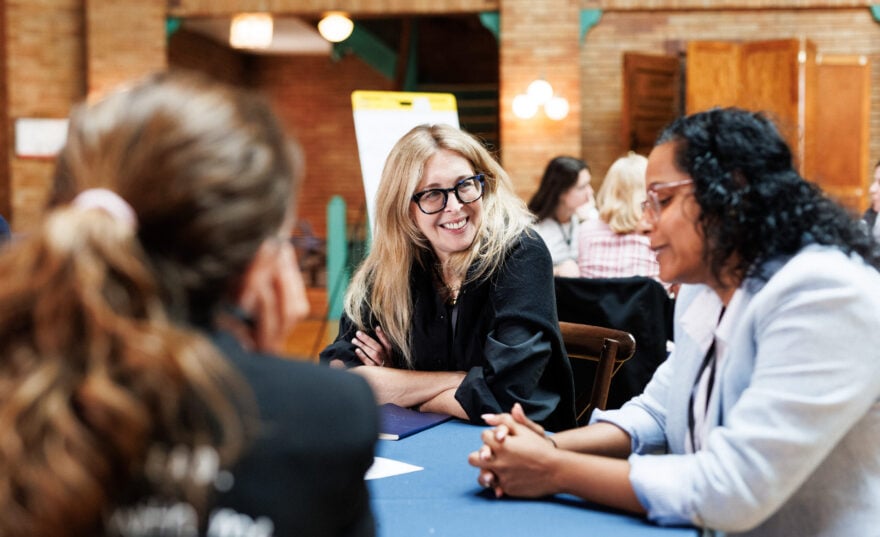
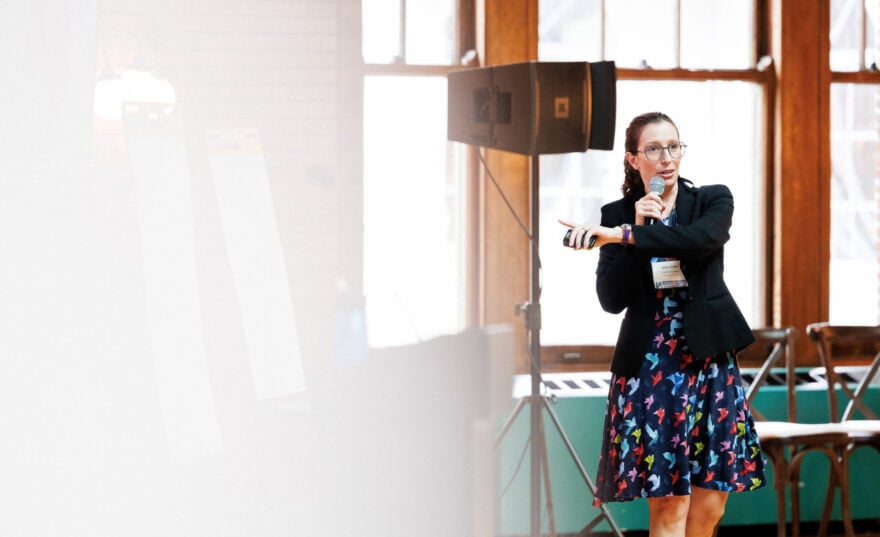
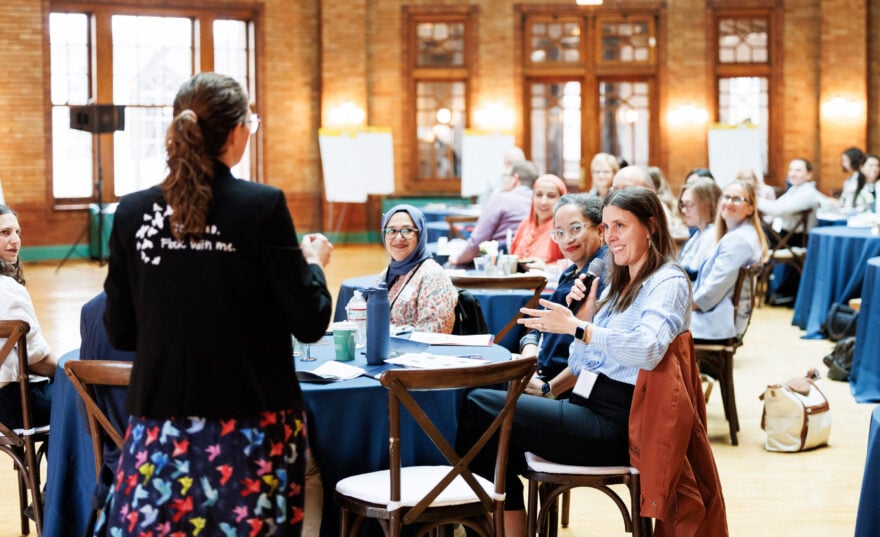
In August, I attended the Interfaith Leadership Summit in Chicago hosted by Interfaith America. It is not normal for me to be in a room filled with individuals from such diverse religious backgrounds. As I scanned the room, I couldn’t help but notice that it was not just our religions that made us diverse, but our ethnic and racial backgrounds as well.
Growing up Hindu in central Illinois, I was taught that there was more than just a correlation between race and religion, but rather that it was one in the same. This formative worldview could be captured in my own life in one simple phrase I learned from my family: “To be Indian is to be Hindu”.
The intertwining of race and religion is not wrong in itself, but I found myself in a predominantly white town in the United States where I had the ability to change, a change that would seemingly increase my social capital and privilege. When I say that I could change my race, I don’t mean that I could actually change it in the physical sense. Yet, everything I did for the first 20 years of my life, was working towards that unattainable goal. Performing into a Euro-American aesthetic was so deeply entrenched in my narrative, it included bleaching my skin to be more “fair.” The skin bleaching cream that has a monopoly in India to this day, “Fair and Lovely”, was a staple in my household. I watched as my mom applied it to her skin every day, which communicated that my skin was not beautiful as it was. But it was not just my skin that needed to change, but my clothes, my hair, my accent, even my smell. I call this process ethnic erasure and assimilation. As an Indian immigrant in the United States, this process was introduced to me before I could even speak. Thus began the war inside of me: Was I Indian or American?
Being Hindu, as my parents explained, was inextricable from being Indian. My parents brought us to the United States when I was 2 years old. Although they were chasing the “American Dream,” they could not easily shed what was natural to them, their Indianness. We had our Hindu idols in one of our bedrooms, where we would have our poojas. Occasionally, we visited the temple that was about a 45- minute drive away. The Indian community in our town got together to celebrate festivals like Diwali. Being Hindu was such an essential part of our being, my parents tried to preserve it the best they could. I remember singing the theme song from a television show I used to watch called “Big Time Rush”: “It’s the only life you got so you gotta live it big time!” My dad scolded me and said, “Don’t sing that; we don’t believe in that. We believe that you have more than one life, that you will be reincarnated.” He was not going to let Western media infiltrate his daughter’s mind and strip her of her belief system. Even me saying “belief system” is just a Western translation, because for Hindus, the tradition is not a religion but a way of life.
Between the ages of 8 and 10, the course of my life changed drastically. My father passed, leaving us alone in a foreign country. We began to attend church with an Indian family. At this age, I knew absolutely nothing about Christianity other than it was a “white man’s religion” and it had something to do with a man named Jesus, their founder and cult leader. Our Indian friends did not attend an Indian church, but rather a predominantly white, fundamentalist Baptist church. Even the paintings I saw of Jesus portrayed him as an Anglo-Saxon. The message was clear: “To be Christian is to be white.”

This was not the first time in my life that I had an opportunity to be more white. My whole existence in America consisted of assimilating, whether it was my clothes, food, hair, skin, scent or personality. I saw the Indian kids in our town get outcasted and bullied for showing their Indianness. For the sake of survival, I subconsciously assimilated. This translated directly to my religious identity. My conversion felt very genuine, and to be fair, I had also experienced a lot of abuse from the South Asian community. The messages I absorbed said being white was not only superior, but it was safer. The people at my church were friendly and safe, and they exalted my conversion story. A Hindu convert, after the loss of her father? Miraculous. For the next 10 years, I found myself in only white spaces, losing access to my Indian community and culture.
There was a great dissonance in inhabiting my brown body but being white in every other way. Eventually, it all came crashing down. First, it was a gentle exposure to my Indian culture, with the safety of a close friend. I was a sophomore in college and my new neighbor on my dorm floor had just come back from a 2-month trip to South India, specifically Andhra Pradesh. This allowed her to already understand the nuances of my culture to an extent that I had never encountered before from a person outside of my culture. We immediately began engaging with my culture is small but meaningful ways, which slowly massaged the wounds of my internalized racism. We would take trips to Little India to eat dosa, make chai, and watch Bollywood movies. The nostalgia was healing, forcing me to reckon with my racial assimilation. My entire imagination had been molded to the pursuit of Euro-American idealism. Race and religion were grafted as inseparable but as a package could be exchanged and performed. I was either Hindu and Indian or Christian and white.
The reality is, I can never truly shed my Indianness, therefore I can never truly undo my Hindu formation. The categories in which I perceive the world, although I have resisted and tried to discard them, are a part of my very own body. From that point, I realized that I had to untie the knots that bound my religion to my race. I did not have to be white to be a Christian. In fact, if Hinduism was a way of life like my parents had taught me, why did I ever need to get rid of it in the first place?
Racialization and structured religion are both Western concepts. The word “Hindu” itself means to belong to the land that is carved out by the Indus River valley, the Indian subcontinent. It is only because of racialization through colonialism in India that it has been categorized as a system, but originally it was a multitude of indigenous spiritualities that the colonizers lumped together because of their resemblances.
In a similar sense, Christianity has also been racialized and colonized into a structured system. Christianity is the inheritance of a Jewish faith, described in the New Testament as a fulfillment of promises “first to the Jew, then to the Gentile.” Jesus was not a white man, as I was led to believe. Rather, he was a first-century Palestinian. To be white is not synonymous with being a Christian.
So, I came to this point in my life where I found myself, a 21st century brown woman in America. I now understand I can be a second-generation South Asian immigrant, a Christian and a Hindu. No one can take my heritage away from me, and I am a Christian because I believe that Jesus Christ died on a cross for my sins and rose again on the third day.
I cannot so easily confess all three of these things. Some Christians would not find it acceptable for me to say I am Hindu because it has been historically developed as a religious system in our modern world. From their perspective, the two religions are mutually exclusive. Some Hindus would say that because I am a Christian, I have forsaken what it means to be Indian. I know that these are the questions I will face all my life, but I can choose to face them with empathy as I once came from these positions as well, wounded by a history of colonialism and whiteness. My interfaith journey has allowed me to begin to craft a theology that explores what lies in front of us, in our postcolonial era.
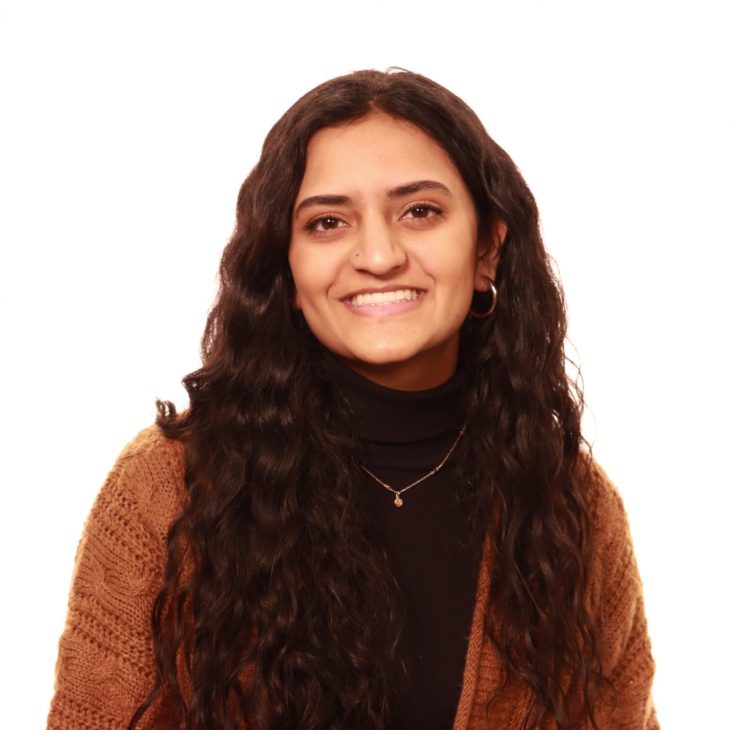
Shreya Ramachandran comes from a Brahmin Hindu background and has been a Christian convert since 2012. Navigating the tension of her two faith backgrounds is what motivates her to explore empathetic, interfaith dialogue. She is studying for a bachelor’s degree in linguistics at Moody Bible Institute in Chicago and hopes to pursue a master’s degree in theology at the intersection of race, postcolonialism, and Asian diaspora studies. She loves writing poetry, cooking Indian food, and serving chai to her friends.