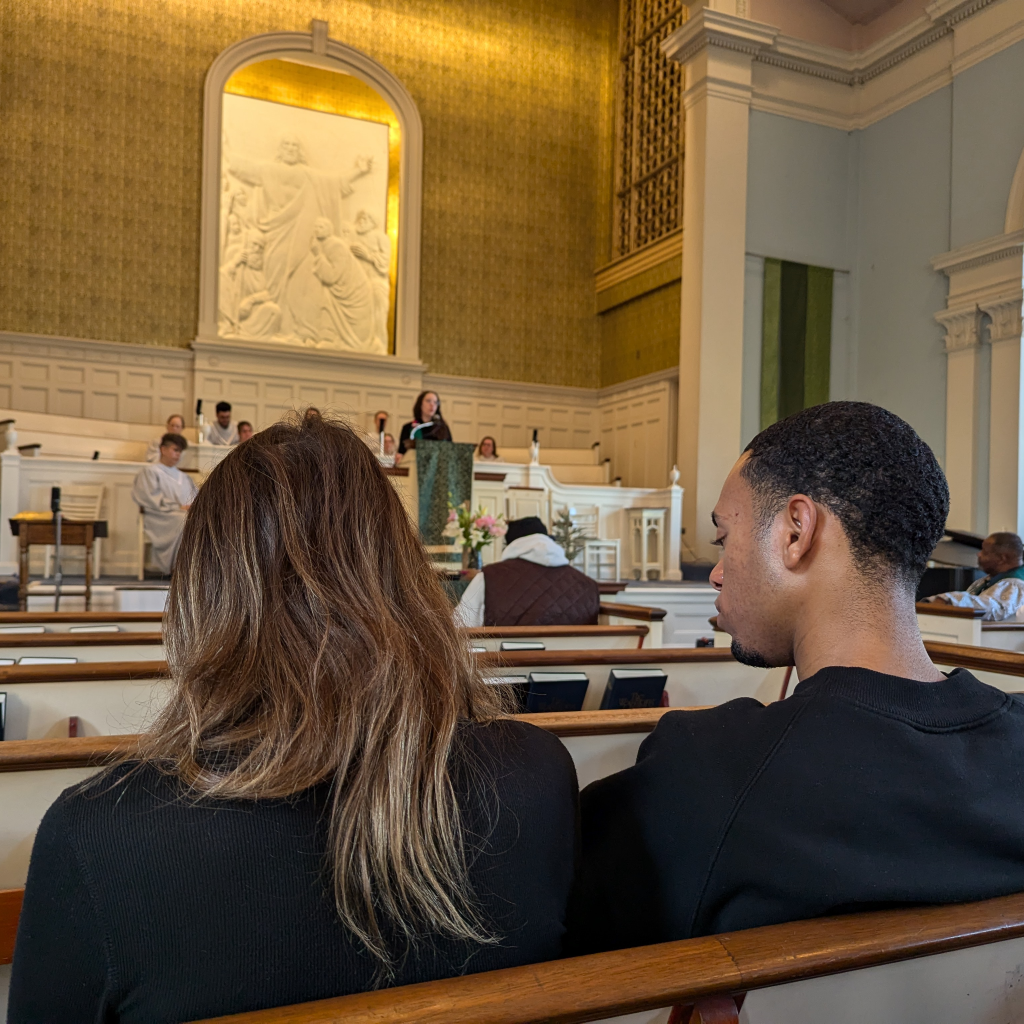
This sermon was preached in English and Spanish for a multilingual congregation at North Shore Baptist Church in Chicago on Oct. 27, 2024, and the text includes both languages.
Listen to the sermon.
There are many metaphors for God’s people in the Bible.
Sacred community can look like
a field,
a building,
a flock,
a bride,
a vine with many branches.
And they all are beautiful in their own way.
But there’s something so particularly powerful about the words of 1 Corinthians 12 which describe the community of Christ as a body.
Hay muchas maneras de describir la comunidad cristiana.
Somos el campo de Dios, el edificio de Dios, su rebaño, su novia,
Los ramos de una verdadera vid.
Pero la que quizás más me llama la atención, la que más
Me inspira, es que la comunidad de Cristo es un cuerpo.
Que cada persona es miembro diferente, con un don diferente,
Con una función diferente,
con partes quizás más débiles
que por ser débiles no son menos importantes.
And I feel chills in my own body every time I hear those words:
“Just as the body is one and has many members,
and all the members, though many, are one body,
so it is with Christ…
If the foot would say,
“Because I am not a hand, I do not belong to the body,”
that would not make it any less a part of the body…
If one member suffers, all suffer together with it.
If one member rejoices, all rejoice together with it.”
La que predica no es más importante
que la que lava trastes,
Que no es más importante que él que canta,
Ni la que hace fotocopias.
Todos dependemos los unos de los otros.
These words from Paul are so deeply grounding.
They remind us we depend on each other.
And they are also deeply frightening, because
they remind us that we depend on each other.
We live at a time in which independence
Is often synonymous with freedom.
Dependence is vulnerability.
It is vulnerability to abuse.
Vulnerability to tyranny.
Vulnerability to the changing whims of another.
Dependerse el uno del otro es algo muy hermoso,
Pero también es vulnerable.
No hay dolor más terrible que el dolor de
sufrir a la mano de alguien en que dependemos.
Independence is important.
Being able to make decisions for oneself,
To have some impact on the world around us,
To have a voice that matters,
These things are essential components of freedom,
And to have them,
One needs some measure of independence.
But there is no escaping the basic reality that our lives
Always depend on one another.
And that is vulnerable.
No matter how many weapons one acquires,
How big an army a nation may have,
How much money one accumulates,
There is no opting out of the fundamental vulnerability
Of human existence.
I don’t know that there is a time
when the reality of our interdependence
Is more stark
Than election season.
You don’t even have to listen to candidates.
You can just listen to people around you
and really soak in
The fact that this person on the television,
or in your family,
or at work
Is bound up with you in a common decision-making process
that has real consequences for all of our lives.
And it is so easy to fall into the trap of trying to escape
the intense vulnerability that election season makes us feel.
Maybe you dream of leaving the country if the election doesn’t go how you want.
Or maybe you pour money into one party or another.
Because you can be a billionaire pouring money into the election,
But at the poll, you are only one voice among millions.
And it is very evident at the moment that there are billionaires
Who find that fact deeply uncomfortable.
Facilmente se rompen el tejido que nos une como seres humanos
El miedo desbordante, la ira, hasta la verguenza
Nos pueden hacer ciegos hasta que lo único que vemos es nuestra necesidad, nuestro dolor.
Podemos hacer cosas terribles a nuestro prójimo,
Pero aunque fácilmente se rompe el tejido,
Nunca escapamos de la red, no podemos esquivar
la realidad básica
Que nos dependemos los unos de los otros.
La que predica necesita él que canta,
Y ambos dependen de los que limpian y los que hacen fotocopias.
El cirujano salva vidas,
Pero también las salva la trabajadora que disinfecta ese quirófano.
Interdependence is scary. Because people mess up.
When we get scared, or enraged, or ashamed,
We can do terrible things to each other.
It is awful to say, but I think probably most of us at some time have felt, at a deep level,
A visceral sense that
“I would prefer to drive these people out than depend on them.”
“I prefer their destruction to their continued existence,
if their continued existence
means I must rely on them in some shape, form, or fashion.”
And we can clothe this amputation of the body in the name of righteousness,
in the name of patriotism,
Even in the name of Christ himself.
Do unto others as you would have them do unto you,”
Becomes “do to others as you imagine they would do unto you.”
The most hideous of acts get justified with the words,
“It’s what they would do to me if they had the chance.”
And that logic begets a circle of violence that has no end.
It requires tremendous courage to claim
That being in sacred community
does not mean escaping our interdependence,
But rather means embracing it.
That being in sacred community does not mean escaping our interdependence, but rather means embracing it.
El Espíritu que nos entrelaza, que nos teje en un solo cuerpo,
Nos va susurrando, que todo va a estar bien.
Que dentro de la dependencia también puede haber libertad.
Es la libertad de saber que no tenemos que hacer todo,
Porque somos parte de algo más grande, que es la obra de Dios.
Y aunque el ser humano nos falle,
Aunque nos hiera,
Seguimos siendo un cuerpo en Cristo
Sostenido por el Espíritu.
Porque el sueño divino para nosotros
no es que escapemos nuestra interdependencia,
Sino que la vivamos con confianza.
Confianza en Dios que quízas nos puede dar valentía
para confiar también en nuestro prójimo,
Con plena conciencia del dolor que nos puede causar,
Porque al fin del día, todos estamos en la mano de Dios.
We are one body.
By one Spirit, we were baptized into one body-
Immigrants and U.S.-born,
Rich and poor,
Republicans, Democrats, and those disillusioned by both.
Baptized into one body and made to drink of one Spirit.
Made to drink of one cup.
And when I read those words this week, the first thing that sprang to mind
Was Jesus in the Garden praying,
“Father, if it is thy will, let this cup pass from me.”
Let this cup that would bind my future to others pass from me.
Let this cup that connects my heart to their pain pass from me.
Let the cup that makes us one pass from me.
The common cup of which we drink
Is often one of pain.
The cup that we drink in Communion, after all,
Is a sign of sacrifice.
To be baptized into the body of Christ
Is to be baptized into a body that was tortured and murdered.
You’d think if the Spirit made us one, we would become something invincible,
We’d become, you know, like Megatron.
But no. We become a body that can be wounded.
And we will be. Regardless of what happens on November 5,
wounds will open and pain will pour out around us
in the weeks that follow.
So it is a natural, human response
when the Spirit makes us to drink of one cup
That the cry of our heart would be
“Let this cup pass from me.”
None of us want to hurt more.
None of us want to suffer more than we already do.
But that’s the thing of it. If none of us want to hurt more,
It’s because all of us hurt.
Every one of us carries grief in our hearts over someone we have loved and lost.
Every one of us has stood by and watched as someone we loved suffered
And felt powerless to help.
Every one of us has felt pain. And fear. And shame. And rage.
Even if we all have our own separate cups,
They still contain the same stuff.
In the 1940s, the Nazis engaged in a bombing campaign against London.
And often families would send their children to live in rural areas.
Kind strangers would open their doors and take them in to keep them safe from the bombing
But after the war, they found that children
who had been separated from their families to live in safety in the country
Experienced more pain and more anguish
than those who remained with their families in London.
The children who stayed with their families,
even through the violence and the fear of the air raids,
were much less traumatized.
This does not mean that people should remain in war zones to be killed.
But it does suggest that there is a particular kind of suffering that emerges
When we intentionally separate ourselves from the suffering of others,
Particularly those who are close to us.
And believing that this separation is the path to flourishing
Will ultimately break our souls.
I do not believe it is God’s will for us to suffer,
But I do believe God is never more present than
in the healing power of sharing pain,
the drinking of one cup.
Because by the peculiar alchemy of the Spirit,
There is healing in drinking of one cup,
Even if it is the cup of sacrifice.
We heal when we share our suffering.
Ser un solo cuerpo es sufrir juntos. Es llorar juntos.
Es compartir la risa y las lágrimas,
con la fe que Dios está presente en todo.
So today we come forward with our pledges,
Agreeing that we are enriched by the community that is built
When we share our resources with one another.
That we are all healed when we take on the vulnerability of one another,
When we share pain with one another in our prayers, in our service.
Today, we celebrate the healing power of a crucified Christ
That moves among us when broken people come to be together in our brokenness.
We celebrate our collective life this day,
The sharing of joy AND the sharing of pain,
Because God’s love is equally present in both places.

Kathryn Ray
Kathryn Ray is an ordained minister in the American Baptist Churches USA. She has served on the pastoral team of North Shore Baptist Church since 2015. She has a B.A. in Religion from Oberlin College and master’s degrees in divinity and social work from the University of Chicago.