In ‘This Here Flesh,’ Cole Arthur Riley Finds the Sacred in Humanity
February 21, 2022
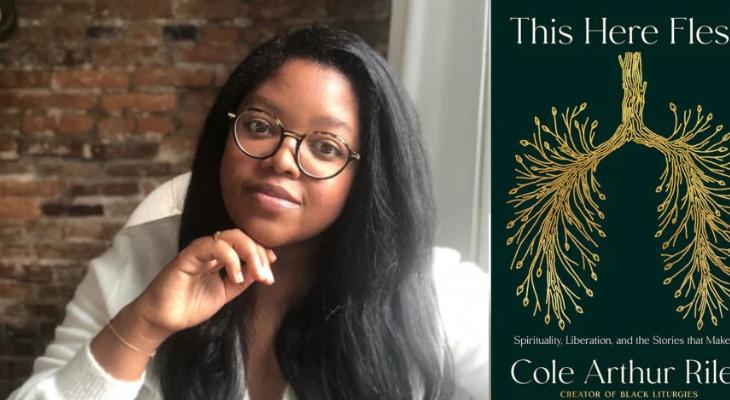
(RNS) — In the cataclysmic summer of 2020, a new account called “Black Liturgies” quietly appeared on Instagram.
“Black Liturgies is a space where Black words live in dignity, lament, rage, and hope,” the first caption reads. Images of white text strewn across earth-toned backgrounds were posted daily, sharing mantras, quotes and prayers written for and about the lived realities of Black readers.
Today, 146,000 followers visit the feed for reflections on the Christian liturgical calendar, the sacredness of Black life and importance of breathing deeply.
Personal details about the author of the Instagram account, Cole Arthur Riley, have been surprisingly sparse, however. “It’s a rare moment that I will show my face or bring my specific story into those spaces,” Riley told Religion News Service.
But with Riley’s debut in print, “This Here Flesh: Spirituality, Liberation, and the Stories That Make Us,” that’s about to change. “I think people will be surprised just how much of myself this book contains,” said Riley.
Citing influences such as James Baldwin, Toni Morrison, Howard Thurman and Julian of Norwich, Riley explores spiritual questions about dignity, belonging, rage and rest through her family’s stories.
Religion News Service spoke with Riley about her evolving spirituality and the vulnerable process of sharing her new book, set to be released by Convergent Books on Feb. 22. This interview has been edited for length and clarity.
How did this book grow out of your Instagram account?
When I began Black Liturgies, I thought I was going to write a book of serious contemplative nonfiction. As I began to write, I realized that my strength as a writer is in storytelling. Simultaneously, I had these conversations with family to preserve my family stories. I started with grandma and father. Their stories were so alive in me, it was like I couldn’t write anything else. I would go to write about lament, and I had nothing to say about it without starting with my grandma crying on the linoleum floor, and I had nothing to say about dignity if I couldn’t start with my dad greasing our scalps every morning. It was a slow unfolding, but I realized that this was the book I wanted to write first.
You dedicate “This Here Flesh” to the house on Cemetery Lane. What’s the significance of that location and the intention behind your dedication?
The title is a subtle nod to Toni Morrison’s novel “Beloved” and the speech that the matriarch Baby Suggs delivers to this intergenerational group of people. In that book, the characters are making sense of this ghost-force haunting their home. I realized as I was telling the stories of my grandma and me and my father, location was key. The home was key as a place of beauty but also terror and secrets. My grandma lived on Cemetery Lane, and there was a lot of darkness there. I wanted to have this declarative statement to ground the book, to say, you will encounter a lot of terrors and traumas that my family has gone through. But in the end, I would hope that there is this message of us remaining. We’re still here. We’re not afraid of the stories that have made us and that have formed me. We’re prepared to face them.
You repeatedly stress the sacredness of the body, yet you’ve experienced physical challenges. How do you reconcile your embodied sense of spirituality with that pain?
I think we’re having a social moment of curiosity and exploration around the body. I and others have used the phrase, “listen to your body.” That’s really beautiful, but for those of us who are disabled and live with chronic pain, it’s a really difficult call, to listen to your body. It carries weight. So when I talk about embodiment in the flesh, it’s not a ‘rah-rah,’ positivity, self-help approach. It’s about paying attention to all of it. Sometimes me attuning to my body is really terrible. The question is more, do you still care for and tend to that physical part of you?
It’s really important, I think, as spiritual people, to push against this narrative of disembodiment, especially in white intellectual spaces. It takes real strength to resist spirituality where the hierarchy of the mind is the path to God, as opposed to your body.
In that same vein, your book articulates a suspicion about faiths that over-emphasize the afterlife. During this time of loss and death, does your spirituality include beliefs about eternity?
I lost my grandma during the editing process of the book, and she is a huge force in this book. I’ve been experiencing a lot of grief in this season, which leads me to think about mortality and what perseveres, what pieces of us transcend. The more I think about it, the more confused I get. I’m in this place spiritually and as an artist where I’m trying not to force any specific set of beliefs and doctrines. I want to always have an imagination for the eternal, but in this season, I’m less clear on what that concretely means. Some days I’ll think one thing, and the next I’ll think something completely different. I want to allow myself that kind of freedom and curiosity.
You’ve said that white audiences have misappropriated or whitewashed the content on Black Liturgies. Were you concerned about that with the book?
It was definitely a concern, and is still. I’ll re-read a passage and think, man, there are a few moments where I kind of let the white gaze in. I’m going to have to live with that. It’s so hard as a writer who needs to be paid. The white gaze, it pays. The white gaze can make a post go viral or get you a better paycheck. So it’s tempting to cater to that. But I knew I had to be really intentional and interrogate myself along the way about who I’m catering to.
You use he, she and they pronouns for God in your book. What does that reveal about your beliefs about who God is?
I hope people feel this expansion, this freedom, curiosity and even playfulness in the pronouns I used for God. Of course, it’s a bit worrying. Will people rate your book poorly, just because you call God “she” on the second page? But to me the cost is worth it in order to give people an imagination for God that isn’t so singular.
Would you use the label ‘Christian’ to describe yourself? Or is there other language that better represents you spiritually?
You’re asking all the things I’ve been asking myself. Some days I wake up and really feel that ‘Christian’ is the identity I live into. Other days, I think, certainly not. No Christian would claim me, because today I’m having a really difficult time believing that Jesus is divine.
I try to be honest about being formed in a Christian tradition in this season, so I’m transparent about the religious privilege I’m speaking out of. There is so much beauty in the Christian tradition. I’m not ashamed of it. But I am ashamed of what people have done in the name of Christianity.
In your chapter on repair, you ponder whether Christ’s death might be itself a form of reparation. Could you expand on this idea?
I’m hoping people read that as a real open-ended question, because I don’t actually know what I think. I’m not convinced that Christ’s death saves people. I think there’s something compelling about the question that James Cone and others have asked — is this a beautiful act of sacrifice or tragic punishment?
It’s an interesting question for those who do believe Christ’s death was necessary. Could that salvific act be seen as reparation? As a chosen act of repair that allows people to exist in greater freedom? I think if you believe that, you should be asking what it means for your beliefs on reparations.
You write about a time when you wanted to be seen and heard as little as possible. What has it been like to share so much of yourself?
It has been terrifying. Anyone who knows me knows that I’m a very private person, and I don’t pride myself on that. When I think about people reading this book, seeing the things that made me, I feel so raw and so bare. So come the 22nd, if you need me I’ll be in bed, under the covers, probably eating Skittles. Hopefully I can have the world go quiet for at least a day before I get into the thick of things.
Share
Related Articles