We Commemorate, We Commit: Out of Catastrophe, a Conversation on Connection and Repair
September 9, 2021
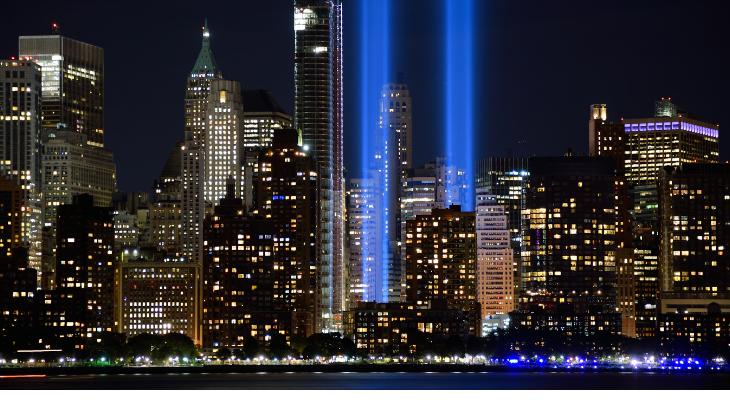
A Sikh, a Muslim, a Christian, a Jew, they worshipped God in different ways and watched the towers fall from different places: Valarie Kaur, the daughter of Sikh farmers, was a student at Stanford University on Sept. 11, 2001. Alia Bilal watched the news that morning from her 7th grade classroom at an Islamic school in Chicago. John Inazu, a young Air Force attorney, was at his desk in the Pentagon when a plane crashed into the building. Robert Klitzman, a psychiatry professor in New York City, got on a subway to the World Trade Center to look for a sister he would never find.
In a moving conversation moderated by IFYC founder Eboo Patel in partnership with Sonal Shah, the founding president of The Asian American Foundation, the four shared a virtual stage yesterday to reflect on that morning two decades ago, mourn the 3,000 who died, and tell how they turned catastrophe into a catalyst for their life’s work: activism, research, teaching and writing that aims to protect, inspire and serve. “Four remarkable people,” Patel said, who took “profound suffering, loss and grief” and “somehow managed to not center enemies. What can we learn from that? How can that be a teaching to the culture?”
Read the highlights of the conversation below. You can also listen to audio of the conversation, watch the full conversation here, or scroll down to read the full transcript.
Valarie Kaur, Founder of Revolutionary Love Project, talks about being home for summer break as a college student when her father woke her up with the news of the attack. As they watched the footage of the attack: “If you weren’t in New York, if you’re just watching it, [the video] was on this endless loop. The towers falling over and over and over again, and then between these images, suddenly the image of Osama bin Laden showed up. A man with a turban and beard and in that moment, I said, ‘Oh, our nation’s new enemy looks like my family.’”
Kaur describes the fear her family felt as news of rising hate crimes against the Sikh community spiked up after 9/11. On Sept. 15, their family friend, Balbir Singh Sodhi, a gas station owner in Mesa, Arizona, was fatally shot – the first hate crime murder in retaliation of the 9/11 attacks. Kaur remembers hiding in her room and crying, and reading Harry Potter to escape the reality. She didn’t feel she could return to college, so she made a proposal to the university: “I asked my university if we could take this camera I had, my cousin and I, and travel across America to start capturing the stories – Balbir uncle’s story, the stories of hate crimes.”
On becoming an activist: “I was going to be an academic, even thought I was going to be a professor of religion, but I wasn’t going to be an activist. That decision came after Balbir uncle’s murder and all the murders that followed, all the hate that followed, but never ended. We call it the backlash, and yet it never ended. It’s still going on like our communities are five times more likely to be targeted to hate than we were before 9/11. And I’m not a college kid anymore — I am a mother. My children are growing up in a nation more dangerous for them than it was for me. That moment to respond to Balbir uncle’s murder by taking that camera and crossing the country was a moment that I think so many of us who were college kids or graduate students had it catalyze a little generation of advocates.”
A few years ago, Kaur joined Rana Singh Sodhi, Balbir’s brother, on a phone call to Frank Roque – Balbir’s killer. Roque said: ‘I am sorry for what I did to your brother. When I go to be judged by God, I will ask to see your brother, and I will ask for his forgiveness.’ Rana replied: ‘You’re already forgiven.’ Recalling the conversation, Kaur says: “The lived faith of Rana Sodhi and so many Sikhs who I’ve been able to witness have taught me that forgiveness is not forgetting. Forgiveness is freedom from hate.”
Share
Related Articles
American Civic Life
Is This a Time for Bridgebuilding? 5 Leaders in Conversation
Racial Equity
Immigrant Faith Communities On Rooting Out Anti-Black Racism
American Civic Life
Dr. Robert Klitzman, Professor of Clinical Psychiatry and Director of Masters in Bioethics Program, Columbia University, was rushing to a 9 am meeting when his mother called to tell him about the planes crashing into the World Trade Center, and that his sister, Karen, who worked in one of the buildings, wasn’t answering her phone: “I told her I am sure she is fine. The way that when someone says it’s an earthquake in a part of the city or some other area in the world and you assume that most people you know in that area are okay.” As he entered the office building, he saw the security guards watching footage of the buildings on flames on television, and he thought to himself, “Oh my God, maybe my sister died.” Everyone in his meeting was talking about the attack, and when they heard his sister wasn’t returning his calls, they suggested he should go out looking for her. He took the subway down, surprised that the subways were still running, and went from one hospital to the other, perusing through the lists of survivors. When the hours turned to days and he didn’t find his sister: “It slowly began to dawn on us that she died. She was 38.”
On the aftermath and grief: “She worked three floors above where the airplane hit. It was horrible, of course, but also surreal in a way, because it’s not like when someone dies in a hospital, there was no body. When someone dies and they were in the hospital there is a chance to say goodbye, or if they have cancer, they may not make it, and you sort of get used to that idea.” A few days later, the FBI started finding body parts, and they identified a femur bone: “For months and months we had nothing. We had to clean out her apartment and…it was…deeply disturbing, deeply upsetting, and hard to get my mind around that some guy in a cave in another part of the world had murdered my sister.”
A few weeks later, the city invited the families of victims to visit ground zero. “We got a tugboat and went down and there’s still piles and piles of debris that was still smoking and hot and smelled. And I looked up in the sky. Why, somewhere up there, she worked in one of the buildings, and it’s gone. It was a sense of profound loss; it still is with me every day.”
On how he moved forward: “Personally, after my sister’s death, I just come to appreciate life much more. I mean how grateful I am to even be alive, you know, to appreciate things that are wonderful…parts of the world that are around us every day and many of us miss them because we are caught up in whatever.” Dr. Klitzman also went on to write a book “When Doctors Become Patients,” chronicling how doctors learned and unlearned what patients go through when they are sick, and redefined their perspective on religion and spirituality.
On the importance of understanding diverse believes: “I think realizing the commonalities is important. I think, politically, there were things that were done in the name of the people who died that are just ridiculous…I think that understanding what are appropriate responses to hate and how we should respond to each other and each other’s beliefs is a really important mission.”
Alia Bilal was getting ready for high school on the morning of Sept. 11, 2001 and noticed her mother watching the news on television: “I heard my mother exclaim. Then I remember her saying, ‘My God, I hope it’s not Muslims.’ It was interesting, because I had often heard my mother say, ‘My God, I hope it’s not Black folks’ while looking at the screen.”
“For me, the aftermath, as we’ve termed it, starts with that day. School shut down early…The police were coming to us and letting us know that we’ve had bomb threats against the school. It’s probably best for you all to go home … Later that evening we learned there were KKK members flooding the parking lots, chanting all sorts of things …And that set the tone for really the next 10, 15, 20 years of my life, and the lives of my Muslim friends and peers and colleagues.”
She noticed more immigrant families displaying the American flag after the attacks. “I never had the feeling I had to prove my Americanness. I’m Black. I’ve been here. My grandparents have been here. My great-grandparents have been here… Especially as a Black American woman in this country, (I felt) the awfulness of wanting to grieve the way that my fellow Americans wanted to grieve that day, and not being able to because we, on top of grieving those 3,000 lives that were lost, are grieving the loss of our innocence and our ability to be able to walk out without people staring at us with daggers in their eyes. I’ve shaken most of that off me, but it’s been a process.”
On early discussions around naming IMAN, the Inner-City Muslim Action Network, where she is now a deputy director: “Some very well-meaning people were really struggling against the idea to put the word ‘Muslim’ in the name … Something in the conscience and souls and hearts of the people forming the organization at the time said, ‘No. We need to put Muslim in that name. We need to demonstrate that there is an organization out there doing this work.’… I’m so grateful that they did.”
On IMAN after 9/11: “Throughout all of the hatred and the vitriol and the burning down of Muslim-owned stores in the suburbs … the community on the South Side of Chicago at the Inner-City Muslim Action Network didn’t have that experience. On 9/11 and afterwards, people came to them said, ‘Is there anything you guys need? What can we do to support you?’” They knew IMAN as “the people that are giving me healthcare, these are the people that have youth programs for my kids, these are people doing organizing with Muslim store owners and trying to get them to have fresh food … that are forming relationships with Black churches and Latino organizations and Jewish organizations across the city.”
On building work out of the tragedy: “It taught me that my place, especially as an African American Muslim born and raised on the South Side of Chicago, is where I need to be anchored is where there’s the greatest pain and the greatest need and the greatest trauma…Our community suffered a loss (yesterday) of an individual who meant so much to so many people. He was a mentor, a brother, a friend, a teacher … Many of us have just been grieving that. But the work that he was doing, at the center of that work, is bringing people’s hearts together, reconciling people’s hearts and reconciling communities. In so many ways, I think that is so much of the work that many of us do… the hard, messy, sometimes really difficult work of bringing people’s hearts together.”
Related Audio
John Inazu, a professor at Washington University in St. Louis, was an Air Force attorney at the Pentagon on Sept. 11, 2001: “When the second plane hit, everybody knew immediately it was terrorism, and we also knew the Pentagon was a prime target.” After calling his mother, he said a prayer: “I think the prayer was something like, ‘Let me focus on my work. Let me be good at my job right now.’” As the plane approached the Pentagon, he remembered noise, and then silence. “Those of us on the other side of the building heard nothing. (Soon) there was a lot of smoke and people starting to scream.” Told to report to work the next morning, “I could see the smoke between my head and the computer screen, and they were telling us, ‘It’s fine. You’ll be okay.’”
On fear: “How incredibly human it is, and how incredibly dangerous it is. I was fearful on 9/11. I was fearful in the weeks after 9/11…I remember that every day I checked under my car for a bomb, not that I knew what a bomb looked like.”
On seeing Christians using fear to justify constraining civil liberties: “I want to say to my fellow Christians, where in the gospel of Jesus do you find fear as a motivator? It’s just not there…Not to say we’re not going to be fearful, but let’s not act on fear…Why does fear manifest as the response from people who say, ‘Perfect love casts out fear’? There are resources to address the very human and very real emotional experience of fear with love and patience and confidence and hope.”
On being a First Amendment scholar concerned about civil liberties and political overreach: “I’m acutely aware of how that can go awry … I’m a Japanese American, and my grandparents were interned during World War II and lost everything they owned. My dad was born at Manzanar. And so on my family side I’ve been on the receiving end of that fear-driven policy.” On hearing Republicans and Democrats discuss the concept of internment camps for Muslims: “My first thought was, ‘We’ve done this one before, guys. It doesn’t work out well.’ … There was undercover surveillance of Muslim Student Associations by the NYPD, and there were countless examples of massive overreach of civil liberties justified, often, by the presence of fear.”
Eboo Patel, on watching the news with his mother that morning: “Together we watched as the planes flew into the building, and we said our Ismaili Muslim prayers, and we just thought, ‘This is the most devastating thing we have ever witnessed.’”
Memories of the aftermath: “I remember in Chicago for the next few days nobody honked. There was this sense of foreboding and of fear. And I remember Bruce Springsteen’s The Rising came out about 18 months later, and my wife and I going to a Springsteen show and seeing this South Asian, hijabi Muslim woman just rocking out about 10 rows in front of us, and I remember thinking there was something deeply American about that and deeply hopeful about that. And Springsteen singing ‘come on up for the rising,’ and this American woman in her rising at that show. I am a glass half full person.”
Sonal Shah, Founding President, The Asian American Foundation, ended the webinar with special remarks: “How do we all work together to look beyond our differences and really find where we have so much more commonality and love? Whatever our faiths might be, whatever our conversations might be, whatever our beliefs might be, the importance is that all our faiths actually teach very similar things, which is how do we find that love and how do we find that radical love.”
You can read the full transcript of the conversation below.
9/11 Town Hall: We Commemorate, We Commit Transcript
Eboo Patel: Thank you so much Becca, thank you to our panelists, thank you to our participants, our audience who join us for commemoration on one of the most horrifying days in American history, a day that changed the world a day that changed, each of us.
We are going to reflect on that day, we’re going to reflect the aftermath of that day we’re going to reflect on how we can commit to building a better nation and a world going forward at the same time as we commemorate the people that were lost that day, the people who were terrified that day, the first responders who rushed into the buildings on that day. This is a time of both commemoration and commitment. I want to say a huge thank you to my friends Alia, John, Valerie, Robert for joining us here today, special thank you to my friend Sonal Shah, the founding president of the Asian American foundation, who will be joining as well, and who is the sponsor of this event and will be offering closing remarks.
I remember minute by minute what happened on September 11th. I was a graduate student in England at the time but happened to be home and in the comfort of my mother’s living room in a condo in the western suburbs of Chicago and together we watched as the planes flew into the buildings and we said our Ismaili Muslim prayers and we just thought, this is the most devastating thing that we have ever witnessed. And those minutes and hours felt like months and years. I remember them with texture to this day, I remember in Chicago for the next few days, nobody honked… there was just this kind of sense of foreboding and a fear. And I remember, at least for me in my own experience, listening to Bruce Springsteen’s “The Rising”.
It came out about 18 months later, and my wife and I going to a Springsteen show and seeing this South Asian hijabi Muslim woman, just rocking out about 10 rows in front of us – she had excellent seats – and just thinking that there was something deeply American about that and deeply hopeful about that.
And Springsteen singing “come on up for the rising” and seeing this American woman, you know, in her rising at that show.
I am a glass half full person. My own experience of September 11th was not an experience of direct loss of the way that other peoples were, it was a moment of recognition that I had to do my work of making faith a bridge of cooperation, helping to build an interfaith America, and I am thrilled that we have a community of people here with different experiences, who will offer their own experiences of the day, and the aftermath. And so, if we could begin with my friend Alia Bilal, say a few words about yourself, Alia and tell us about your experience of that day.
Alia Bilal: Well, good morning, I think, yes, good morning everyone, peace be upon you, as-salamu alaykum.
Thank you so much Eboo and friends for inviting me to be part of this again. Yes, my name is Alia Bilal, and I serve as one of the deputy directors for an organization called IMAN, the Inner City Muslim Action Network.
And my experience is very much grounded in you know who I am as a person, I am the daughter of two African American converts to Islam, my two sisters and I were raised Muslim. And we were placed in a full time Islamic school for most of our upbringing. So for me that was the first really 15 years of my schooling career and so on that day 20 years ago I was on my way to high school.
And I distinctly remember you know the television was on at my house, my parents were getting ready and watching at the same time, and I, and I heard my mother exclaim something, just like an “oh my God” or something.
And I didn’t really pay much attention to it because I was a teenager and I was a high schooler and I, you know, there were always things happening on TV and on the news.
Then I remember her saying, “my God, I hope, it’s not Muslims”.
And that, for me, was interesting because I had often heard my mother say “my God, I hope it wasn’t black folks” while looking at the screen, but it was new for me to hear my mother describe just the kind of the anguish that she’s feeling in the moment of hearing some news in that way.
You know, we got in the car, my father was taking us to school that day. And my father, who is also another… he’s a very… you can’t get much past him, he’s not easily you know surprised. This had to have been about 17 minutes after you know the exclamation that I heard from my mother and we heard something on the radio on NPR and my father said, “my God, the other one?”. And that was another just shocked, my father doesn’t shock easily.
And then we got to school and it was a history class, high school history class, that was the first class for me of the day. And you know I went to, my sisters and I went to a full time like I said Islamic School in the heart of, if you check on the map on the southwest side of Chicago or the southwest suburbs of Chicago, it’s a neighborhood called Little Palestine, that’s dubbed Little Palestine, so it’s this enclave of mostly Palestinian but also other Arab and South Asian families who live around a mosque and two Islamic schools that are all in the same parking lot in a triangle. And I went to one of those Islamic Schools.
As I got school and we, you know, our history teacher told us we weren’t going to be studying what we were planning to study that day, she wheeled in a television and we just watched as the towers then crumbled and tried to figure out, this group of, you know, unruly teenagers, what this meant for us.
And for me, really, I think that the aftermath, as we’ve termed it, you know, it starts with that day, school shut down early, we were all sent home because there were reports, the police were coming to us and letting us know that we’ve had bomb threats against the school, it’s probably best for you all to go home.
Because my family lived on the South side of Chicago and we were in the southwest suburbs, it took a long time for my parents to pick us up, so I was one of the last students, my sisters and I were one of the last students that were still at the school. We were finally picked up and later that evening we learned that there were rings of KKK members that were flooding the parking lot between the mosque and the two Islamic Schools, and you know, chanting all sorts of things about how Muslims should go home and, and that set the tone for the next really 10, 15, 20 years of my life and of the lives of many of my Muslim friends and peers and colleagues.
And you know for me, and I’ll wrap up shortly, for me, you know as someone who had this experience of being both a black American and a Muslim, coming through the world at a very formative period, you know, in my life. I think that’s it’s been a lot to grapple with because, while I didn’t have the same kind of things to grapple with as some of my, you know some of my peers, who were maybe the sons and daughters of immigrants – I never had the feeling that I’m not American, I’ve never had the feeling that I had to prove my Americanness, I’m Black, I’ve been here, you know, my grandparents been here, my great grandparents been here. They did and I had to grapple with that and we had to grapple with our school, you know, putting up American flags and you know driving through the neighborhood with American flags on it and trying to grapple with, what does that what does that mean for me? Do I really need to, is that how I show my Americanness? Is that how I, is that all it takes? And especially as a black American, you know, woman in this country, how do I reconcile these things.
The awfulness of wanting to grieve in the way that my fellow Americans wanted to grieve that day and not being able to do that because we, on top of grieving these 3000 lives that were lost, are grieving the loss of our innocence and are grieving just, you know, our ability to be able to walk out and feel like people are staring at us with daggers and in their eyes.
And that’s something that even as I age I’m cognizant, you know, I’m cognizant of and I think I’ve shaken most of that off of me now but it’s been a process. I’ll leave it there for now.
Eboo Patel: Thank you for that. Thank you for that Alia. Robert, may I ask you to share next.
Robert Klitzman: As background I’m a professor of psychiatry at Columbia University and have founded and direct the Masters of Bioethics program there, so I work in bioethics and healthcare. And on the morning of 9/11 I was sitting in my office, about to leave my office to go to a nine o’clock meeting in another building when my phone rang and my mother, it was about a quarter of nine and she said, “did you hear that a plane hit the World Trade Center? That’s where Karen works.” Karen’s my sister. So I said well have you tried to call her and she said, I have, but I was getting her answering machine or voicemail.
So I said well I’m sure she’s fine, the way that would, you know, someone says it’s an earthquake in a part of the city or some other area in the world, and you assume they’re probably, most people you know in that area, are okay.
So, so I had to run to this meetings, but as I left, I tried calling Karen myself and got her voicemail and then I went downstairs in the front of the building and there was a security guard watching the TV and there, of course, was the World Trade Center with the flames coming out and I thought, oh my God, maybe my sister died. So I went to a meeting and everyone was sitting around, all people we’re talking about with 9/11… was the attack and mentioned who they knew who worked downtown and I said well my sister worked in the World Trade Center and they said, well have you heard from her? I said that I hadn’t so they said we should go look for her, go downtown and see you know if you can find something out, maybe she’s at a hospital.
So I took the subway down, I was surprised that subways were still running. It was around 9:30 at this point in the morning and I went to St. Vincent’s Hospital, they said that’s where people are going, so I got to St Vincent’s Hospital and there were 30 or 40 nurses and doctors lined up in neat rows in front and there were no people as patients who had survived coming there.
I spoke to a doc who said they’ve had no people who are survivors coming, they must have been just evaporated in the attack.
So I went to another hospital and then people said well go to the new school, there’s a list of people who survived, and New York and Manhattan was sealed off, so I was the only member for my family there, so I went from one hospital to the next that day.
And of course it slowly became apparent that she hasn’t gotten back to us, it’s now several hours, she’s not in any of the hospitals.
And we didn’t know what to do, because if you, I mean if you were in New York, you may remember people put up posters of their loved one saying, you know, have you seen so, and so, so we made a poster with her name, you know, in case anyone’s seen heard. Of course, no one had seen her.
We then had decided – this was several days – I went to the FBI and listed her as a missing person and begin to sort of officially do that, and it slowly began to dawn on us that she died, she was 38. She had an identical twin sister, who is still alive.
And then, after a few days, it was the Jewish high holidays and you couldn’t have a memorial service then, so we needed to do it right soon or soon afterwards and my mother, courageously, said “look I think she’s gone, I think she’s died, we have to just accept that”. So we had a memorial service. I called it into the New York Times for the obituary and they said, you know, I said well you know the World Trade Center two, and they said “well how do you spell two, is that a two” because it was still new in some ways.
And then we had to pack up her apartment, it was just like poof she was gone, you know, she was sitting at her desk when you know, an airline hit her. You know, it made no sense, suddenly she was, there was no, she never contacted anyone. She worked, I should say for Cantor Fitzgerald, she worked three floors above where the airplane hit.
And it was horrible, of course, but also surreal in a way, because it’s not like when someone dies in a hospital, there was no body right, not like when someone dies and they were in the hospital and you have a chance to say goodbye, or you know, gee, they have cancer, they may not make it, and you can sort of get used to that idea.
We eventually later found the FBI began, finding body parts a few months later, so they found a leg, actually it was her femur bone, so a femur bone was all we had, had but for months and months we had nothing.
We had to clean out her apartment and it was just, again, and other people had been affected, too, but it was, you know deeply disturbing, deeply upsetting, and hard to get my mind around. I mean some guy in a cave in another part of the world had murdered my sister. And, you know, we’ll talk later I think about what that means, but at least initially, it was, you know hell, worse than hell. A few weeks later, the city invited families of people who had died to go down to the site, so we got a tugboat went down and there’s still piles and piles of debris that is still smoking and hot and smelled. And I looked up in the sky and knew somewhere up there she worked and now the whole building is gone.
So I could talk more about different things as I’m sure we will. It was, you know, a sense of profound loss that still is with me every day I think of her. She has an identical twin sister, whose fine, who thinks of her, you know, they were best friends, so it’s a hole in our lives and yet we’ve, as I’m sure we’ll come to talk to, you know, found ways of coping of going on, a sort of rebuilding of life and family, etc, but those were the initial hours and days.
Eboo Patel: I can’t say how grateful I am, I think all of us are, for you sharing that. Alia spoke of loss, which you experienced is the most direct kind of loss. And the texture of the details – the tugboat, the subway you took down, the security officer watching television that you saw, the phone call from your mother, just… it is overwhelmingly powerful, thank you. Thank you for sharing that. I want to observe that we are, we sit in the middle of the Jewish High Holy Days right.
After John and Valerie remark on their experiences of the day, one of the things I want to ask is how people’s various faiths were affected that day and what role it has played in the immediate aftermath, and the commitments made afterwards. Alia, you speak about the Islamic school in Bridgeview, right, I know that part of the world, we live in the same city, so that that’s… the dimension of faith is powerful here for all of us and I’d love to discuss. John I want to go to you next if you just introduce yourself and tell us about your experience of that day.
John Inazu: Sure, it’s good to be here with all of you. I teach law at Washington University in St Louis and I research and write on the First Amendment and on 9/11 I was an active duty air force attorney working at the Pentagon and my paralegal was sort of informing us about the first plane that hit and then our whole office, when the second plane hit, everybody knew immediately, it was terrorism, and we also knew that the Pentagon was a pretty prime target. So I remember going back to my desk and I call my mom and woke her up, she was in Colorado at the time, and I hung up the phone and then said a prayer. I think the prayer or something like, you know, just let me focus on my work, let me be good at my job right now, because I can’t control this. And then I heard the plane come in, and it was it was very loud and very close and so, then, and I mean it was kind of odd because it was, this was not the most sort of spiritual moment but my thought at the moment, was well there are five sides to the building so there’s a 20% chance at this point, and then. And it got loud and then I heard nothing. And in the plane impacted the other side of the building and just because of the way the pentagon’s built, those of us who are across the building heard absolutely nothing. You heard impact miles away, in the other direction, but not across the building.
So then, there is this very surreal time of not really, I don’t really know how much time passed, but then there was a lot of smoke and people started to scream and that was when it was kind of confirm that, indeed, the plane had hit, and so, then it was working to get out of the building which took a while and took a couple of false starts, as some people in my office and I tried to go in different directions.
When we finally, the Pentagon has an open mall area with a bunch of stores and when we finally got down there, lots of people and the security people, at that point had been told that another plane was inbound, and so they said, you know there’s another one that’s going to hit, you need to get out of here immediately.
So that was sort of psychologically challenging to be in that moment of trying to get out not really knowing what’s going on.
And then, and then we were out and, of course, trying to call people, all the cell phone lines were jammed, I didn’t get back in touch with my mom, for I think about four hours, was the first time I could talk to her and then we just tried to do the roll call in our office to figure out who was where and if people are accounted for.
Interestingly, we, I was an active duty officer and we were ordered back to work the next morning. Secretary Rumsfeld wanted to make a point to say the Pentagon was still open for business and even though most of the building was completely uninhabitable and still on fire my part of the building was functional. So there are people with monitors walking, I can see the smoke between my head and my computer screen, and they were still telling us, “it’s fine you’ll be okay,” and after the news cycles in the morning, they sent us home.
And then it was just I think, you know, days and weeks of a mixture of trying to figure out what had happened, also dealing with massively ratcheted up security in that building.
And then the building coordinating the response, the military response, and I wasn’t directly part of that, but it was very much in the building.
On the Saturday after 9/11 I was on the roof of the Pentagon, I had a security clearance and needed to help with some contractors who were clearing debris and so from the roof, I was looking down at the impact site all day on Saturday. It was striking and profound and hard to see that. And then, and then starting the process just the orders of magnitude in New York, as well, and so I think I didn’t have much, I don’t think there was a lot of reflection going on in a deeper sense until a long time later, but those were the first few days and weeks.
Eboo Patel: Again I’m just struck by the details people remember, right. I’m just struck by the idea of there’s this loud, loud noise and then there’s nothing, and you know something’s happened but I’m just struck by these details. Valerie you have a story to tell to.
Valarie Kaur: Yeah and Eboo I’m struck as well, and as I’m listening to each of your stories I just feel, I can feel the rawness in my throat and this heaviness in my chest, and you know I’ve been working and organizing around the anniversary, but I haven’t felt this. And it’s like, oh okay, this is what it feels like to touch the trauma that we have been holding in our bodies and that we’ve been holding collectively and it, it is uncomfortable. And it requires courage, and I thank you for the courage and telling these stories and for all of us listening the courage it takes to really let them in.
And I keep thinking, all right, the reckoning, this is what this is, the reckoning of what we’ve all lived through is what’s required to be able to reimagine as we go forward, so just thank you.
I worked in civil rights since 9/11. I am a lawyer, filmmaker, organizer. I lead the Revolutionary Love Project, I’m the author of the book See No Stranger, which is really a kind of chronicle of the last 20 years from the lens of the Sikh American activist.
I was a kid in college, I was home for the summer. My father woke me up in the morning and said something about New York and the World Trade Center and his brother works a few blocks away from the towers and so we pulled ourselves, got myself out of bed, and you know it’s California so it’s really early but we sat in front of the TV set in time to watch the second plane and I felt the rawness in my throat and the heaviness in my chest, and this feeling of freefall and scrambling to see if uncle was okay, and he had, you know debris had hit the glass of the building where he worked and he covered his face with a cloth and made it down the stairs with others, so he was okay.
But within minutes you know I’m watching the towers, because if you’re, if you’re watching it, if you weren’t in New York, if you’re just watching it, it was on this endless loop. The towers falling over and over and over again, and then between these images of that loop suddenly the image of Osama Bin Laden, a man with a turban and beard and then at that moment, I said oh, our nation’s new enemy looks like my family.
I think it was within a few hours that we started getting emails and phone calls from Sikh Americans all across the country… “my brother’s been shot, my sister has been stabbed, our gurdwara is on fire, someone threw a Molotov cocktail through the window of our home when our three year old was playing in the living room”.
This was before social media, before Twitter, before YouTube, before we had any channels to tell her own story, so we just had these emails and these list serves. And it was so clear that the hate violence that erupted across city streets, across America we’re targeting Muslim Americans and Sikh Americans and because Sikhs wear turbans as part of our faith, it seemed that first wave, we were on the forefront of a lot of that violence, we were such visible targets. So our Community was in siege and in crisis and what I kept hearing was, someone’s going, to die someone’s going to die. And then September 15 I get a phone call from a family friend in Mesa in phoenix Arizona saying Balbir Uncle is dead.
Balbir Singh Sohdi was a turbaned Sikh American father, who was standing in front of his gas station in Mesa planting flowers when a pickup truck wheeled around the corner and he was shot five times in the back. Frank wrote, when he was arrested the next day, yelled “I’m a patriot, let those terrorists go wild, arrest me and but I’m a patriot”.
And in that moment, Balbir Uncle was a family friend and I don’t think people of color need to be saints in order to be remembered in death, and, Balbir Uncle was exceptional.
You know, he was known to pass candy out to the children of his customers at the gas station, as if they were his own children. People would come and fill up on gas and realize that they didn’t have any money he would just let them go and his brothers would look at him and say, “are you a saint or you will fool” and Balbir Uncle would just laugh and say, “well, God wants us to serve all”.
He was standing the checkout line at Costco when he saw a jar for the victims of 911 and he emptied out his wallet, $75, he kept telling us brothers, “I want to go there, I want to go there” and his brothers were like, you need some kind of skill, you know, you can’t just go. It was just like sweet, you know, earnest love that he radiated and so his killing was horrific for the family, but really for the whole community. And as a college kid, you know, 20, all I had was a high school diploma and I felt like I needed to do something, but I didn’t know what and I was so frightened I just, I ran into my bedroom, I locked the door, I hid for days, like it wasn’t this heroic thing, not the most spiritual moment.
I looked at my bookshelf and I’m like what can I read and I have these texts on religion and violence and history and law and I pulled down Harry Potter. I wanted to escape this world where, you know, our country was under attack, my family, our community was under attack, you know how, how to face it all. And of course, you know, I chose the story where the kids had a kind of magic that the adults in their lives wouldn’t wield.
And so I looked at my bed, I had this old camera and I had a list of questions and I made a proposal to the university. I didn’t feel like I could return, it felt like hiding again so Balbir Uncle’s story was barely told in the national news, the stories of thousands of acts of hate were just drowned in this anthem of national unity, so I asked my university if we could take this camera, my cousin and I, and travel across America and start capturing the stories, Balbir Uncle’s story, the stories of hate crimes.
That decision, you know, I was going to be an academic, Eboo, I was going to be a professor of religion, I was, I wasn’t going to be an activist, but that decision, like Balbir Uncle’s murder and all the murders that followed, all the hate that followed that never ended – we called it the backlash and yet it never ended, it’s still going on. Our communities are five times more likely to be targets of hate than we were before 9/11 and I’m not a college kid anymore, I’m a mother. I’m a mother and my children are growing up in a nation more dangerous for them than it was for me.
That moment to respond to Balbir Uncle’s murder by taking that camera and crossing the country was a moment that I think so many of us who were college kids or graduate students had. It catalyzed a whole generation of advocates and we’re still we’re still fighting the good fight, aren’t we, and I keep thinking now my task is how do we find longevity resilience, courage, even joy if the labor for justice will go on and on.
Eboo Patel: Thank you Valerie, and you’ve gotten us into the second question, which is what is what is our work, what do our commitments look like after 9/11. And your book, you know, See No Stranger, which I was thrilled to see just came out in paperback because it is really a chronicle of the last 20 years, right, told by an Asian American woman of Sikh faith, who has done – you speak about hiding on that day, that’s a that’s a courageous thing for you to confess to, but you have not hid for 20 years right, you have delivered. You showed us what America can be through your commitments and I love the book because it’s a chronicle of those commitments in the context of changing nation. So, thank you for who you are, and thank you for getting us into this, to the second part of this question.
Which is, how does that day shaped the next 20 years of each of our lives and I just want to go straight back to the top and begin with you, Alia. You’re a high school student on the day, you have those textured experiences of being at school, being one of the last students picked up, driving from the south suburbs back to the south side of the city. What’s the last 20 years been for you and your work?
Alia Bilal: First, I just want to say, that rawness, Valerie, yes, it’s been, it’s been in my throat, on my chest, the entire time hearing all of you speak, so thank you Valerie, thank you John, thank you, Robert for sharing. It means so much just to be in this conversation, and I, I agree, and say I don’t think I, yeah, I wasn’t prepared for revisiting the emotion, somehow, since so much of my work over the last 20 years I felt like has been putting that, throwing that into the work, throwing that into action, and sometimes even forgetting how connected that action is to just the pain, the trauma the love behind what we all do.
So for me, you know, I work in an organization called IMAN. And we incorporated in 1997, before 9/11. And you know, if you were doing the math by this time I was still an elementary school student at the time of incorporation of IMAN, but as they were attempting to figure out what to call themselves as an organization, the folks around them, very well-meaning people were really struggling against the idea to put the word Muslim in our name.
And you know, well-meaning folks just saying, you know if you put Muslim in we don’t think you’ll be able to get funding, we don’t think you’d be able to, people just won’t recognize you in the same way. You won’t be able to do as much you won’t be able to go as far and there was something, you know, there was some metal for sure, but also just something in the consciouses and the, you know, the souls of the hearts of the people that were gathered around that time forming this new organization that said, no, we need to put Muslim in that name. We need to, we need to demonstrate that there is an organization out there that is doing this work to foster health and wholeness in inner city, even before we had all the fancy language and the brochures and, you know, in inner city communities across the country and I’m so grateful that they did, even if, you know, five years later, Inner City Muslim Action Network would be something that people had a whole lot of questions about.
So, you know, in my experience of 9/11 there’s kind of a, there’s an interesting, you know what I would come to learn when I started at IMAN and I’ve been at IMAN now as a full time staff member for the last 12 years. But I had been involved in IMAN programming since I was young, and IMAN had stayed on my radar. And when I started here, one of the earliest questions that I was getting from people, I think, maybe it was just because one of the first few months after I started at the organization was another anniversary of 9/11, and so we got the question from people about how has 9/11 affected your work here at IMAN.
And I was stunned to learn something that I didn’t know at the time, even though IMAN as an organization, we were only a few miles away from where I was at school in the Southwest suburbs. And that was that throughout all of the hatred and the just the vitriol and the you know the burning down of Muslim owned stores in the suburbs and just the kind of hate crimes that you, you know, Valerie, were describing, that was happening to that community, the community on the South side of Chicago at the Inner City Muslim Action Network didn’t face that, they didn’t have that experience.
In fact, on 9/11 and afterwards people came to them, asking “is there anything you guys need, is there anything we can do is there, you know, what can we do to support you?”
And I think that’s really telling to me, because this is an organization that has never tried to hide, you know its values, its roots, as you know, an organization rooted in, you know the expression of Islam.
And yet it’s an organization that people come to not seeing, oh these are Muslims. They come to seeing that, you now these are the people that are giving me health care, these are the people that are, you know, that have youth programs for my kids to join, these are the people that are doing organizing with others, you know, Muslim store owners and trying to get them to have fresh food and deal with customers better, these are the people that, you know that are that are forging relationships between Black church members, and Latino organizations and Jewish organizations across the city.
And so, when they think Muslim in this neighborhood, they think Iman, they think those people down at IMAN, or sometimes as we’re called, I-man. And, and for me that was such a stark, such a stark difference, and it taught me that my place, especially as an African American Muslim, you know, born and raised on the South side of Chicago that where I need to be is anchored where the greatest pain and the greatest need and the greatest trauma often is. The neighborhoods that we work in on the South Side of Chicago, they’ve experienced the kind of aftermath of 9/11 for generations. You know, Black folks could teach courses on how to deal with hatred, how to deal with vitriol, how to deal with crimes against you just because of who you are and what you believe in.
They could give a class on that and, in many ways, they are there, you know, the communities here are the best ways to insulate, from that kind of hatred, is doing work with communities and having communities understand who we are from the inside and not from what we tell them. And so I think the lesson for me is the lesson that I think so many of us have been, you know, carrying the banner of for generations and certainly for the last 20 years.
Just yesterday actually, our community suffered a loss of an individual who meant so much to so many people, he was a mentor a brother, a friend, a teacher.
And you know he, he lost a four year battle with ALS, he passed yesterday. And so, you know, many of us have just been grieving that. But the work that he was doing, at the center of that work is bringing people’s hearts together, reconciling people’s hearts and reconciling communities and in so many ways, I think that’s so much of the work that many of us do, and so much of what we have to do if we’re going to, you know, deal with the world that we’re in with all of its pain and trauma and all of its beauty and opportunities, is focused on what makes us human and what values we hold, which, at the end of the day, are so similar and do that work in whatever way we can, from whatever capacity, whatever station we are in life, to do the hard, difficult, messy, sometimes really, really painful work of bringing people’s hearts together. I’ll leave it there.
Eboo Patel: Alia, I’ve known you a long time, I think that this is, this is a raw and real moment, thank you. Thank you. The work of reconciling heart, the work of reconciling communities, thank you. Robert, the last 20 years, the commitments you have made, the work that you have done, how you have moved forward from just a devastating day.
Robert Klitzman: Yes, and I also want to say how moved I have been by but my fellow panelists, and what you said, and what we just heard, I think that the is a bottom line, finding ways to bring our hearts together, really it’s a major, I think, theme of a lot of what I’ve tried to do, and many of us have tried to do, I think we all need to do. So I had described what happened earlier with my sister etc., and after that we sort of put her apartment up for sale, we emptied out all her belongings, she was a young person still, it was horrible. And then I just couldn’t get out of bed, I just didn’t feel like, watching TV or listening to music or reading and I just, it hurt to move and I thought I had the flu. And I’m a psychiatrist and people said no, these are symptoms of grief and I said no, I know I’m sad it’s over. It’s just, my body hurts, I just felt comfortable laying in the sheets and anything else other than that just hurt. And they said no no, this is a symptom of grief and, of course, they were right. I was struck how I as the psychiatrist I had not experienced this. And how it was so much beyond words, this experience of this kind of pain and trauma. And so I responded in several ways, personally professionally and politically.
Personally, I mean I after my sister’s death I’ve just come to appreciate life much more. I mean how grateful I am and you know, to be alive, to appreciate things that are wonderful, as I was saying, other parts of the world that are around us every day and many of us miss, caught up in whatever we’re caught up with. Professionally I was so struck by how much I as a physician didn’t understand about what patients go through that I ended up writing a book called When Doctors Become Patients. I interviewed 75 doctors who became patients on what they learn being a patient or having symptoms, they didn’t know before. And how much they learned, what they unlearned, and one of the things that came out from that, actually, that’s relevant to this discussion, is a lot of these doctors said things like you know, before I was sick, ( and most of them had cancer or other kinds of serious problems) before I was sick patients would say to me “Doc, would you pray for me?”.
And they’d say “oh yeah, yeah whatever”, like poo poo what they said, then they still me then they became a patient and realized how important these issues were. Finding meaning and hope and spirituality in a religious sense, however, they define that. So I wrote the book and then I set up, as I mentioned, I run a masters of bioethics program, so I set up a course on religion bioethics. It’s really a comparative religion course. Because one thing I think that we need to do is to understand each other’s religions more. I think there’s tremendous ignorance about, even within the Judeo-Christian tradition, but when you go beyond that, I mean people just do not understand Islam, they do not understand what a Sikh is, they think Sikhs are Muslims. You know they don’t understand what Hinduism is, Buddhism is sort of chic a little bit with sort of new age stuff, so people have sort of, some sense of a little bit of Buddhism, but the ignorance is staggering. So I set up this course. We had a Buddhist, Hindu, and Muslim come and talk about bioethical issues of you know, in bioethics we look at issues of you know, when is someone born, issues around birth, around death, around suffering, meaning. I then also start a course on meaning and hope in bioethics, so they’re following around hospital chaplains of different faiths.
And I am now working on a book called Dr. Will You Pray for Me, about how patients find meaning, search and meaning and purpose and hope in life’s darkest times. I was struck, I was struck by my own ignorance about that, right? We all know a certain amount about other religions, but I felt that we need to understand more and all the similarities that exists between religions and, you know what is it there. And of course, there are books saying, like The God Delusion saying you know, this is all myth, we should ignore it, but of course what I found in dealing with patients and for myself, these are deep issues we all need to deal with and wrestle with so. When Osama bin Laden was found and killed people said, gee are you going to celebrate. And I thought, why would I celebrate? I mean to me, we still don’t, that was one guy and we just, there’s so much we don’t understand about why he and people he worked with hated us so much, why is that hate there, so I wrote an article for the New York Times and did some writing for other places as well about the need to sort of understand each other more and each other’s perspectives.
And I think we evolved with a need for meaning, but unfortunately also evolved in tribes were there was a sense of us in them, and I think that we now live no longer live in true tribes, we now live in a global interconnected world and you have to live with each other and therefore need to understand how these instincts to find meaning and hope in our lives are something that we all have. And how we can best live together with different beliefs, but I think realizing the commonalities is important, and I think politically. They were things that were done in the name of the people who died and in terms of hate crimes that are just ridiculous that are, I think,
understanding what are appropriate responses to that and how we should respond to each other’s beliefs, I think, is a really important mission that I’m working on, and I’m glad here that other people are doing wonderful things along these lines.
Eboo Patel: Well, Robert I have to say that I’ve known Valerie, Alia, John for each you know, a decade, more in some cases, this is the first time that we are meeting, but it just so happens that you’re part of a panel at an organization, whose entire mission is about people from different religions understanding each other better. It’s about the centrality that faith plays in many people’s lives and about the importance of sectors of American and global society from higher education to healthcare taking it more seriously. So you’ve shared a little bit about the last 20 years. And how the events of 911 shape the last 20 years of your life, it might well be that the discussion today shaped some of the next 20 years because we are definitely going to be in touch and find ways that we can just continue to raise the volume on the positive and proactive dimensions of American religious diversity. So, thank you for sharing that. John, take us from being an attorney for the Air Force at the Pentagon on September 11, 2001, through to commitments that have shaped your life since.
John Inazu: Yeah, you know there’s so much swirling in my head right now, it’s almost hard to know what to touch on. I think what comes to mind is: the emotion of fear and how incredibly human it is and how incredibly dangerous it is, and tied into all of the things that we’re talking about. So, I mean I was fearful on 9/11 I was fearful in the weeks after 9/11. The National Airport was shut down for three weeks and my parking spot at the Pentagon became part of the FBI crime scene, so we had to park at National Airport and then go to get on an empty metro every day and metro into the Pentagon. And then I remember, every day I checked under my car for a bomb, not that I would know what a bomb looked like, but I just had this sense of what’s going on? I was scared, didn’t know what’s going on, didn’t want to be parking in an airport that nobody was at. And then you know within months of that we had the anthrax attacks, and we had a false alarm of anthrax in our office, and then we had the DC sniper.
And so, this was all within a year of 9/11, there was fear in DC, I felt fear personally. And so I get the sense of fear and then, yet at the same time, as a First Amendment scholar, and someone who pays attention to the importance of protecting civil liberties, even against moments of raw fear and political overreach, I’m acutely aware of how that can go awry and lead human beings into bad actors. You use control to violate civil liberties, and how bad government policies can emerge from that. And I think, I’m a Japanese American and my grandparents were interned during World War Two and lost everything they owned and my dad was born at Manzanar. And so I, and on the family side, I’ve been on the receiving end of that fear-driven policy, and so, in my professional work I’ve been, you know, astounded as recently as 2015 there were politicians from both major parties talking about internment camps for Muslims. And my first thought was, we’ve done this one before guys, that it doesn’t work out well. And there was undercover surveillance of Muslim student associations by the NYPD and there were countless examples of massive overreach of civil liberties, justified often by the prevalence of fear. And so, in my own work, although I do care deeply about important government interests like national security and public safety, I also want to be aware of the overreach of fear-driven policies. And then, as a Christian, I end up speaking to quite a few Christian audiences from some of my work. I want to say to my fellow Christians, where in the gospel of Jesus, do you find fear as a motivator? It’s just not there.
And so there are resources within Christianity, to deal with it, not to say we’re not going to be fearful, but let’s not act on fear. And I see in the policy space so much expression of fear and anxiety from Christians on a range of issues, some of it may be warranted, a lot of it not seemingly warranted to me, but whatever the motivations: why does fear manifest as the response from people who say that perfect love casts out fear? And there are resources to address the very human and very real emotion and experience of fear, with love and patience and confidence and hope, and so that’s where a lot of my own public work has been in the last few years. And I don’t know, I hope people are listening.
Eboo Patel: Yeah, people are listening, people are listening, and part of what strikes me is we’re in a conversation about comparative theology now, right. And there’s sociological dimensions to it, and there are psychological dimensions to it. You know, what does it look like for a doctor who is hyper science-driven to become a patient and then want other people’s prayers, right.
Alia’s observation of how people who had direct experience of the Inner-City Muslim Action Network weren’t afraid of Muslims. They weren’t afraid of Muslims right, and John’s point about, fear is not in the gospel of Jesus Christ. Fear as a motivator is not in the Gospel, perfect love’s in the Gospel and it actually evaporates fear. And Valerie that reminds me a lot of who you are, and your work and your book right, because there is this, there are kinship connections to Sikh Americans that you have. And your book is also, in a lot of ways, a Sikh theology of interfaith cooperation. And I’m just wondering if you would kind of follow in the line that Alia and Robert and John have kind of laid out for us and discuss how your faith in your own South-Asian American identity kind of impacted the work that you have chosen to do over the last 20 years.
Valarie Kaur: Yeah I’ll answer that through story. For weeks and for months after 9/11 my cousin and I were on that road trip going from home to home from city to city from gurdwara to gurdwara, sometimes when the blood was still fresh on the ground. And we would sit with these elders, these aunties and uncles, and first they would be very stoic and then they would describe the moment of violence. And you know, the hardest part of every testimony wasn’t the actual act of violence, it was what followed. It was this lost sense of belonging, a loss of dignity, and I think many, many Sikh Americans at that point, still have this idea in their minds of linear progress, that the story of America was one where our grandparents sacrificed that we could be more and more free and suddenly we’re sliding backwards, and so I saw Sikhs reach into our religious imagination, our religious history, to pull resources to make sense of what was happening now. Oh our ancestors had to fight the oppression of empire, they were targeted for their turbans, they had to choose not to hide in the face of injustice, but to stand up and to fight and to insist on an ethic of love and service, which is what the Sikh faith springs from.
So, to hear you know, when the picture I have behind me is Mai Bhago, the first Sikh woman warrior, so to hear little girls start to invoke Mai Bongo, it’s like oh, we need to, how do we take this history of Sikhs being Sant Sapahi, sage warriors, the warrior fights, the sage loves. It’s a path of revolutionary love. Can we, in the face of ongoing relentless hatred and violence still live in the spirit of Chardi Kala, ever rising joy, even in darkness kind of buoyant high spirits. I saw Sikhs, I saw the tension, you know between having to wrestle with the grief and the rage and then to choose again and again to show up. But we couldn’t do it in a vacuum, because I remember from city to city, people started to yell at me and my cousin to go back to our country, I started to feel this sense of despair, I was not in Chardi Kala, I was not in ever rising spirits, you know. I was, I felt very detached from what my faith was inviting me to live into, and what I saw so many Sikhs tried to return to, and so my last interview was with the widow of Balbir Singh Sodhi.
I flew all the way to India, to Punjab to find her, she was living there. And I never met her before.
She was standing in front of her home, you know as a silhouette dressed in white the color of mourning. And I had this long list of questions, at that point we were making a film that became our first film, Divided We Fall, and I thought okay I’m going to ask her all these questions to try to like understand how to manage the despair. And the list of questions was really long and I just, you know she was crying, and she was mourning, she was in grief, so I just threw away the questions I said auntie, what would you like to tell the people of America. Like here, it is right here’s the. And she said, “tell them, thank you. When I went to Arizona for my husband’s funeral they came out in the thousands Hindu Muslim, Christian, Jew, they didn’t know me but they wept with me, cared for me. They loved me. Tell them, thank you for their love.”
Eboo, I got back on that flight home floored, and I realized that Balbir Uncle’s story wasn’t told to the nation at large, but the local community reached out to the imam, to the rabbi to the priests, in their communities, got the faith communities themselves to show up along with educators, local leaders, 3000 people showed up because Balbir uncle’s story was told so well in that small community. And that story invited people to see Balbir uncle not as a foreigner, as a terrorist, but as a neighbor, as a brother. And that little pocket of what I like to call you know, revolutionary love, that pocket of solidarity, was enough to heal this widow’s heart, so that she can find the courage to keep going, so she could return to Chardi Kala, to our faith.
All the years since, Eboo, this is why I believe so much in what IFYC does. That alchemy of turning strangers into sisters, brothers, siblings, to be able to look at anyone and say you are a part of me I do not yet know, can I listen to your story can I grieve with you, can I stand up for you. And that didn’t mean the violence ended right, because in the 20 years since hate, violence against Sikhs and Muslims was followed by state violence. The special registrations what John was referring to the detentions, deportations, torture, surveillance. I was one of the legal observers at Guantanamo thinking, you know, I was there to observe the military commissions thinking Guantanamo, is going to close, I’m going to be one of the last observers. That was 2009. We’re still holding people there, so 20 years. of a war on terror that has wreaked havoc on the bodies of people of color at home and abroad, just watching Afghanistan has showed us how dividing the world into us and them has failed. Responding to aggression with enormous aggression, which we have done for 20 years has failed.
So how you know, what is love in the face of all this. A few years ago, I was standing at the gas station where Balbir uncle was murdered next to his brother Rana and at that point Rana turned to me and said nothing has changed. We’ve tried to tell the stories and nothing has changed and I asked okay Rana, who is the one person who we have not yet tried to love. And we call Balbir uncle’s murderer the next day. To reach out, to reconcile hearts, the theme of our conversation and at first Frank says I’m sorry for what happened to your uncle but I’m also sorry for all those killed on 9/11. He wasn’t taking responsibility. I was feeling so angry, but Rana kept wondering kept listening to Frank and he could hear what I could not hear, he said, Frank, this is the first time I’ve heard you say you were sorry. And Frank said yes, yes, I am sorry for what I did to your brother. And when I go to heaven to be judged by God, I will ask to see your brother, and I will hug him and I will ask for his forgiveness. And Rana says, we’ve already forgiven you.
My faith, Eboo, the lived faith of Rana Sodhi and so many Sikhs who I’ve been able to witness has taught me that forgiveness, is not forgetting, forgiveness is freedom from hate. And it took us all those years to wrestle with the grief and the rage, but. Once we were able to be loved enough and heal enough, we can lift our gaze and wonder about our opponent and learn that Oh, there are no such thing as monsters in this world they’re only human beings who are wounded. Who do what they do, out of their insecurity or greed or blindness. That doesn’t make them any less dangerous, but once we can see the wound, we can choose to hold up a vision of a world that doesn’t leave anyone behind not even them. So I’ve spent the last 20 years organizing around hate. I’m going to spend the next 20 years organizing around love. This kind of revolutionary love. If Rana Sodhi who lost his brother could refuse to create another us and them, if he could refuse to let anyone outside of a circle of care, what would happen if we did that, as a country. It would be nothing less than revolutionary and that’s what I’m committed to now.
Eboo Patel: You know, I’m struck in this in this conversation, of like profound suffering, of loss, of grief. There’s not that much talk of enemies. Right, there’s not that much talk of enemies. And, there is something to be gleaned from that, I mean, these are four remarkable people we have with us in John, Alia, Robert, and Valerie, right. But you know I’m struck also by moments of deep humaneness, right, of Valerie, you say, ‘I hid’; Robert, you say, ‘I couldn’t get out of bed,’ you know, so you’re remarkable human beings. But you’re still human and you have somehow managed to not center enemies. What is it what can we learn from that?
How can that be a teaching to the culture. John, you speak of the power of your faith in that, Valerie you as well, right. Robert you began by observing that 9/11 happens during the Jewish high holidays, we are currently in the Jewish high holidays right Alia, you spoke of just how proud, you were at how important it was that “Muslim” was in Inner-City Muslim Action Network, I remember those conversations, right, I was more proximate to them back when IFYC was beginning, and IFYC and Iman have, in some ways, have walked parallel paths from a very similar time. But what does it look like to not have enemies, and, vis-a-vis faith, Valerie, one of the things I remember is in the horrible, racist, hate crime shooting at the Oak Street Gurdwara. The moment that I will never forget, is on the news seeing the members of that gurdwara the South Asian Sikhs, when the first responders came, right, like literally, the blood is not dry. And they are giving food to the first responders because it is a Sikh commitment, it is langar. You feed the people who come.
It’s so moving right. It’s so moving. So, thank you for the gift that you have given our IFYC community, thank you to IFYC participants from campuses, from companies, from civic organizations, from foundations, who have joined. Very, very grateful to that. I want to make one more remark, and then I want to turn it over to my friend, Sonal Shah, who is the founding president of The Asian American Foundation, but before she was the shooting star founding president of The Asian American Foundation, she was my friend and she, of course, had done a dozen super important, impressive things before then, founding Indie Corp and being the founding director of President Obama’s Social Entrepreneurship Office. But I want to, I want to make one remark, one note before asking Sonal, whose foundation has sponsored this event, and thank you for that.
There is another 9/11 event that we commemorate in a couple of days, and it is, it is a very different kind of event than September 11th 2001. It is September 11, 1893. And it is the first day of the Parliament of the World’s Religions that took place in Chicago. And it was a gathering, probably the widest most diverse gathering of people from different religions in the United States to that time, it was the first time that the Bahai faith was spoken of in the United States, I actually visited the Bahai temple in Chicago with my mother, who is on this webinar, hi mom, this past Sunday with my boys and my wife. Representative from Buddhism was there, and the great speech of that day was given by Indian Hindu monk, who offers a Hindu theology of interfaith cooperation, who speaks to the people of America as brothers and sisters, and ends his remarks by saying that this event will be the end of all fanaticism, the end of all bigotry the end of all ill will between people of different religions.
And that speech was given at the Art Institute of Chicago, which is about eight blocks from our offices at IFYC in the city. And I go to the Art Institute on a monthly basis and I visit the site where Swami Vivekananda gave that speech, and then I walk to Chagall’s America windows and I connect those two exhibits. I connect the site of this speech of the end of prejudice between people and I connect to this beautiful display of songs and prayer and diversity and music, that is the fruit of this Jewish refugee from Russia’s vision of what America could be. And you all have offered that right, you have offered a hopeful vision of what America can be if we think of the ethos of September 11, 1893, while commemorating the grief and loss of September 11, 2001. And we build that America of diversity of song, of prayer, of cooperation, of not seeing an enemy. Of a revolutionary love as you say, Valerie. So, thank you for being with us, thank you for helping us commemorate, thank you for helping us commit to an America and a world that we would be proud to live in, that that lives up to as close as you can on earth, the ideals of our diverse faiths. And I want to turn it over to you Sonal, thank you for believing in and IFYC’s work around religious diversity and the recognition of the centrality of that to the Asian American experience and please take us out with some of your closing remarks, my friend.
Sonal Shah: Eboo, thank you so much for hosting this conversation. I was so grateful to be off video at that time, because then I could have the tears flow and not have to worry about being online, while that was happening and listening to each and every story that was being told by each and every one of you. I can’t tell you how moving it was. Probably more than anything else how hopeful it was to listen to each of you and sort of how you have taken what happened 20 years ago, to how you created your lives today. And Valerie, I loved your statement of just radical love and moving towards, from hate to radical love and that is a very hard act of courage. I think, too often, we think of love as a soft thing and what’s amazing is how hard it is actually to do, how hard it is. You know, for example, Robert in what you experienced and then moving forward, creating sort of this community and really pushing others and yourself to this and John your comment on just ensuring you know, that what happened to your relatives in the Japanese internment incarceration wasn’t going to happen again, but making sure that, you know, your experiences were there. Alia, your story of how you experienced it as a young person and then how you have incorporated faith into your world, it’s just incredible so.
I think what’s important here, and what I take away from this, Eboo, is we want to continue our partnership with you because interfaith cooperation is so important, but more than that to committing to how do we actually all work together to look beyond our differences and really find where we have so much more commonality and love. Whatever our faiths might be, whatever our conversations might be, whatever our beliefs might be, but the importance, that we actually, all of our faiths actually teach very similar things which is how do we find that love, and how do we find that radical love is Valerie so aptly puts it. And what I think, what I will take away from this is that committing for the next 20 years to think about, how do we create the America that we want to create? Not the America that is reacting to what happened on September 11, 2001, but really. The America that we can all work together to create and it’s going to take radical acts of love to make that happen, and that courage to make that happen. But I can’t imagine a better partner and to do this with as we move forward and I’m so grateful for each of you and your stories. And really helping me find the courage to say, how do we create the America that we want?