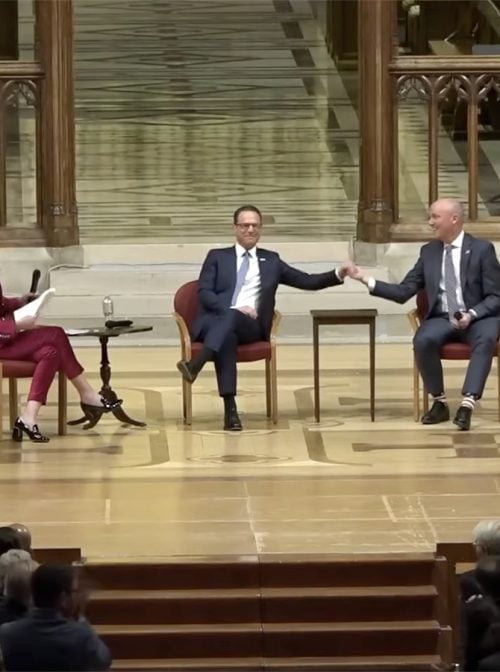
WASHINGTON (RNS) — When conservative activist Charlie Kirk was killed at a campus event in Utah in September, the first call Gov. Spencer Cox received was from Pennsylvania Gov. Josh Shapiro.
That gesture to a Republican governor from a Democrat whose governor’s mansion was attacked months earlier after he had just concluded a Passover Seder has led the two men to establish a united front against political violence and for depolarization.
“I don’t care what color his politics are,” Cox said, sitting next to Shapiro on Tuesday (Dec. 9) at an event titled “Toward a Better Politics” at Washington National Cathedral. “In that moment, we were two Americans who were deeply saddened and struggling. And I’m grateful that there’s somebody I can trust even though we disagree on a lot of things. We agree on this thing.”
The discussion — a part of the cathedral’s “A Better Way” speaker series — was held as studies show Americans believe politically motivated violence is rising.
“At a time of increased polarization, mistrust and political violence, we believe there is a better way to live together as Americans, a better way to learn from each other, a better way to find a way forward together to protect the integrity of our democracy,” said cathedral Dean Randy Hollerith at the beginning of the 90-minute event.
A recent Pew Research Center study found that 85% of U.S. adults say politically motivated violence is increasing, with almost the same percentage of Republican and Republican leaners (86%) and Democrats and Democratic leaners (85%) sharing that view. Similar agreement was found among Protestants (86%), Catholics (88%) and the religiously unaffiliated (82%). The survey of 3,445 adults from Sept. 22-28 occurred in the wake of the Sept. 10 killing of Kirk, the 31-year-old leader of the conservative youth organization Turning Point USA, and recent attacks on Democratic and Republican elected officials, such as the June killing of former Minnesota House Speaker Melissa Hortman and her husband and assassination attempts on President Donald Trump during his campaign last year.
Politico and Public First released a poll in November that found more than half of Americans surveyed (55%) expect an increase in political violence. It also found that almost a quarter (24%) of the U.S. population thinks there are some situations when violence is justified.
NBC’s Today show co-anchor Savannah Guthrie, who moderated the conversation with the two governors — Cox, a member of The Church of Jesus Christ of Latter-day Saints, and Shapiro, a Jew —asked them about how faith informs their thoughts about addressing political violence.
Shapiro recalled receiving a letter from an elderly chaplain of a volunteer fire department whose firefighters were among those who responded when Molotov cocktails were fired at the governor’s mansion earlier this year. On the back of the note from firefighters was a prayer written down by the chaplain, who was registered in a different party from the governor.
“There is a universality in our humanity and in our faith. There is more that binds us as Americans than divides us.”
“It was his favorite passage from the Old Testament that he wanted to give to us,” Shapiro said. ‘There is a universality in our humanity and in our faith. There is more that binds us as Americans than divides us. The answers to so much of the darkness that we see in America today is the light that ordinary Americans bring each day.”
Cox said he misses the days when partisanship was less obvious in houses of worship.
“When I grew up … I did not know who the Republicans and the Democrats were in my congregation, and I wish I didn’t know that now,” he said, drawing some applause. “To my fellow Americans, to my fellow worshippers, whatever it is, whether you’re in a sacred place like this, whether you’re in a synagogue, whether you’re in a mosque, I don’t care where it is, you are our fellow Americans. And tonight, we, a Republican and a Democrat, a Mormon, a Jew, we need you now more than ever. This country, if we’re going to make it another 250 years, if we’re going to make it another 2.5 years, we desperately need you tonight to lay down your swords and to treat each other with dignity and respect again.”
Shapiro added, “Amen.”
They also had critiques of members of both of the major political parties who they think are not doing enough to combat political violence.
“If President Trump were here right now, he would tell you that this isn’t his thing,” Cox said. “I think he was very honest about it at the celebration of Charlie Kirk’s life.”
During Kirk’s memorial service, the president said, “I hate my opponent and I don’t want the best for them.”
Shapiro said that it’s hardest for people to speak out against people in their own party, but it should be done to make it clear that violence is unacceptable.
“When I watched my friend Spencer Cox dealing with the tragedy in Utah and there were people on my side of the aisle or people who thought like me or agreed … with me politically, celebrating the death of Charlie Kirk, I called that out,” he said. “When there were people celebrating what happened in Butler, Pennsylvania — thank God the president wasn’t killed but was shot at — I called that out.”
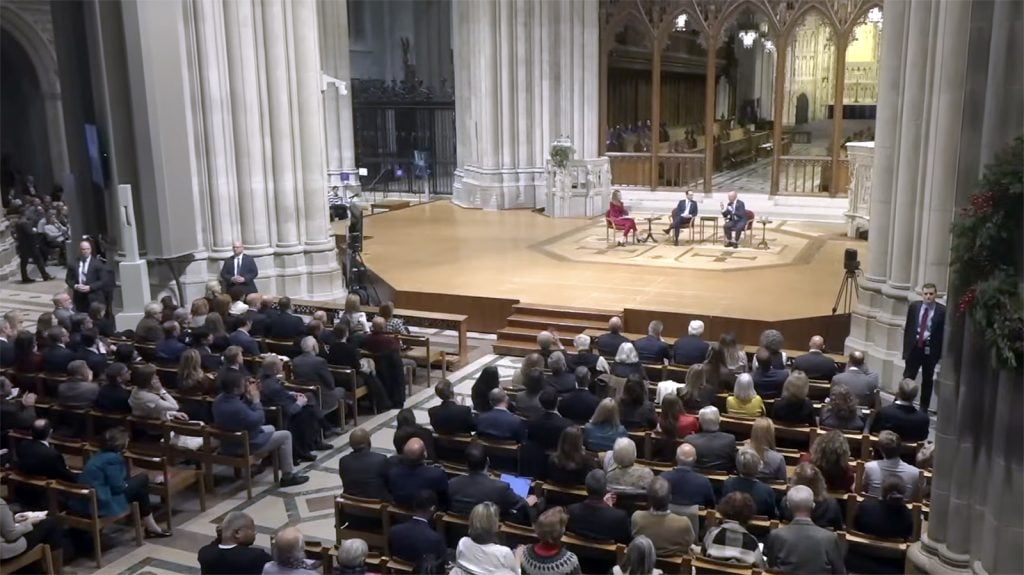
Cox appeared in a similar 2024 event at the cathedral in conversation with Maryland Gov. Wes Moore, a Democrat. Moore had worked with Cox, who was then-chair of the National Governors Association and developed a “Disagree Better” project to seek bipartisan solutions. The project is now an independent nonprofit involving political leaders, celebrities and other public figures seeking to reduce conflict and foster understanding.
Disagree Better partnered with the cathedral and other groups, including Wheatley Institute at Brigham Young University, the National Institute for Civil Discourse and the Pew Charitable Trusts, for Tuesday’s program. Before the governors’ conversation, a panel featuring Yuval Levin of the American Enterprise Institute, Ford Foundation President Heather Gerken and Melody Barnes, executive director of the University of Virginia’s Karsh Institute of Democracy, discussed the history of political violence and the need to encourage empathy and reduce othering.
Perhaps a sign of current tensions, the event was interrupted four times by shouts of individual protesters, whose words were hard to discern in the neo-Gothic cathedral. In an interview afterward, Hollerith said a similar outburst occurred at a previous “A Better Way” event, when someone shouted concerns about Palestinians and Gaza. He said similar sentiments were expressed on Tuesday.
“I think it’s disappointing in that you have folks who are trying to have really good honest conversations,” the cathedral dean said. “At the same time, it’s part of our American tradition, right? So it kind of goes along with all the good things we’re talking about.”