To Help Refugees Fight PTSD, a New Handbook on Religious Literacy
December 17, 2021

The United States has seen a significant increase in refugee resettlement this year, following historic lows in 2020. While many refugees arrive with their own religious beliefs and practices, Melissa Jenkins, one of this year’s IFYC Interfaith Innovation Fellows, finds that many who work with refugee clients are unprepared to engage religious diversity. Melissa and her colleagues have been working to bridge this gap.
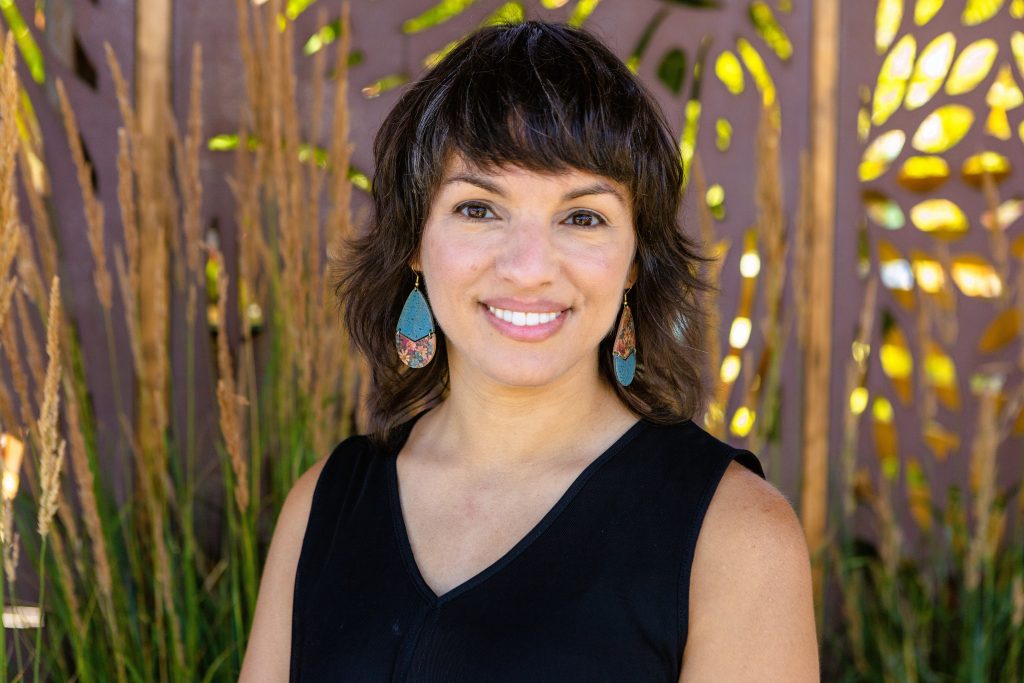
Melissa is a doctoral student at the University of North Carolina at Chapel Hill School of Social Work, and she attended three of IFYC’s Interfaith Leadership Institutes as an undergraduate. In this conversation with IFYC Program Manager Alexis Vaughan, Melissa joins her U.N.C. project partners and colleagues, Erum Agha and Andy Al Wazni, to discuss their experiences as social workers and the role religious literacy plays in refugee resettlement.
Alexis Vaughan: Your Interfaith Innovation Fellowship project involved creating a resource for social service providers working with refugees. What inspired this idea?
Melissa Jenkins: We are each social workers, and through our work with refugee clients, we have seen the need to bring awareness of the significance of religion and cultural competency to service providers who work with refugee families. Our goal was to create a handbook for practitioners and volunteers who provide resettlement services in North Carolina that describes methods for becoming more inclusive and welcoming.
Andy Al Wazni: One bad encounter with a service provider can prevent someone from coming back. It’s not true of everyone, but an effusive American might greet someone by going in for a hug and that can be uncomfortable, and even offensive, in some cultures. People who are drawn to helping professions typically do this in an effort to be kind, so it’s completely unintentional, but the lack of cultural competency and religious literacy can lead to undesired outcomes. It is a big problem in this profession, so we wanted to create a resource to assist service providers.
AV: What are some of the barriers to inclusivity and welcoming that are difficult for service providers to overcome?
AAW: Islamophobia is as American as baseball and apple pie. It is so embedded into our culture and our psyche socially and politically. Most of the time service providers and volunteers don’t even realize that they’re being Islamophobic in their interactions with people. It’s not necessarily done with malicious intent, but it does end up being harmful to people.
One of the biggest issues in working with refugee communities is that a lot of people are afraid to broach the topic of religion. There’s this pathologizing of Muslim religious belief in particular. Providers either overthink the situation—thinking they need to bring a Quran into the therapist’s office, or they show no cultural competency at all. You’ve got licensed social workers out here asking Muslim women to remove their headscarves if they want to get therapy. It happens all the time. It’s a really big problem, and it’s not then the responsibility of the Muslim refugee to educate the service provider on their Islamophobia. Licensed social workers have the responsibility to provide holistic care to real people. Providers need to know how to recognize religion as part of someone’s identity and not the entirety of the person. Most people don’t even think to get to know Muslim people as more than their religious identity.
Erum Agha: I am a post-doc research fellow at UNC School of Medicine and an immigrant myself. I know that for most people who come here, the U.S. is very culturally different regardless of what faith tradition you belong to. Working with Muslim clients, of whom make up less than 5% of my clientele, I agree with Andy’s observation that Islamophobia keeps people away from seeking services and support. If I am visibly a Muslim (wearing a hijab, having Muslim sounding name) and I have experienced Islamophobia upon arrival in the U.S., if I have a mental health condition on top of that, I am going to be much less inclined to see social services as a safe space for me. I’m not going anywhere near it.
AV: What are some examples of how you’ve seen implicit bias affect the refugee community?
AAW: This is real, and I see it all the time in my work. It’s important to remember that the experience of a refugee is different from a voluntary immigrant or even an asylum seeker in many ways. If you’re a refugee, it means you’ve been given a visa before ever stepping foot into the receiving country. Just by receiving that visa it is as if the receiving country is saying “we want you, we will take you.” The vetting process for that can take years, and to be successful, applicants have to prove their worth in a sense to the receiving country. So many of the refugees coming to the U.S. now have risked their lives in unimaginable ways to protect U.S. armed forces, so to come here and be told you’re the terrorist you’ve been escaping, is terrible! There have been research studies that have shown that people from Arab countries, or who are assumed to be Arab, who came to the U.S. as refugees actually experience PTSD, not from what happened to them in their country of origin or from the process of visa application, but from being Arab or assumed Arab in the United States.
Share
Related Articles
American Civic Life
American Civic Life
Higher Education
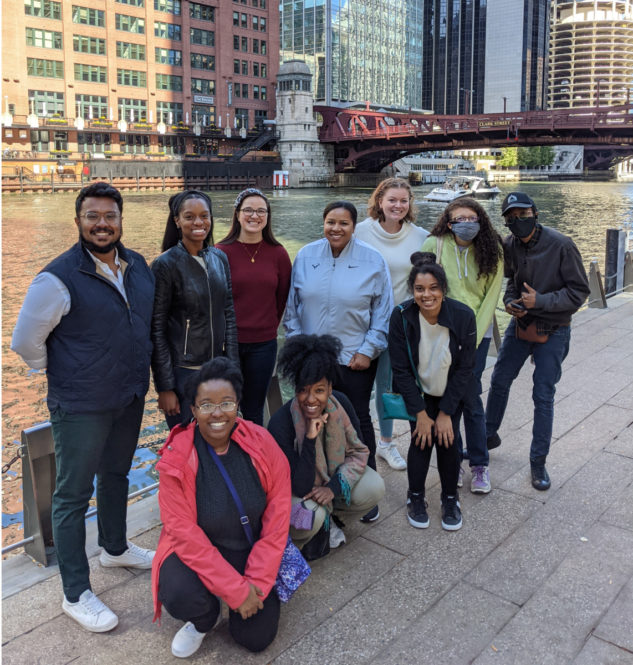
Melissa Jenkins, third from right, with other 2021 IFYC Interfaith Innovation Fellows in Chicago last fall.
EA: There are also assumptions that people who are not proficient in spoken English are uneducated. I’ve had clients who were doctors and teachers in their home countries who are now working as dishwashers here in the U.S. and they ask me, “How can I practice medicine again?” or “How can I be a schoolteacher?” I tell them they should look into taking English classes at Durham Tech. But it is very difficult. You are working as a dishwasher for an 8-to-10-hour shift, then you have to take a 2-to-3-hour English class, all while trying to take care of your family and attend to your wellness. When people talk down to you and treat you as if you are uneducated just because you can’t speak perfect English, it adds to the burdens these people are carrying.
AV: How is the handbook you are creating different from other resources out there?
MJ: Our methods of rapport building with refugee clients come from a perspective that honors everyone’s worldviews and traditions.
EA: The way we train the providers is that we use the terminology that is familiar to the groups they are serving, but also by using stories reflective of their own culture. For example, if the service involves parenting skills, we teach about parenting using terms, names, and scenarios reflective of their cultures. We would use an example like: Zaitun wakes up and gets herself ready to leave for school, knowing that some people come from places where there are no separate rooms for children, and they may be responsible for getting themselves to school in the morning. Through the handbook we are basically giving language and conversational tips to providers. As simple as this may sound, this is in itself an intervention because everything we are doing is targeted and systematic to make change. Our goal is to have a handbook that will help other service providers make these very calculated changes and allow them to approach diverse groups in a manner that is sensitive to their needs.
AV: Have clients responded well to that?
EA: Yes! For example, when I’m working with clients, I don’t ask direct questions like “are you feeling depressed today?” That would be off-putting. I would tell a story using names and scenarios that would be familiar to them that describe a mental health situation and ask them what they think about that story. Then you get people talking. It is important for providers to know how to have that productive first interaction to build from.
AAW: A lot of this stuff is really simple. It’s not a heroic lift to be welcoming to other people, but it does involve reflecting on your own behavior and worldviews. At least 60% of my trainings are history lessons. It’s history and it’s policy. That’s how you unlearn Islamophobia. A phobia is an irrational fear and so many people have an irrational fear of Islam because they do not understand how big a hand American culture, history, and policy has had in perpetuating these fears. I train the way I do so that people can understand the need for the practical skills I give them to use in their practices that make a big difference to people.
A lot of these behaviors are known as microaggressions, which isn’t a term I like to use because it implies that the harm inflicted is small. The behaviors that are most insidious are the everyday interactions in the workplace, at the store, or in the doctor’s office, where someone makes you uncomfortable, but you can’t quite put your finger on why since the behavior is not overtly discriminatory. For example, asking a woman wearing a hijab if she is hot when it is 90 degrees out, is not a good way to break the ice. You are not truly curious about whether she is hot– of course she is hot! It’s 90 degrees out! What you are implying with your question is that she looks ridiculous. You might mean it as a joke, but the woman may not take it as one.
If that is your first encounter with a therapist, for example, you may never come back or seek the services you need. Additionally, you might tell your family members and friends not to seek help because of your bad experience with a provider. This has a ripple effect that people don’t fully understand.
AV: What is your advice to service providers and volunteers who want to do better and be more inclusive? How should they get started?
MJ: It’s difficult to answer that without context. Every community is different, but generally speaking, neighborhood events are great ways to demonstrate welcome and belonging. As was mentioned earlier, not everything you do with Muslim people has to involve the Quran. A good place to start is just with being neighborly with people. For example, we know that people love to gather to enjoy food and the arts. So much joy is cultivated when people share a meal together!
If you are a service provider in an area hosting a local community event, see if there is a way to extend an invitation to refugees who are trying to meet new people and get to know the area. Reach out to community centers, mosques, and other houses of worship with refugee populations. Just that simple invitation is a way of saying “you belong” and “you are welcome here.” With the handbook we are creating, we are making sure that service providers have access to these ideas. We want everyone to know that these are simple things, they are easy to do, and this is how you do it!
IFYC is accepting applications for the 2022 Interfaith Innovation Fellowship now through January 16, 2022! Fellows receive a $5,000 grant to use toward getting their innovative interfaith project off the ground, an all-expense paid trip to Chicago for an exclusive retreat planned for the fall of 2022, and 10 months of support to grow their leadership experience and professional networks through one-on-one support from IFYC staff and their cohort members. For more information, contact Alexis Vaughan at [email protected].