The Vote is Sacred. The Poor People’s March Reminded Me Why.
June 28, 2022
As part of our Vote is Sacred initiative, Interfaith America interviewed current and recent college students all over the country and asked how they felt about voting. Our research and interviews revealed a pervasive sense among students that their vote does not matter.
Feelings of mistrust and apathy were attributed to a variety of sources; historical repression, doubts about election safety, and skepticism that voting changes anything were all cited. Students associated voting with participation in an opaque national structure that felt more like a game politicians were playing for power instead of a way to express their values and construct a public life that served the common good.
As a 30-something former pastor, I understood their sentiments well. They reminded me of the lyrics to a John Mayer song that I’ve been listening to a lot during the pandemic:
I guess I just feel like
Nobody’s honest
Nobody’s true
Everyone’s lying
To make it on through…
I guess I just feel like
Good things are gone
And the weight of my worries
Is too much to take on
I think I remember
This dream that I had
That love’s gonna save us
From a world that’s gone mad–
I guess I just feel like
What happened to that?
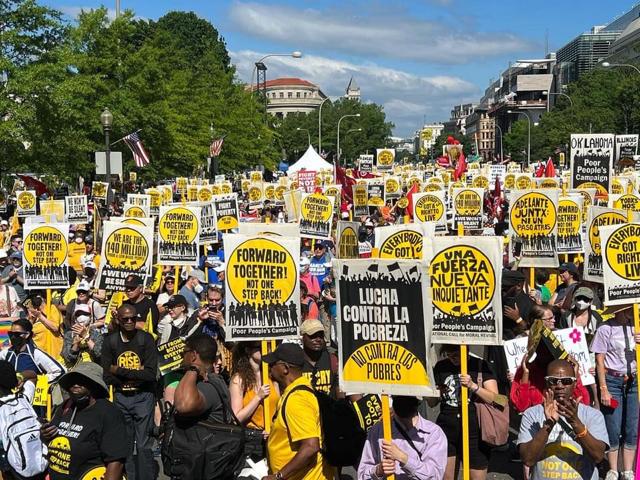
In our 24/7 news cycle it seems like all we see are stories of misuses of power by elected officials and further polarization of our communities. It can be hard to find hope that we can overcome the challenges we face as a society. And yet, that “still, small voice” that remains in me as a person of faith led me to attend the Poor People’s March in Washington, D.C., this past weekend in the hope that I could find a way to reclaim and reignite my sense of hope for our democracy.
The Poor People’s Campaign is a national call for moral revival among people of faith who believe in earnestly addressing the social ills that plague our society, namely racism, poverty, and militarism. The goal of the march was to go beyond rhetoric and shift the moral imagination of all people to build power and advocate for policy decisions that address poverty and related issues geared toward the economically disadvantaged.
“I am honored to be here on this Father’s Day weekend,” Marin Webster Denning, member of the Wisconsin Oneida tribe and organizer with the Wisconsin chapter of the Poor People’s Campaign, said as he addressed the crowd as the opening speaker. “I had three children and lost them all to suicide.”
I could hear gasps from others around me.
Mr. Denning went on to describe how he found his way onto the stage as a grieving father and the event’s first speaker. His daughter had long struggled with mental illness and sought help repeatedly but was denied care from our health care system. He lamented the fact that it is far easier to get a gun in this country than it is to get mental health care when one is in despair. He carefully traced the grief cycle of his last surviving child who was overcome with survivor’s guilt following the loss of his sister. He felt like he was betraying his siblings by continuing to live, so he left a letter for his family and went to sleep. In their community, it is also easier to get one’s hands on dangerous amounts of opioids than it is to access therapy.
I was astounded by Mr. Denning’s courage and vulnerability. I wondered why the event organizers decided to begin the event with such a somber story, but then Mr. Denning closed his remarks with these words: “To remember them is to love them. But now it is time to fight like hell for our living!”
The march went on to include remarks from leaders from the Poor People’s Campaign chapters in all 50 states and Washington, D.C. With each speaker we were reminded that poverty robs us of so much, but it doesn’t have to. As co-founder of the Poor People’s Campaign, the Rev. Dr. William J. Barber II, reminded the crowd, “We don’t have a scarcity of resources in this country. We have a scarcity of moral determination.”
This is indeed a shame in the wealthiest nation in the world, the Rev. Barber reminded us, “But there is something else that is even more grotesque: the regressive policies that produce 140 million poor and low wealth people are not benign, they are forms of policy murder.”
The realities of those living in poverty are the direct result of policy decisions that we have the power to change by voting in local, statewide, and national elections. The Rev. Barber and others spoke openly about their faith and how it compelled them to model the connection between our responsibility to one another as members of a democratic society and the imperative on our lives to create a shared public life that allows all to thrive. In recent years, the dominant narrative about poverty is that it is the result of personal choices and failings rather than systemic consequences. We are told that the American dream of prosperity is equally and permanently available to all peoples, but as one speaker boldly stated, “You’ve got to be asleep to believe in that dream.”
Dr. Bernice King, daughter of the Rev. Dr. Martin Luther King Jr., went on to caution the crowd about the dangers of this narrative by reminding us of her father’s words: “We are caught in an inescapable network of mutuality, tied in a single garment of destiny. Whatever affects one directly, affects all indirectly.”
Interfaith bridgebuilding is crucial to protecting our democracy because organizing and uniting people across geography, race, religion, gender, sexuality, and all the issues and lines that divide us expose the Achilles heel of a system that oppresses, exploits, and marginalizes so many in our society.
There are real reasons to believe that our votes truly matter to our lived experiences. Interfaith America’s Vote is Sacred initiative aims to continue this important legacy of bridgebuilding. Civic engagement is a vital component of many faith traditions and sacred texts, and to revitalize the hope and promise of one our foundational democratic processes: voting. In the world’s most religiously diverse democracy, people of faith and moral conscience have the responsibility to protect that democracy and ensure that it works for everyone, not just the privileged few. The Vote is Sacred, along with local and national efforts like the Poor People’s Campaign, aims to focus on the solutions and the power that people are building across lines of difference, as Rev. Barber says, “Not just to curse the darkness, but to shine a light on the solutions and possibilities that are at hand when we work together in a spirit of unity.”
Forward together. Not one step back!
Alexis Vaughan is Interfaith America’s Director of Racial Equity Initiatives.