Shaken by a Grim Discovery, an Imam Builds a Bridge to Indigenous Communities
March 15, 2022
The grim discovery of the mass graves of Indigenous children in the Kamloops residential schools in the summer of 2021 sent shockwaves across Canada and the world, once again unearthing the unspoken sensitive history of Canada. Like hundreds of other organizations, Justice for All Canada and the Canadian Council of Imams issued a solidarity statement which was read out by over 75 Canadian Imams in their Friday sermons on July 9, 2021.
As an imam at the Danforth Islamic Center in Toronto, I read the statement to my congregation and was confronted with the bitter reality emphasised in the last paragraph: “Our pledge to you as Relatives: We will stand and work with you to bring healing, justice and peace with Truth and Reconciliation.” It gave me a severe jolt. It questioned my integrity.
The pulpit is renowned as place of truth; still, I asked myself if I was being sincere when I invited the congregation to stand in solidarity with our Indigenous neighbours who were experiencing such deep grief and trauma. I found myself questioning the role I ought to play in leading reconciliation efforts needed to make such a bold pledge with integrity.
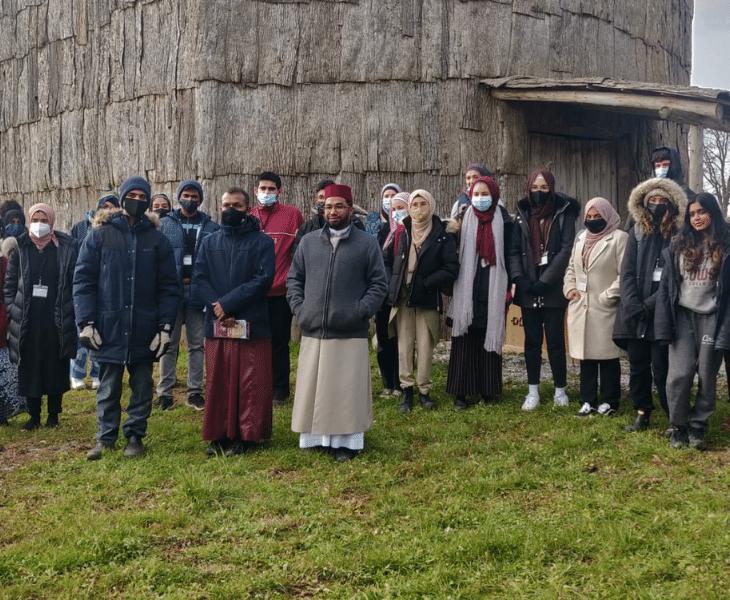
This was the spark that led me to form the Muslim-Indigenous Connection program with the support of IFYC’s Racial Equity and Interfaith Cooperation Alumni award.
I’m a settler on the Turtle Island. As a more recent immigrant, I don’t share the history of the colonizer nor am I an accomplice in their unspeakable crimes against Indigenous peoples. However, I am living on the land which originally belongs to a community whose history I did not attempt to learn nor whose permission I attempted to seek before calling this place my home.
As a Muslim, my duty towards Indigenous communities should extend even further. We are reminded in our tradition of the first Muslim migrants who, fleeing oppression in Makkah, came to Abyssinia and then on to Medina. The example of the teaching of the Prophet Muhammad (Peace Be Upon Him) was to acknowledge and honor the hosts and leaders of the lands wherever they went. In fact, when the first refugees visited Abyssinia, they recounted the story of Jesus and Mary in the Qur’an as a way of honouring and accepting the Christian traditions of the reigning King. These traditions magnified the sense of guilt and hypocrisy I had when reading that statement in front of my congregation about not doing enough to acknowledge the Indigenous peoples and traditions of this land.
As Muslims we follow the Prophets of God in terms of their actions and the model that they stood for. All prophets from Abraham to Noah to Moses to Jesus to Muhammad stood against injustice and advocated for the marginalized and the oppressed. They were sources of light, love, and reconciliation when the world was engulfed in darkness.
Inspired by this collective mission of the Prophets, I set out to develop trusting relationships between Muslim and Indigenous communities to stand against injustice and be a bridge of healing.