How Americans Have Adopted — and Adapted — the Indian Festival of Holi
March 18, 2022
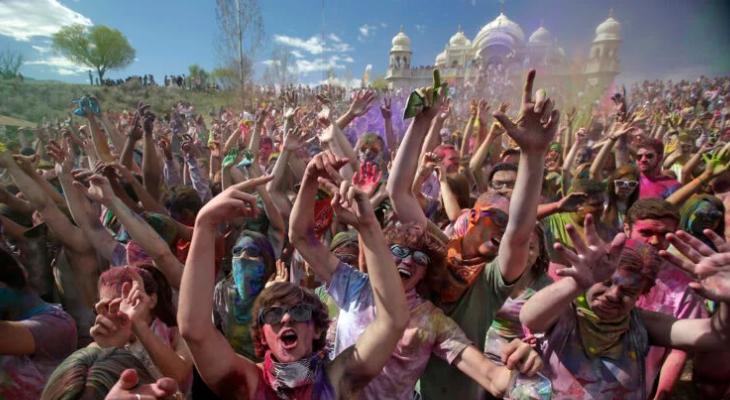
(RNS) — The arrival of spring always brings sweet memories from my childhood in India of Holi: the sound of drumbeats and people dancing merrily in the streets, bodies smeared with a multitude of colors. In our home, buckets filled with wet colors would be kept ready to be poured on friends, family and neighbors, who would walk in with their own fistfuls of colors. The visitors were served freshly prepared sweets and savories from my mother’s kitchen along with a delightful almond drink, suffused with saffron.
Traditionally celebrated on the last full moon in the lunar month of Phalguna, which falls this year on Friday (March 18), Holi commemorates the triumph of good over evil. In Hindu mythology the demon king Hiranyakashipu commands his subjects to acknowledge him as the supreme God, but his son Prahalada, a devotee of the god Vishnu, refuses. In a rage Hiranyakashipu gives his sister, Holika, a protective cloak and instructs her to take Prahalada in her lap and sit on a burning pyre.
As Prahalada chants Vishnu’s name, the cloak flies off Holika and wraps around him. Holika is charred to death, while Prahalada remains unharmed.
In different regions of India, it comes with different rituals and meanings. Some light a bonfire on the evening before, while elsewhere Holi is a celebration of love honoring the divine love of Lord Krishna and Radha. With its fun and brightness, the festival has long since become a secular celebration — not unlike the West’s Christmas.
But with the Indian diaspora, Holi has gone global, adapting to local conditions and sensibilities. Deep in Mormon Utah, Salt Lake City’s Holi celebration, organized by ISKCON — the International Society for Krishna Consciousness (more familiarly known as the Hare Krishnas) — draws a crowd of around 25,000 people for a ticketed event held over two days (March 26 and 27 this year.) Holi celebrations in other cities have become highly commercialized, with food, yoga classes and rock bands.
“When I was a child growing up in Boise, Idaho, my parents organized the Holi festival,” said Ravi Gupta, a scholar of religious studies at Utah State University, “About 25 Indian families and a couple of other friends would turn up. But in past one or two decades, Holi has gone beyond that demographic. It has been an opportunity to involve and engage other communities.”
Caru Das, director of the Krishna Temple, said that after the first celebrations started at the temple in 1995, festivities soon moved outdoors to accommodate a rock band, and more people started to come as word got around.
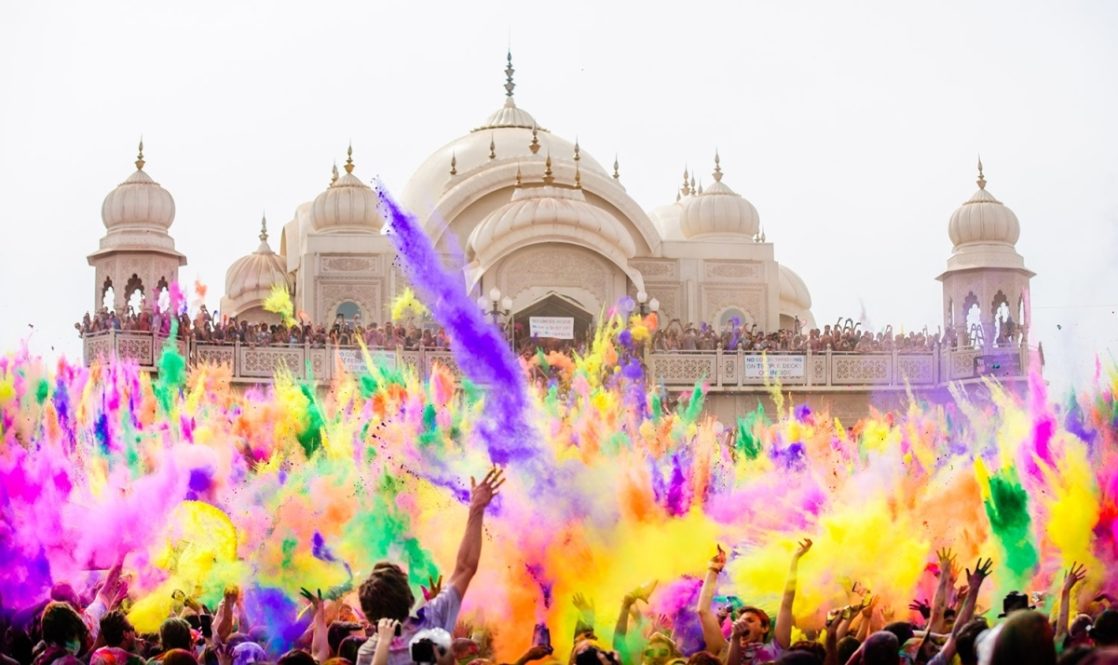
The Hindu festival Holi is one of the many festivals that has been adopted by many Americans. The recognizable throwing of color is now found in events and festivals across the U.S. Courtesy photo
The adaptations are seen by many as very much in keeping with the richness of the Hindu tradition, in which adherents may hold multiple beliefs and interpretations.