
The Reverend Jesse Jackson passed recently. He was a titan of civil rights who made immeasurable contributions to American society and the world. His relationship with the Jewish community was difficult at times, as is the relationship between Blacks and Jews today. This relationship is particularly alive and complex for folks that are both Black and Jewish, and their voices should be centered in this conversation.
While Rev. Jackson faced conflicts with the Jewish community, he also modeled the reconciliation, bridgebuilding, and pluralism practices needed to mend Black-Jewish ties and continue working together for the good of all. We can honor the memory of Rev. Jackson and countless others that came before us by continuing their holy work of shared activism and intercommunal bridgebuilding.
—
I grew up going to Jewish sleepaway camp. The campers were mostly Ashkenazi Jews of European descent, with white skin. The camp was founded in 1924 to help Jewish immigrants get out of the sweatshops of inner-city Baltimore and learn how to be “American.” They played baseball and ate apple pie and ended each day with the American military song “Taps.”
By the summer of 2013, very few campers came from the inner city. Most Jewish families had long since found upwards economic mobility and moved to the suburbs.
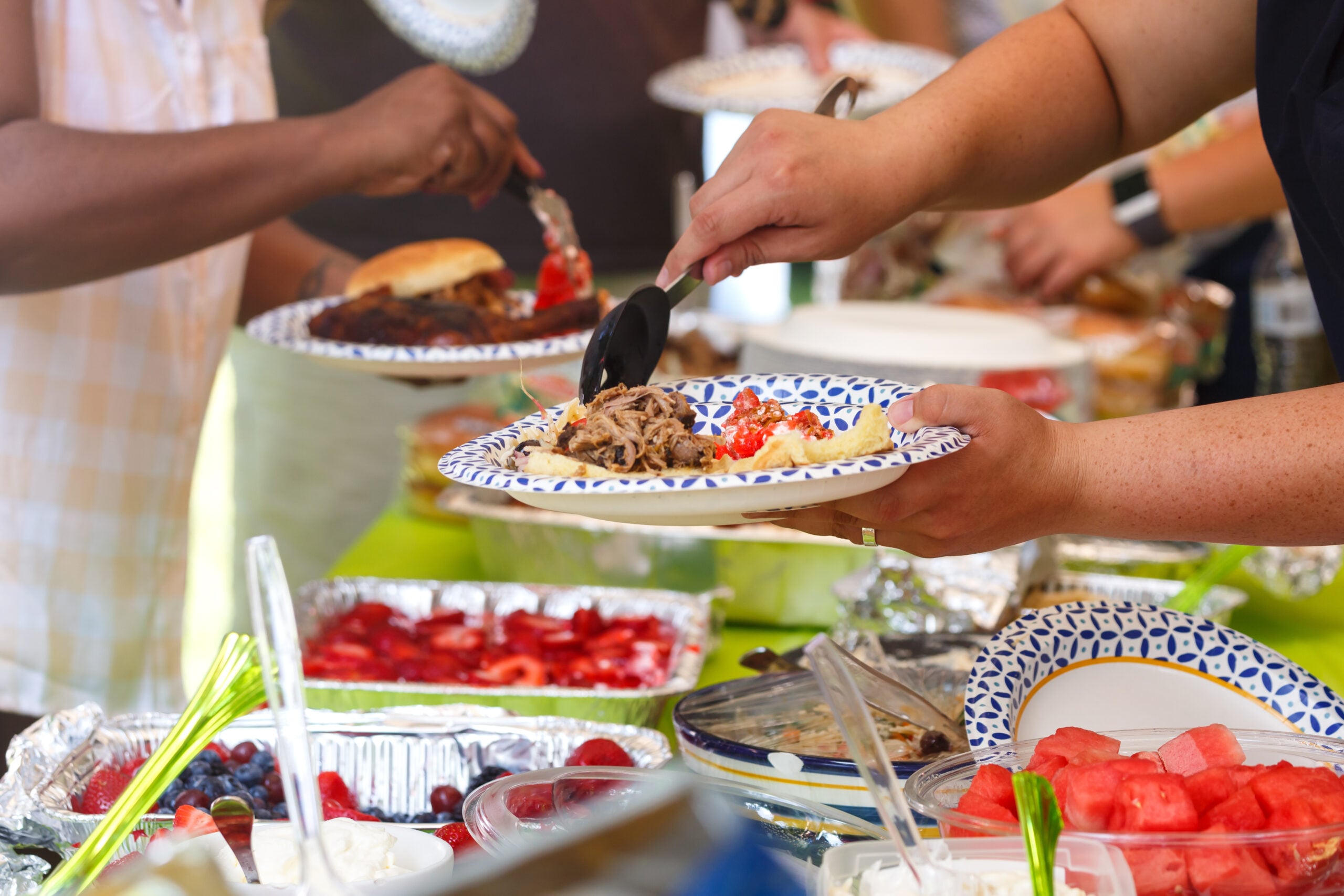
But that summer a new face arrived. Chef Mike was a big, boisterous black man from a tough neighborhood in Baltimore. He came to run our culinary program. As it turns out, Chef Mike was born to go to Jewish camp.

Suddenly, Chef Mike was everywhere. He was in the pool, with dozens of little campers hanging off of him. He was on the basketball court, even though he wasn’t very good. He was in the Camp Olympics, running around, dripping sweat, hollering at the top of his lungs.
You could hear his laugh from across the camp.
—
A few weeks into the summer, someone dedicated a new Torah scroll to camp.
We had a ceremony welcoming it in.
We unwrapped the Torah, stretching it all the way out, using it to encircle the entire camp population — a visual representation of the community and history that binds us.
Chef Mike was in that circle, where he belonged.
Chef Mike stood up and talked about how he instantly felt part of our community, how even though he wasn’t Jewish, he felt a strong connection between his history and faith as a Black Baptist and our story as Jews — the struggles, the community, the love, the meaning. We were all deeply touched.
Chef Mike returned summer after summer.

Until Chef Mike was killed in an armed robbery.
Dozens of us from the camp staff attended the funeral at his church. His family was so happy that we were there. The service reminded me of how us Jews pray: with spirit, passion, and a sense of both solemnly honoring the past while also looking forward to better days.
After Chef Mike’s death we wanted to find a way to honor him. We arranged for the choirs of a Jewish day school and a predominantly Black school to meet and sing together. They eventually sang together on national television on “The View” on MLK Day. One of the students said, “It doesn’t matter what the color of your skin is, what your religion is, what your background is, you can come together in a common passion, and that’s what we’ve done with music.”
I know that Chef Mike was looking down and smiling.

Chef Mike’s story makes it sound like Black-Jewish relations in particular — and building pluralism across differences in general — are obvious and easy. For me, they always have been obvious, though not necessarily easy. Chef Mike is just one story, but he stays close to my heart and helps guide me in my life.
My family’s story also guides me. My grandma grew up at a time when Blacks and Jews lived in the same neighborhoods. She had Black friends and neighbors that she’s close with to this day. My great-grandfather ran a small grocery store in a neighborhood where he was the only Jew. His store served Black folks and white folks throughout the 50s, 60s, and 70s. He became a respected community member and political figure. My Catholic step-grandfather had a hand in negotiating and writing the Civil Rights Act. I grew up seeing and knowing that the story of my family is one of loving our neighbors, however they may look.

Jewish folks in particular often remember the “golden era” of Black-Jewish relations in the 60s and before, when Rabbi Abraham Joshua Heschel marched alongside Dr. Martin Luther King, when Blacks and Jews went on Freedom Rides together (and tragically were murdered together for their activism), and when the NAACP was co-founded by a Jew.
We should remember and aspire to those times. Our shared activism created new institutions and laws that protected civil rights for all Americans. We wielded strength together as allies, challenging American democracy to live up to its ideals.
But Black-Jewish relations and building pluralism across difference haven’t always been easy and are not easy today. What started as a relationship of solidarity and communion has become fraught and difficult over the years.
The Reverend Jesse Jackson embodies these struggles and also shows us a path to reconciliation and healing.
Rev. Jackson was a giant of the civil rights movement. He “led a lifetime of crusades in the United States and abroad, advocating for the poor and underrepresented on issues, including voting rights, job opportunities, education and health care.” He was a mentee of Dr. King and a mentor to Reverend Al Sharpton. He was an “impassioned orator” and a “moral and political force, forming a ‘rainbow coalition’ of poor and working-class people.” The difference he made – here at home and across the globe – cannot be overstated.
And Rev. Jackson had a difficult relationship with the Jewish community. He used an antisemitic term, “Hymietown,” to describe New York City, invoking Jewish rage. He refused to condemn Louis Farrakhan, the Nation of Islam leader often accused of antisemitic extremism. These things hurt deeply for a Jewish people that saw Black folks as allies, that felt they did their part to work together in solidarity for the good of both people, and that keep close the memories of persecution and genocide.
But Rev. Jackson sought reconciliation. He spoke at “synagogues and Jewish community forums and participated in Holocaust remembrance events.” He “made two headlining speeches condemning hatred of Jews, at the Democratic National Convention and to a World Jewish Congress meeting in Brussels.” I’m sure that this wasn’t easy for him, and that he faced pushbacks of his own.
I firmly believe in the power, validity, and importance of admitting when one is wrong and finding restorative justice. Reverend Jackson demonstrated this for us.
“It’s human to err, divine to forgive,” Reverend Jackson said.
Like Rev. Jackson, I hope that my community also can recognize the areas where we can be better, where we can work to foster connection and genuinely listen and seek to understand the experiences of others. We hold up the memory of Rabbi Heschel, but are we still doing everything we can do to build bridges and advance civil rights for all?
I don’t ignore the difficult context: many American Jews feel abandoned by our partners in other minority communities — especially since October 7. And, I prefer we focus on what we can take responsibility for, the positive actions we can take.
—
The experience of Blacks and Jews might be the most challenging and alive for folks that are both Black and Jewish. The growing number of Black Jews and Jews of color complicate the narrative of Black-Jewish relations, showing that our communities are not mutually exclusive and can’t be painted into neat categories. A new PBS documentary, “Black and Jewish America,” delves into these complexities.
I had a rich and robust conversation with a Black Ashkenazic colleague, Melissa Carter, EdD, who shared with me the double consciousness she works through living in the world in a Black and Jewish body. I wondered if Black Jews have a special role to play in building bridges between the communities, being able to relate to both. Carter said,
“As someone who embodies both identities, I have done deep work to find understanding and compassion, for both identities to sit at my internal table, together. I now feel a sacred obligation out of my pluralistic values to help others sit at tables externally and do the same work – not so I may be tokenized or for my energy to be misused, but in service of the Truth needed to move our nation forward.”
A Black and Jewish rabbi I spoke to, Rabbi Heather Miller, said she similarly feels a responsibility as a leader to be a safe person to ask complicated questions about identity.
In conversation with Melissa, Rabbi Heather, and other colleagues, we agreed that Black Jewish voices should be centered in this conversation — without the expectation of their emotional labor, but with the hope to be able to learn together from a place of genuine care and curiosity.
I recognize that I did not center Black Jewish voices in this story. It is written from my heart and through my eyes. But moving forward I know I have a lot to learn from Black Jews and I want to uplift their voices.
—
In Judaism, when someone passes, we say, “may their memory be a blessing.” Reverend Jesse Jackson provides a blessed memory and a model to guide us. He reminds us that humans are flawed, that we make mistakes, that building bridges is difficult and complex, and that we must keep trying.
American democracy asks that diverse communities find ways to live well together. The massive challenges facing our democracy require that we work together across difference — that we build a big “tent of decency,” in the words of Interfaith America founder Eboo Patel.
There is much work to be done to reconcile between the Black and Jewish communities. We have so much in common, we will both benefit from working together, and we can lead together to improve American democracy for all — as we have before.
May we honor the memories of Chef Mike, Rev. Jackson, Dr. King, Rabbi Heschel, and so many others that came before us by continuing their holy work and standing together to build a better America, for the common good of the entire nation.
Jake Shapiro is the Program Manager for Democracy Initiatives at Interfaith America. Jake is an American Jew and the proud product of immigrants.