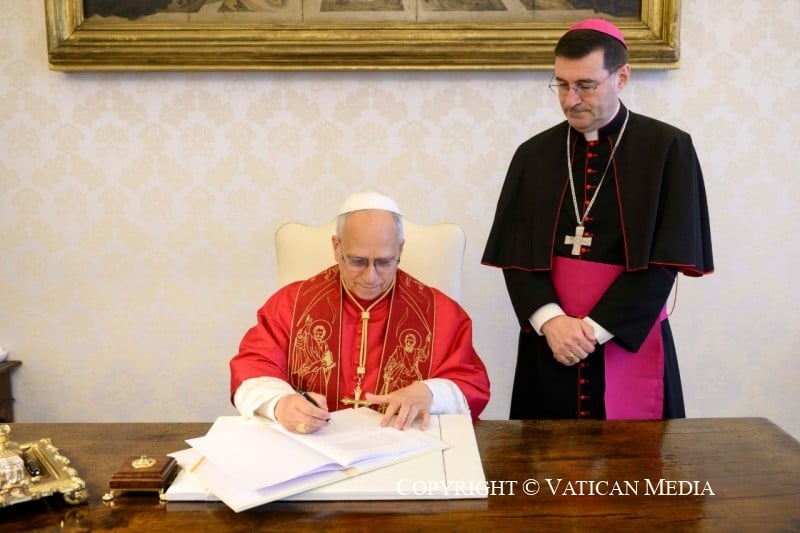
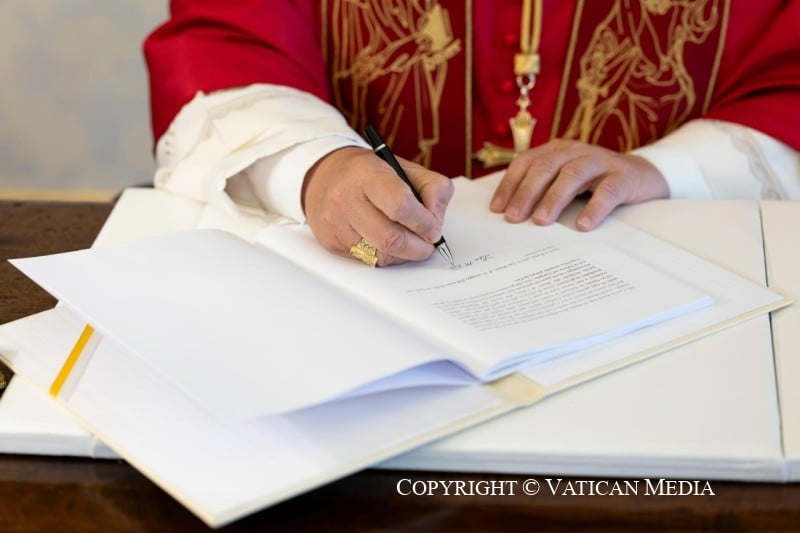
Early Monday morning, Pope Leo XIV signed his first papal encyclical, Magnifica Humanitas (“Magnificent Humanity”) — focused on discussing artificial intelligence and technological advancement in light of the tradition of Catholic Social Doctrine. Pope Leo makes multiple references to pluralism, interfaith cooperation, and serving the common good.
The pope’s bottom line: If the world is going to meet the challenges and opportunities of AI, we’re going to have to do it together — and that means shoring up a sense of community and working together across our differences.
‘Building for the Common Good’
The central focus of Leo’s encyclical is to serve the “common good” — a word that appears 82 times throughout the document. Leo says the common good, “is a greater good that belongs to everyone, and it can only be achieved, nurtured and protected by our collective efforts.” He calls on government officials, tech leaders, and everyday people to think beyond what benefits ourselves as individuals and to build systems that serve everyone. He calls this service a “non-negotiable” for his flock: “For a Christian, going beyond the narrow confines of one’s own interests and committing oneself, within the limits of one’s ability, to the common good is a non-negotiable value, as is the promotion of life.”
Working Across Differences
Although he speaks on behalf of the Roman Catholic Church, Leo emphasizes that the work of serving the common good requires each of us. “We wish to engage in dialogue with all men and women of our time, with whom we share in the events, questions and aspirations of humanity,” he writes. “Together with them, we seek to identify new paths for the common good and for promoting a dignified life for all.” Building this vision for the common good requires “responsibility and courage” and for each of us to find our own piece of the work in serving our neighbors.
An Image of how to Build — Together
Drawing from the Bible’s Book of Nehemiah, Leo references an ancient story of rebuilding the walls in Jerusalem. Rebuilding the walls was done “through the shared responsibility of all: men, women, priests, artisans, heads of households and young people all play a part. It is an undertaking with God at the center, which rebuilds relationships before rebuilding with stones.” Applying this image to the systems of our time, the pope writes, “All are given their own section of the wall: scientists and researchers, entrepreneurs and workers, educators and legislators, civil society, popular movements and faith communities…We should not be intimidated by tensions or differences because they can become creative forces when guided by shared responsibility.”
Diversity as a ‘Bright Possibility’
Pope Leo’s image for rebuilding includes tapping into diversity as a resource: “Rebuilding today means recognizing that, precisely from the plurality of voices and visions which, even though they sometimes remind us of the confusion caused by the diversity of spoken languages, a bright possibility emerges. Indeed, this is the possibility of building together, of transforming diversity into a resource and of making listening and dialogue the common ground upon which to cultivate justice and fraternity.”
The Interfaith “Spirit of Assisi”
The pope references his predecessor’s prior work toward interfaith peacebuilding. He says that “Interreligious dialogue plays a decisive role” in preventing violence. He says, “to fight in the name of religion means attacking religion itself.” Leo recalls previous interfaith gatherings in Assisi, first hosted by Saint Pope John Paul II, as models for promoting peace in an interfaith context, and praises Pope Francis’ dialogue with the Grand Imam of Al-Azhar.
Chris Crawford is the Senior Director of Civic Strategies at Interfaith America.