The Whisper of Dangerous Memory
May 17, 2022

I’ve been thinking about the Middle Passage a great deal. Not because it’s an area of study or research, in fact, I don’t know very much about it from a research perspective. But I think about it because that is my origin story.
The Middle Passage, the part of the slave trade journey that brought millions of Africans to be enslaved on U.S. soil, in trade for other goods, is known for its inhumane conditions. These conditions included insufficient space to dwell, poor food, rampant disease, and the destruction of one’s humanity. This journey – my origin story as an American – has become prominent in my thinking.
In fact, as I stand and look out at the Atlantic from the shores of North Carolina, I have begun to feel a visceral tug toward someone – not something – on the other side of this ocean. The nearly magnetic pull I feel is towards a person who began that harrowing journey and who was one of my foremothers. I gaze out at the ocean and wonder how she felt? What was the experience in her body? She had been captured and, perhaps, sold at least once. I imagine the fear was overwhelming. I look at these waves on a cold December morning and I try to imagine what her experience was on that boat. She probably couldn’t move. She was likely sexually violated. Undoubtedly the stench of death surrounded her. The motion of the waves and lack of food must have been unbearable at times.
And yet that fateful journey continued and brought her to these shores. I wonder: when the ship stopped, was there any sense of relief or release? She did not know what horrors would await her. Horrors that continue to have an impact on our society, on her descendants, 400 years later. I feel a tug to a spirit on the other side of this ocean. Did she feel all hope was lost? Did it feel like a beginning? For me, that was my beginning. A beginning that, today, feels dangerous to remember.
Johann Baptist Metz, the prominent Catholic theologian, wrote extensively about dangerous memory. For Metz, a political and liberation theologian, our collective memory too often leaves out those who have been marginalized. Metz proposed that foregrounding the memories of those whom history would rather forget – the dispossessed, the victimized, the marginalized – would be dangerous to the status quo by forcing us to look at the political systems that allowed such cruelty to unfold. Metz proclaimed that these dangerous memories are essential in understanding systems, promoting liberation, and, fundamentally, understanding the power and meaning of Christ’s suffering on the cross.
For me, those dangerous memories began on the shores of Africa in the body of one woman and were transported to this waterfront in the United States. Her memory of fear, terror, hurt, and longing for the ship to stop. Is that dangerous memory now mine to proclaim? How do I give voice to her anticipation and subsequent disappointment when she realized what awaited on these shores and was left to a life as chattel. Who tells her story and surfaces this dangerous memory that impacts me (and others) even today?
I believe this longing as I stare at the sea is that dangerous memory whispering in my spirit. That, in fact, I cannot understand my present without understanding her past. Yuval Noah Harari writes in his 2017 book on human evolution, “Homo Deus”, “Your feelings are the voice of millions of ancestors each of whom managed to survive and reproduce in an unforgiving environment.”
Is Harari right that our DNA evolved and that by holding and capturing those memories hope can be born in such deep despair? Is my hope, my joy, the very nature of my being, inextricably linked to the suffering of those who faced this ocean? And what does that mean for my mission, my calling, my vocation, my work, my way of being in the world? Does it mean that I am destined to suffer, or does it mean that I have an obligation to remember, to surface and use my voice to articulate the dangerous memory; to use my voice, a voice epigenetically rooted in her suffering, to give hope to the world around me?
Her experience is now my dangerous memory. It’s now in my DNA. A memory of suffering. A memory of doubt. A memory of questioning. And yet. And yet, somewhere in that memory from those shores of Africa across this rolling ocean and on to these hateful shores there is also a memory of courage. A memory of survival. A memory of hope. A memory of perseverance. That’s my dangerous memory too. I get up each day to honor that dangerous memory, to emphasize the hope, to let her know that I pray her trip to these shores has resulted in something good.
For many generations the hope of that better life relied on death, sweeping through the pearly gates for relief. The sweet freedom found in death is not my only source of hope today. My hope is that we can actually make this world, this hostile rough environment better. My resilience is that if I just take one more step, I, we, can change the world. Was that ambition born in the hollows of the ship filled with despair? How could something so beautiful, a natural inclination towards hopeful action, be born under such devastating circumstances? And yet I have no other way to explain it.
Share
Related Articles
American Civic Life
American Civic Life
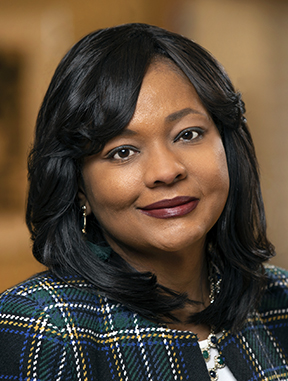
Dr. Mary Dana Hinton
Mary Dana Hinton, Ph.D., became the thirteenth president of Hollins University in Roanoke, Virginia, on August 1, 2020. An active and respected proponent of the liberal arts and inclusion, she is also chair of the Association of American Colleges and Universities and a member of Interfaith America’s board of directors.