The Awokening Will Not Bring an End to the Nightmare
December 15, 2020
Musa al-Gharbi is a Paul F. Lazarsfeld Fellow in Sociology at Columbia University and an Interfaith America Racial Equity Media Fellow.
“Is there anything of which one might say, ‘See this, it is new?’ Already it has existed for ages which were before us. There is no remembrance of earlier things; and also, of the later things which will occur, there will be for them no remembrance among those who come later still.”
Ecclesiastes 1: 10-11 (NASB)
As I have highlighted previously, within modern history, there were at least three periods of major attitudinal shifts and broad cultural unrest around identity issues.
The first, of course, was in the mid ’60s through the mid-’70s. The second was in the late 80’s through the mid 90’s, leading to the last major blow-up around ‘victimhood culture,’ ‘political correctness,’ ‘free speech on campus’ etc. (on my read, in response to changing demographics at American universities and other elite institutions, and the tensions that more-or-less inevitably accompany significant increases in diversity). And apparently, we are in the midst of another today.
We see these three movements across a range of data. For instance, political scientist Eric Kaufmann has highlighted the same three temporal spikes with respect to book publications on identity issues. Communications scholar David Rozado has highlighted similar patterns in media discourse from 1970 through 2018.
Each of these periods was preceded by significant shifts in public opinion — typically among pivotal segments of the white population. Explaining the relationship between these attitudinal shifts and the discourse about these attitudinal shifts, political scientist James Stimson emphasized that, generally, by the time we see widespread activism or public debates around changing norms or values, the shift is a fiat accompli.
The activism is a product of shifts that have already occurred. The attitudinal changes have generally slowed or ceased in the lead-up to widespread demonstrations. Activists try to push public sentiment further, typically in vain, often provoking slight retraction if anything (although there is something like a ‘trap door’ quality to many of these shifts, Stimson argues. While attitudes often regress from their movement peaks, they rarely return to their antecedent baselines).
Similarly, by the time that journalists and academics start talking about a shift in culture, the story is already mostly over. It takes a while before deep shifts in public attitudes show up consistently in polls or surveys. Even longer before journalists notice and highlight a shift. Longer still until books or journal articles dive deeper into these changes and speculate about their causes (eventually generating a second wave of public debate about the shifts in question, and what they ‘mean’).
Much like how astronomers cannot see celestial events until they are long past, social observers generally do not recognize cultural shifts until they are already over. Their shock at the sudden realization that a dramatic change has occurred contributes to an illusion that the change is itself new or sudden – and is a product (rather than a driver) of the associated social movements and public debates – when in fact, this is rarely the case.
The cultural changes being argued about today are no exception to the rule. The biggest shifts happened years before anyone noticed them.
For instance, there was a major uptick in student protests on college campuses nationwide beginning in the fall of 2014 (with signs that something was afoot visible even in 2012). But it took until 2016 for most to recognize that a significant shift may be underway – with the debate over ‘kids these days’ reaching its zenith around 2018. That is, four years later.
In fact, it turns out, there had been a major normative shift among white liberals overall. Indeed, not only were the shifts on identity issues happening among liberals, the changes in attitudes were causing more people to identify as liberal. From 2014 through 2019, there were significant increases in the number of Americans who identified as ‘liberal’ – although, critically, this was a trend-driven overwhelmingly by whites:
Share
Related Articles
Higher Education
American Civic Life
Faith Based Efforts Work in Vaccine Uptake: Now Let’s Make it Easy
Higher Education
What Does Interfaith Engagement Mean from an Evangelical Perspective?
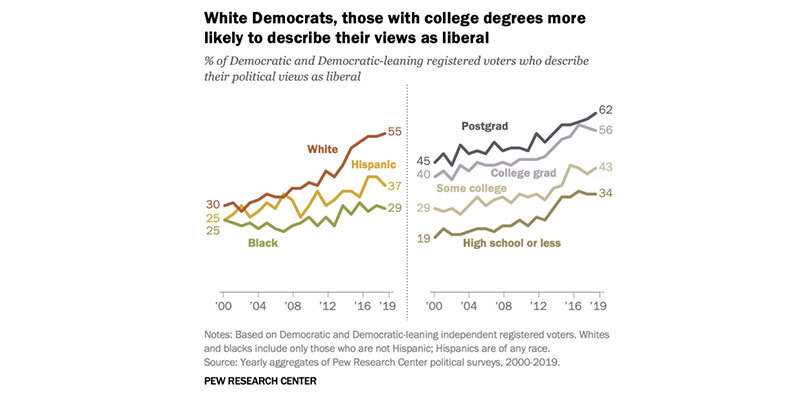
Focusing so intensely on college students (who are disproportionately white, liberal and relatively well-off; that is, hailing from the very demographics where the change was most pronounced), many missed this larger trend.
The (Third) Great Awokening
In April 2018, The American Sociologist first published my study demonstrating that research on Trump and his supporters seems to be regularly undermined and distorted by issues like prejudicial study design and confirmation bias – allowing glaring errors to often not just make it through peer review, but to also be widely cited and prominently discussed in the media – with almost no one apparently noticing these obvious problems.
One of my examples featured an analysis of public opinion on race questions in the American National Election Survey (ANES) from 1988 through 2016. The author of said analysis highlighted that the gap between Democrats and Republicans on ‘symbolic racism’ questions was larger in 2016 than at any point on record. On this basis, he argued, Republicans must have been uniquely motivated by racism in 2016 as compared to other years.
Just one problem: his own data clearly showed that white Republicans had grown less likely to endorse ‘symbolically racist’ attitudes in 2016 as compared to 2012. That is, white Trump voters were actually less ‘racist’ than white Romney voters.
The reason the gap was larger than it had ever been was because attitudes among white Democrats shifted in that same direction, but in an extreme way. White Democrats grew less likely to endorse ‘symbolically racist’ attitudes in 2016 than at any other time in the past 30 years – including when there was an actual black person on the ballot from their own party (indeed, endorsement of ‘symbolic racism’ went up among white Democrats with Barack Obama on the ballot. But that’s an issue for another time). See for yourself:
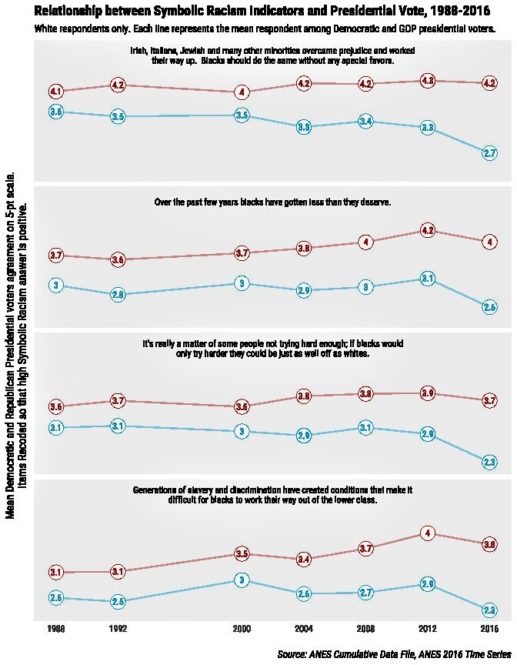
To understand the current political moment, I argued, the ‘real’ action might be among white Democrats rather than Trump voters.
Picking up on this thread, Georgia State University political scientist Zach Goldberg soon demonstrated that the same patterns also held for a number of other questions about inequality, immigration and related topics — beginning in 2014 and accelerating under Trump – among white liberals. Moreover, he showed, this was not just a phenomenon of the American National Election Survey (the specific dataset in which I initially highlighted this phenomenon) – it was apparent in virtually all major national public opinion surveys over the preceding years, but had gone largely unnoticed.
In early 2019, describing Goldberg’s research, Vox’s Matt Yglesias popularized the “Great Awokening” as a shorthand for describing this most recent sea change in expressed attitudes on identity issues. One particularly helpful aspect of this framing is that it calls attention to the religious overtones of the contemporary discourse around identity issues (evoking, of course, the “Great Awakening” religious revivals of the mid 18th century).
Indeed, for a particular subset of white people, antiracism has itself become something akin to a religious creed. There is a discourse of slavery as America’s original sin, of whiteness as a primeval and malevolent force responsible for, or implicated in, virtually all of the world’s ills.
There is a gnostic element, with adherents believing that they can see the ‘real’ structures of the world, which others are blind to – along with the sense of superiority that accompanies such beliefs. There is an eschatological sense of being on the ‘right side of history,’ and in many circles, an intolerance for doubts or heresy.
There is a fetishization over the destruction of ‘black bodies,’ paired with an obsession with the contents of whites’ hearts and minds – without anyone apparently noticing, or seeing a problem with, this asymmetry.
Trayvon Martin, Michael Brown, Eric Garner, Tamir Rice, Philando Castile, Breonna Taylor et alia are held up as saints, as martyrs for the cause – glossing over the far more disturbing truth that these were ordinary (flawed like the rest of us) people who were needlessly murdered while going about their daily lives. Most do not seem to have been particularly political, and likely would not have agreed with many of the political claims now being made by liberal whites (bolstered by elites of color), ostensibly in their names.
A Tree is Known by Its Fruits
“And when they are told, ‘Do not spread corruption on earth,’ they answer, ‘We are but improving things!’ Oh, verily, it is they, they who are spreading corruption – but they perceive it not.” Qur’an 2:12
At the root of the trendy new faith lies a decline of the old. Indeed, the people most likely to hold beliefs and dispositions associated with the “Great Awokening” are highly-educated, relatively well-off whites who have strayed away from organized religion.
Unmoored from religious tradition, people often reach for political fundamentalism to provide a sense of identity and purpose for their lives (this is nothing new); they often pursue political activism as a means of engaging in fellowship with like-minded believers. It should not be surprising, then, that the nationwide protests in the wake of George Floyd’s murder often took on an overtly religious character.
Video after video emerged of whites ritualistically confessing their privilege:
And demanding that peers do the same:
Or washing the feet of black people:
On and on. Apparently lost on the followers of this new religion are the admonitions of Christ (also lost on many Christians and other believers, to be fair):
“Beware of practicing your righteousness before men to be noticed by them; otherwise you have no reward with your Father who is in heaven. So when you give to the poor, do not sound a trumpet before you, as the hypocrites do in the synagogues and in the streets, so that they may be honored by men. Truly I say to you, they have their reward in full… When you pray, you are not to be like the hypocrites; for they like to stand and pray in the synagogues and on the street corners so that they may be seen by men. Truly, I say to you, they have their reward in full… Whenever you fast, do not put on a gloomy face as the hypocrites do, for their neglect their appearance so that they will be noticed by men when they are fasting. Truly I say to you, they have their reward in full.” Matthew 6: 1-16 (NASB)
The lesson: the manner in which people carry out a task can tell you a lot about who they are doing it for. Undergirding very public demonstrations of morality are typically impure motives. And behind performative antiracism, in particular, lies a stark reality:
As I have shown elsewhere, the whites who seem most eager to condemn ‘ideological racism’ (i.e. people saying, thinking or feeling the ‘wrong’ things about minorities), and who are most ostentatious in demonstrating their own ‘wokeness,’ also tend to be the people who benefit the most from what sociologists describe as ‘institutional’ or ‘systemic’ racism. Consequently, the places in America with the highest concentrations of whites who are ‘with it’ also happen to be the most unequal places in the country.
And while the expressed attitudes of whites have changed dramatically in recent years, this dynamic has not. To understand why, consider:
Most of those taking part in protests for racial justice does not seem to be making meaningful changes to their behaviors or lifestyles in the aftermath. Demonstrating side by side with people of color, in the moment many whites experience intense guilt and righteous anger – followed by a sense of catharsis and pride at their ‘contributions’ to social justice (which they make sure to highlight on social media). And of course, sooner or later the demonstration ends. And then everyone carries on more-or-less as usual at home, at work, in their social lives, etc.
Here, too, there is nothing new under the sun. I’ll give the last word to the inimitable Gil Scott Heron, who put it like this back in 1970 (i.e. during the first “Great Awokening”):
“Young, very young, teeny-bopping revolt on weekend young
Dig by proxy what a mental a** kicking they receive through institutionalized everything
And vomit up slogans to stay out of Vietnam
They seek to hide their relationship with the world’s prostitute
Alienating themselves from everything except dirt and money
With long hair, grime, and dope to camo-hide the things that cannot be hidden
They become runaway children to walk the streets downtown with everyday Black people
Sitting on the curb crying because we know
That they will go back home with a clear conscience and a college degree.”