
Teaching Divine Wrath in a Time of Tribulation
January 14, 2021
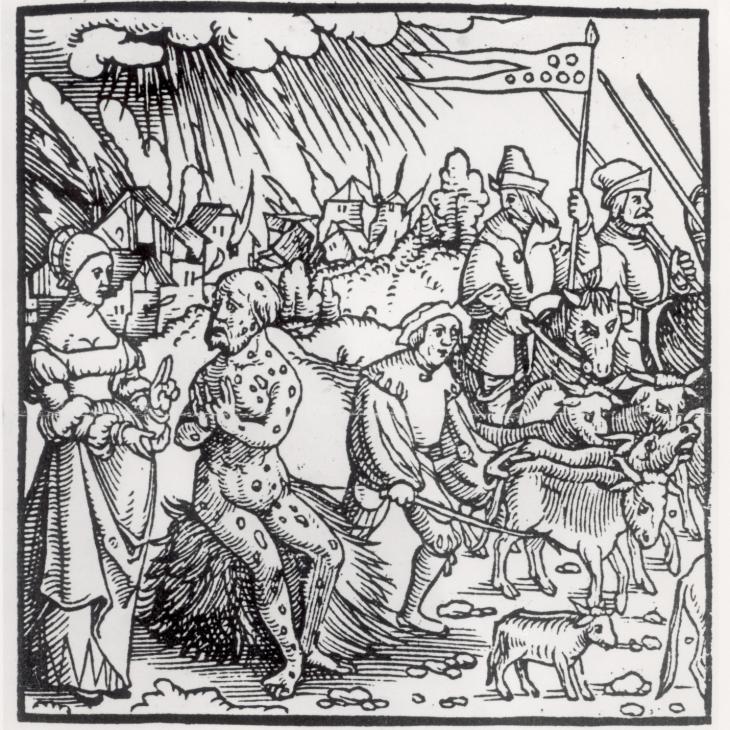
As a nonconfessional historian of religious thought, I try to keep the critical distance that historical investigation favors, in the hope of maintaining that degree of detachment from the material that allows others to engage from different perspectives. This has not been hard for me, since my area of focus is the rhetoric of theological polemic in the Reformation era. I’m personally unpolemical in demeanor and have no identification with any of the combatant traditions. I’m drawn to the issues that drew thinkers into controversy, and interested in the sources they used against each other in defending their positions. My entire teaching career, moreover, has been at state universities where students and faculty alike are expected to discipline themselves against making normative statements or disputing others’ beliefs.
One thing I appreciate where I work is the chance to teach an upper-level course from my current research. Having recently completed a monograph on the rhetoric of divine wrath, a year ago I led an honors seminar on the way in which an angry deity is presented in Judaism, Christianity, and Islam. It was the most successful course I’ve ever taught, with lively and thought-provoking discussions every week about Lamentations and Lactantius and Edwards’s “Sinners” and whether earthquakes in Turkey are a warning from Allah, a debate that took place in secular and Islamic media a decade or so ago. The class: a lively mix of 20 highly-engaged students representing a range of viewpoints and backgrounds.
This year it wasn’t quite the case of everything being different despite nothing having changed, but the topic made me uncomfortable (in a way that I found surprising, given that a punishing deity is absent from my own faith perspective) and I had to wonder whether the material touched the students differently given the distress of the year. Our sources were accounts of adversity interpreted as divine retribution for human misconduct, and a student firmly anchored in those texts could easily read them now as commentary to the plague that continues to threaten us. After all, our topics included suffering with no evident explanation (Job), sermons exhorting repentance during the Plague, and a reflection on whether God is punishing America.
Curiously, the class seemed less uncomfortable with the material than I. An aspect of the course is that students are welcome to share knowledge and sentiment anchored in their own religious backgrounds. (How else can they learn from each other?) A year ago students spoke openly about their backgrounds and encounters with the language of divine punishment, some doing so with reference to their sexual identities, others in connection with the fear of death. They also spoke with the detachment of 17th-century Quaker sermons after the Fire and Plague of London. This year, amidst the same conditions that had been the backdrop for sermons such as those, they were equally dispassionate discussing worldviews in which the deity punishes and rewards. And none mentioned the pandemic.
Like many, I take stock of a course at the end of a semester and plan ways to make it better the next time. Now at the end of the semester, I’m certain that I don’t want to teach this material so long as this pandemic still rages. That’s not a “never,” but a decided not-now. Teaching about divine wrath during a time of suffering makes me uncomfortable. This discomfort is not personal because I don’t believe in a wrathful deity intervening in history to punish malefactors. Divine wrath is, after all, a central yet overlooked component of Western religious thought, so there should be courses in it.
This was the first time, however, that I considered that my students might be closer to the concept than I, their religious identities bound to belief structures in which divine punishment of an errant people is a real part of human experience. I recognize that in this I am a late arrival to a set of pedagogical concerns never far from colleagues who teach about racism, antisemitism, and the like, and who have always understood the sensitive nature of their material. Previously shielded by the screen of critical objectivity, I came to recognize that divine punishment might well be an explanatory hypothesis for what we were all enduring and felt that it was psychologically insensitive to have students engage this line of thought.
The decision to put the course on hold for a while was the product of considerations I might want to call pastoral, addressed to what our students need to navigate a period that will leave a permanent imprint on their lives. It’s a decision that came in the space between my own inability to imagine a punishing deity as the cause of our calamity and my students’ susceptibility to such thinking. Exercising compassion during a time of tribulation involves, in this case, not just how one teaches, but what one wants students to think about.
Ralph Keen is Schmitt Chair of Catholic Studies, and Dean of the Honors College, at the University of Illinois at Chicago, as well as a past president of the American Society of Church History. His research focuses on early-modern religious controversy and his recent courses have included Spirituality of the Spanish Golden Age and Divine Anger in Western Religions.
Share
Related Articles
American Civic Life
Higher Education
American Civic Life
We Commemorate, We Commit: Out of Catastrophe, a Conversation on Connection and Repair