Study: Faith-inspired Organizations Account for 40% of Vital Human Services
February 8, 2021
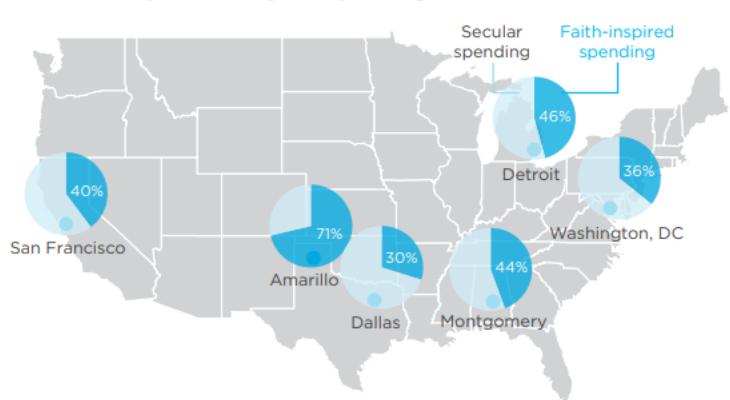
A recent study by The Bridespan Group found that faith-inspired organizations account for 40 percent of vital human services across six cities, but only receive 12 percent of the funding from philanthropic foundations. The research focused on Amarillo, Dallas, Detroit, Montgomery, San Francisco, and Washington, DC., analyzing interviews with field experts, and perceptions of the social sector honed over 20 years of work in the sector.
The study affirms that faith-inspired organizations serve as the bulwark of the social safety net for the most vulnerable in the country, but also found that the perspective has not translated into funding from the largest institutional philanthropies.
The study offers an important contribution to the robust dialogue about the role of faith-inspired organizations in driving social change by asking the question – what opportunities are missed by neglecting such a sizeable share of the ecosystem of support for individuals, families, and communities?
“Faith-inspired leaders and nonprofits have been at the core of social movements that have transformed the United States—ranging from Quakerism among white abolitionists to the Christian temperance movement in women’s suffrage to the interfaith organizing (principally led by Black preachers, Catholic priests, Jewish rabbis) that formed the core of civil rights era organizing,” says Devin Murphy, a partner in The Bridgespan Group’s New York office, who worked on the report.
Echoing the language that is found in the study, Murphy adds that “as we collectively confront the crises of a global pandemic, our country’s racial reckoning, and increasing threats to democratic norms, it is all the more imperative that we look for ways to more deeply engage with the systems and institutions that motivate, convene, and establish a sense of community across the lives of millions in this country and billions of people abroad.”
The study highlights different examples of innovative faith-inspired nonprofits that are doing work at the forefront of immigrant integration (e.g., FaithAction International House), workforce development (e.g., Jewish Vocational Services – Boston), and partnerships with homeless service providers (e.g., Family Promise).
A compelling example, shares Murphy, is the Inner-City Muslim Action Network (IMAN). On the South Side of Chicago, many corner stores are the primary sources of food in communities where supermarkets are unwilling to set up shop, leaving residents in “food deserts” that lack access to fresh fruit, vegetables, and meat. To address this gap, IMAN’s Corner Store Campaign provided avenues to connect store owners to local farmers’ markets and offered microloans and grants to encourage stores to stock fresh foods.
Today, tensions among Black and Latinx residents and storeowners have significantly decreased, and IMAN now holds month-long community events during Ramadan to foster connection and share in the celebration of breaking the fast. The program has been so successful that IMAN’s founder (Rami Nashashibi) was awarded the MacArthur Genius Grant in 2017 for “building bridges across racial, religious, and socioeconomic divides to confront the challenges of poverty and disinvestment.”
The Bridgespan Group’s research identified and dispelled three myths that leave an impact on the table:
Myth #1—Secularism is the dominant frame for America.
Reality: Despite recent declines in religious affiliation, nearly three out of every four Americans remain religiously affiliated – with Black, Latinx, rural and low-income communities actively engaging in their faith at higher rates.
Myth #2—Faith-inspired organizations are a small portion of the social sector.
Reality: Giving to religiously affiliated organizations (which includes donations to congregations) represents nearly one-third of all giving in the United States. Roughly a third of the 50 largest nonprofits in the country have a faith orientation. And 40 percent of international nongovernmental organizations are faith-inspired.
Myth #3—Faith-inspired organizations are stodgy and lack innovation.
Reality: Many faith-inspired organizations are at the forefront of innovation in service delivery and the ability to meet the needs of the communities they serve.
“The rigorous study from The Bridgespan Group fully affirms the deep experience IFYC has had working with diverse faith-based groups in American life,” says Eboo Patel, founder and president of Interfaith Youth Core (IFYC). “Simply put, they are the most important and least appreciated vehicle for strengthening our society. It’s time that everyone from government agencies to philanthropic institutions prioritizes engagement with such groups. Truly, they are doing God’s work.”
Share
Related Articles
American Civic Life
American Civic Life
American Civic Life
Philanthropists And Politicians: Religion Is Not A Problem To Solve, It’s A Partnership Opportunity