
The Forgotten Philosopher Who Can Heal America’s Political Divide.
November 7, 2022
Tomorrow (Nov. 8) is Election Day! While people across the country will be exercising their right to vote and tuning into the news to watch the midterm elections, it’s hard to escape the feeling that America’s sharp political divisions are becoming increasingly intractable.
A new poll by the American Psychological Association noted that the country’s political state stresses out a majority of Americans. Another recent poll from Economist-YouGov poll alarmingly showed that 40 percent of Americans believe that two in five Americans say a civil war is at least somewhat likely in the next decade.
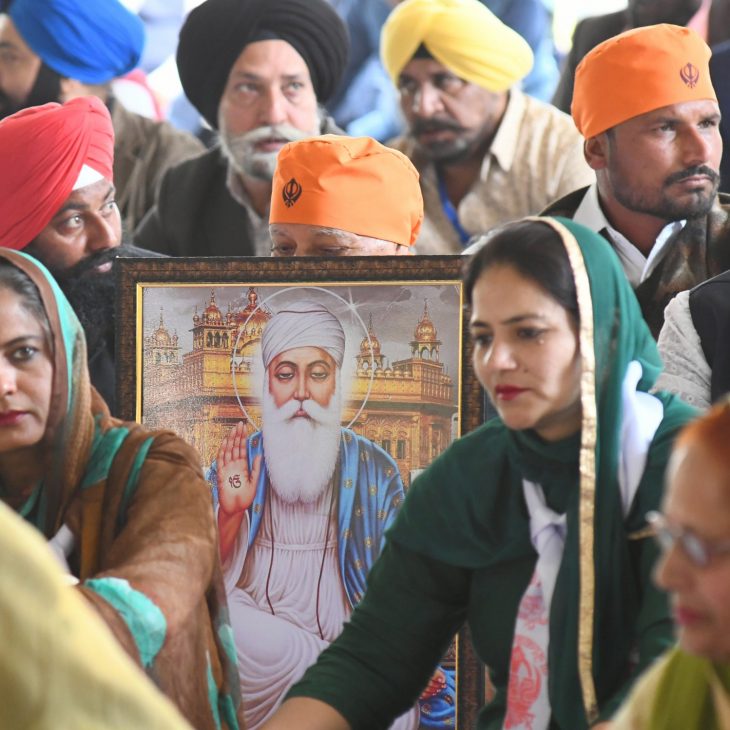
It is not easy to imagine how our country will overcome our political differences. However, the teachings of one of the most influential philosophers in history, who is completely unknown to nearly all Americans, Guru Nanak Dev Ji, can provide insights into how the United States can break through our entrenched political divisions.
Guru Nanak served as the foundation of Sikhism, and his teachings were revolutionary for their time and remain relevant today. It feels appropriate that this year Election Day, November 8, falls on the day when my Sikh community celebrates the Guru’s birthday. Just as the United States Founding Fathers put together a Bill of Rights that protected the fundamental rights of all U.S. citizens, Guru Nanak shared a core set of beliefs that focused on the rights of all people to “life, liberty, and the pursuit of happiness.” He believed that all men and women are created equal and that the right to practice religion freely.
When Guru Nanak Dev Ji was born in 1469 in Pakistan, the religious landscape of South Asia was marked by divisions between Hindus and Muslims. While both religions coexisted peacefully at times, there were also periods of increased tension and violence. A rigid and oppressive caste system also subjugated many people, and women were more likely to be treated as property than as human beings.
When the Guru turned thirty, he had gone missing for three days and when he reemerged, he’d clearly undergone a spiritual transformation and declared:
“There was no Hindu and no Muslim.”
People were confused and taken aback by his words. Surely, there were Hindus and Muslims.
Guru Nanak Dev Ji meant that all humans are equal and deserve dignity, regardless of religion, race, gender, or social standing. One of his central beliefs was in the concept of “Ik Onkar,” the understanding that one supreme creator exists within all living beings and that all humans are equal.
America has created a nation consisting of people from every culture and religion from around the world, and beyond our racial, religious, and political differences, we are one people.
Guru Nanak was a scholar of all various religions, cultures, and languages, and he traveled across India and the Middle East, spreading his message of love and unity. He encouraged people to break down societal barriers and treat each other with respect and kindness by appealing to these values in people’s unique faith traditions and cultures.
In many ways, the United States of America today is Guru Nanak Dev Ji’s vision come to life. America has created a nation consisting of people from every culture and religion from around the world, and beyond our racial, religious, and political differences, we are one people.
While America still has a long way to go to reach its highest ideals, every generation has successively worked to bring to life our nation’s motto: E Pluribus Unum – Latin for “Out of many, one.”
Just as Guru Nanak Dev Ji appealed to his Hindu and Muslim brothers and sisters, who often viewed each other with suspicion at best and their enemy at worst, to see beyond their religion and each other’s humanity, Americans need to see each other first and foremost as fellow citizens bound together by their common values and their common humanity.
In effect, we have to start treating each other like we are on the same team because we are.
While engaging in our political debates with this mindset does not immediately sort out all our political differences on a range of important issues such as the economy, race, abortion, climate, etc. It also does not mean we can’t vigorously disagree about these critical issues. But this mental framework lays a foundation that can foster an environment of constructive dialogue and create pathways to compromise and find common ground rather than simply demonizing people who may hold different beliefs.
Guru Nanak Dev Ji’s teachings and how Sikh Americans today use his teachings to bring people together from different backgrounds here in the United States have been cataloged in a recent award-winning documentary, “Guru Nanak —The Founder of Sikhism: Life & Legacy.” The documentary is available to watch here and also runs on the PBS World Channel every year in December.
The film includes narration by faith leaders such as Bishop John Bryson Chane, a Christian leader and former head of the Washington National Cathedral; Rabbi David Rosen, a Jewish leader and well-respected interfaith leader; Bob Thurman, a Buddhist scholar and one of Time magazine’s 50 most influential people; Dr. A.K. Saran, a Hindu scholar from Georgetown University, and several others. I highly recommend you check out the documentary to get a full accounting of the Guru’s life and enduring impact.
Guru Nanak’s philosophy offers a much-needed perspective on the importance of bridging divides by emphasizing our common values and dignity. As we navigate this period of political darkness, let us turn to Guru Nanak’s universal teachings for inspiration and to reclaim our nation’s promise.

Gurwin Singh Ahuja
Gurwin Singh Ahuja is a Director in the Strategic Communications at FGS Global. Previously, Gurwin served in the Obama White House. He is also the founder of two national non-profits: We Are Sikhs and Know Your Neighbor. We Are Sikhs is a comprehensive campaign to help inform the public about the values and contributions of Sikh Americans. The Know Your Neighbor Coalition is a coalition of leading civil rights organizations that was backed by the Obama White House and focused on fostering a dialogue on the country’s growing religious diversity. Gurwin holds an MBA from Columbia University and graduated summa cum laude from The Ohio State University with a degree in Finance. Connect on Instagram: @gurwinahuja and LinkedIn: @Gurwin Singh Ahuja